This is author biographical info, that can be used to tell more about you, your iterests, background and experience. You can change it on Admin > Users > Your Profile > Biographical Info page."
Want help to write your Essay or Assignments? Click here
Free Higher Education
Introduction
Higher education has transformed to become one of the most important systems in this modern era. The education system has shaped the market into highly competitive global economy by producing practitioners and professionals in various disciplines. Just like any other commodity, higher education has a price tag. However, the price of education has increased significantly thereby closing out potential economists, doctors, engineers, lawyers and many others. The benefits that accrue to the economy because of the contribution of higher education provide enough evidence that the commodity should be made free.Free higher education would have more positive impacts.
Higher Education is usually the next level after secondary education and includes both under-graduate and post-graduate levels. It is difficult to describe whether vocational and technical training fall in this category since the policies and laws that regulate education system vary in different countries. Word Bank (2011) provides a category of institutions that fall under the higher education system.
Free Higher Education
Want help to write your Essay or Assignments? Click here
This includes; universities, colleges, nursing schools, research laboratories, centres of excellence, community colleges, technical training institutions and distance learning centres. Free education refers to a situation where learners do not incur the price of education. Mostly, free education can be funded through taxes or grants from charitable organisations. Primary and secondary education is free in most countries; however, higher education is free only in some specific regions, mostly European Countries.
For example, Norway offers free education in state institutions to both foreign and native students. Sweden currently has no tuition-free universities since the process was halted in 2010 where a bill was passed requiring non-European Union student to pay for tuition and application fee. However, most universities in Sweden offer scholarships and grants to fund higher education especially for foreign students.
Other examples include Denmark, Greece, Argentina, Germany, Northern Europe Estonia and Finland. Article 13 of the International Covenant on Economic, Social and Cultural Rights states that free primary education is a right and progressively, free secondary and higher education will be introduced as a right too. The main participants and beneficiary in the free higher education will be the government, taxpayers, institutions, learners and the parents or guardians. It is quite evident that everybody within the system or society will be affected or influenced by its introduction, either in the positive or negative.
Free Higher Education
Want help to write your Essay or Assignments? Click here
A lot of debates and arguments have been going about whether to make higher education free or to charge the commodity. The benefits of free primary Education will obviously outweigh its negative implications. Free primary education will contribute significantly to the growth of the economy by ensuring that all access higher education training thus increasing the human capital which is very vital in an economy. Most countries continue to invest huge amounts of funds on grants and financial aid that usually don’t benefit the targeted individuals.
This therefore translates to huge loses both in terms of human and financial resources. It has been established that that it would cost less to offer free higher education rather than offer financial aid to specific individuals. A recent analysis, undertaken by the U.S. Department of Education estimated that the cost of making higher education free is $62.6 billion which is $ 7 billion less than the expenditure on grants and financial aid to needy students.
Furthermore, college and university fees have become very expensive and most of the graduates either take too long in the system or finish with huge loans and debts. A review by Forbes indicated that U.S.A State student loan balances exceeded $1.2 trillion (Denhart 2013). It is very expensive for the economy to loose bright minds just because they are not able to afford to join a higher education facility. If free higher education is provided then a lot of challenges faced by many countries will be solved immediately.
Free Higher Education
Want help to write your Essay or Assignments? Click here
Making higher education free has numerous benefits and advantages. First, free higher education will create an opportunity for all citizens or individuals interested in furthering their education to access institutions offering these services. This will beneficial to the economy as the right amount and quality of labourers will be produced and released into the market. There has been countless debate whether higher education benefits an individual or the society at large.
The answer is both since it increases returns to the individual to an estimated amount of $1,000,000 and increases chances of being employed to about 80%-90%. On the other hand, the country or society will benefit from skilled and educated human capital. Germany introduced free higher education because they established that the high college prices were preventing many from joining universities and other higher education institutions.
Secondly, making higher education free will reduce the student loan debt balances which has been plummeting in many countries. Since most are unable to fund the program they opt to take loans which have very high interest rates. For example in U.S, students who applied for loans in 2012 to fund their under-graduate program have approximately a loan debt balance of $29,400 and 70% graduate with debts.
Free Higher Education
Want help to write your Essay or Assignments? Click here
Making higher education will pose to be a smart and wise investment for most governments apart from reducing the loan debt levels. It will also be cheaper than the current financial aid and grant system that is used by most governments and federal states. A report undertaken by the U.S Education Department revealed that it $7 billion less to offer free higher education than providing grants to low-income students. It is worth mentioning that the U.S grants to needy students amounting to $69 billion did not include federal loan subsidies.
Thirdly, free higher education program can be used as a tool to reduce low unemployment within an economy. Education is usually referred to as an empowerment tool that equips individuals with skills to create jobs, perform certain duties that will in turn increase their financial status. Education should not however be directly interpreted to mean employment. It is an instrument that when combined with other factors increase the chances of employment. This argument is however only true in certain economies where the level of unemployment is high. When unemployment rate reduces, the economy is expected to grow holding other factors constant up to a certain level.
On the contrary, critics against free higher education argue that the systems will reduce the quality of education, send the wrong message to students and that it will be a burden to taxpayers. They argue that it is very expensive and difficult to offer free education and therefore the public must be charged for it through taxes. When taxes are increased individuals and professional will look for better options where they can enjoy their earnings without so many reductions.
Free Higher Education
Want help to write your Essay or Assignments? Click here
This will therefore result to contra-effect in the system since as more enter the market others are opting to leave (Vedders 2014). Sanders (2014) recommends, based on the Morill Act of 1862, that countries can fund higher education by taxing financial transactions which will provide two-thirds of the budget and the rest can be contributed by the government. Additionally the government can decide to use the federal loan subsidies and financial aids to support the program.
Some argue that education will open up doors and opportunities for many students to join higher education programs thus diluting the value and status that comes with it. The objective of any education systems is not to block out others but to impart knowledge. Therefore, this argument does not apply at all.
Finally, others argue that free higher education will force other private institutions to cut on their tuition fees in order to remain relevant in the market. In the recent past, most institutions have transformed into profit making ventures. The private institutions will therefore have to venture and invest in other areas in order to remain relevant in the market. However, a cost- benefit analysis must be undertaken to determine this position. Obviously, the economic benefits that result from free higher education would exceed the loses in the collapse and closure of the private institutions.
In conclusion, the benefit of free higher education exceeds the benefits and opportunity cost of failing to adopt the program. Free higher education will play a big role in economic growth and result to other social benefits. Adopting free higher education is an investment in to the future and every state should consider it.
Free Higher Education
Want help to write your Essay or Assignments? Click here
References
Huffington, P, (2013), Why going to college is a valuable investment (In 1 Chart). Available on http://www.123helpme.com/search.asp?text=college+tuition.
Vedder, R, (2004), Going broke by degree: Why college costs too much, AEI Press, 2004. Washington D.C.
Want help to write your Essay or Assignments? Click here
Federal Contracting Activities and Contract Types
Overview of the history and background of each company vying for the government contract
VectorCal: This is a big corporation which was established in the year 1976 and has a workforce of roughly 722 employees. It has its head offices in Providence, Rhode Island. The yearly revenue of VectorCal is about $317 million. It specializes in the production of navigation systems for drone as well as stealth drone aircrafts. VectorCal Company sells its products directly to the United States federal government.
It is notable this corporation is one of the few firms in the United States with the ability of producing drone navigation systems in mass for the federal government’s stealth drones. For this reason, VectorCal is a major contender for the government contract. This firm serves many clients including the federal and state governments and various businesses in the United States as well as foreign governments and companies.
Drone Systems Limited: this is the company which is also vying for the federal government contract and the only competitor of VectorCal for this contract. Drone Systems Limited is my firm and was established roughly 2 years ago. It is a small business with the head offices located in Albuquerque, New Mexico. This region is classified as a historically underutilized business zone.
This firm largely specializes in the production and retailing of drone navigation systems to private clients. Being a start-up and a small business, Drone Systems Limited has a workforce of only 29 full time staff members including myself, who is the company’s founder and owner. This firm has been in existence for just 2 years and in the past year, the firm achieved revenues of $210,000.
The vision of this small business is to become a $100 million dollar company over the next decade. Its mission is to be the best drone navigation systems company in the world that offers highly technologically advanced navigation systems for individuals, businesses and governments throughout the globe.
Federal Contracting Activities and Contract Types
Want help to write your Essay or Assignments? Click here
Recent major contract awarded to both firms
One recent major contract which was awarded to VectorCal Company was the repair and maintenance works of Department of Defense’s drone navigation technologies. This contract was awarded by the Department of Defense, which is an agency of the federal government. The company won this contract because requirements stated that the eligible company should be an established firm, not a small business.
The contract was worth $623,000 hence only large businesses were eligible. The Public Law 95-507, which made amendments to the Small Business Act 1978, made official the Small Business Subcontracting Plan requirement in contracts of more than $500,000 to big, established companies. Government contracts worth over $500,000 can be awarded only to large businesses (Handley, 2015). As such, the small business Drone Systems Limited could not vie for it.
One recent major contract that was awarded to Drone Systems Limited was the supply of 5 navigation systems to the federal government in September 2014. This small business won this contract because the contract was worth $98,000 and this small business was eligible to vie. The Federal Acquisition Streamlining Act which was enacted in the year 1994 was passed for the purpose of simplifying government purchasing procedures.
It got rid of most competition limits on federal government buys of less than $100,000 (Kearns, 2015). New procurement reform laws require that all purchases by the federal agencies that are worth more than $3,000 and less than $100,000 must be awarded to small businesses, except if the contracting officer is not able get offers from at least 2 small firms which are competitive on delivery, quality and price (US Small Business Administration, 2015a).
Furthermore, under the Small Business Set Aside Program, with the exception of acquisitions reserved for businesses that are very small, every acquisition of supplies services with a dollar value of more than $2,500 and not in excess of $100,000 is set aside only for small businesses such as Drone Systems Limited. According to the simplified acquisition procedures, procurements of more than $3,000 but less than $350,000 are also set aside or reserved for small firms exclusively (US Small Business Administration, 2015a). As such, large businesses such as VectorCal were barred from vying for this contract.
Federal Contracting Activities and Contract Types
Want help to write your Essay or Assignments? Click here
Contracts for which both firms qualify
The main types of federal government contracts for which both Drone Systems Limited and VectorCal Company both qualify include the following:
Fixed-price contracts: these are completion contracts and often provide a firm price. At times, an adjustable price level might be utilized for a target price, a ceiling price, or both (Deltek, 2014). Under fixed-price contracts, payment is dependent on the delivery of the required service or product.
Given that the price is fixed, the contractor will take full responsibility for all the cost as well as the resultant loss or profit. Federal agencies particularly favour fixed-price with economic price adjustment and firm-fixed price whenever they procure commercial products. Unless clearly described in the contract, the target price or ceiling price could be adjusted only through clauses of the contract that provide for fair and reasonable adjustment (Deltek, 2014).
The contractor, under a fixed-price contract, will agree to deliver the items or services at a price that does not surpass the agreed-to maximum. These types of contracts must be utilized whenever the contract risk is comparatively low or the government and the contractor could reasonably agree on the maximum price (Handley, 2015).
Federal Contracting Activities and Contract Types
Want help to write your Essay or Assignments? Click here
Cost-plus or cost-reimbursement contracts: these are types of contracts in which the contractor is paid by the government for all of its allowed expenditures up to a preset limit, in addition to extra payment in order to allow the contractor to make some profit. These types of contracts are different from fixed-price contracts in that in a fixed-price contract, the government pays the company a negotiated amount of money no matter the expenditures incurred (Deltek, 2014).
In essence, under cost-reimbursement contracts, the company will agree to make its best effort in completing the contract. The contract provides for payment of acceptable incurred expenses to the level that is specified within the contract.
Time and Materials contracts: whenever possible, the government usually avoids these types of contracts given that they transfer risk from the company to the contracting organization. These contracts are essentially a hybrid of cost-reimbursement and fixed-price contracts (Deltek, 2014). They present the lowest risk to the contractor and greatest risk to the government agency, and are therefore not desirable at all for the federal government.
Direct and indirect costs
Direct costs: these are costs that could be easily traced to individual products made by the company. The direct costs for each company include the following: cost of direct labour such as wages of the factory labourers, cost of direct materials such as electronic components, cost of batteries, and fuel cells, cost of manufacturing supplies, and cost of internal combustion engines. On the whole, these direct costs are directly linked to the production of particular units of finished products/items.
Indirect costs: these are costs that cannot be easily traced to individual products made by the company. For each of the two companies, the main indirect costs include the following: power/electricity, factory insurance, salary of factory manager, quality control costs, and cost of factory depreciation. Indirect costs are also referred to as overhead and they are the production support costs that cannot be easily related to a particular product.
Federal Contracting Activities and Contract Types
Want help to write your Essay or Assignments? Click here
In essence, understanding the cost contributions of indirect and direct costs is of major importance, particular in planning and budgeting exercises. Nonetheless, these costs could also be vital cost concepts in the setting of price, in performing cost/benefit analysis, assessing fiscal accounting reports such as the Income Statement, as well as business case analysis such as return on investment, total cost of ownership, and financial justification analysis (Gormley, 2014).
Since Drone Systems Limited is a small business with relatively fewer employees and comparatively less direct and indirect costs associated with the production of the drone navigation systems than VectorCal, Drone Systems Limited would sell the products to the government agency at a relatively lower cost than how VectorCal would sell the products to the government agency.
In other words, the government agency would buy those products from Drone Systems Limited relatively cheaply than it would pay for them if it purchases from VectorCal, which would sell them at a higher price since it incurred higher indirect and direct costs in producing them. As such, Drone Systems Limited is more eligible to get the contract that VectorCal.
Federal Contracting Activities and Contract Types
Want help to write your Essay or Assignments? Click here
Company to be awarded the contract
My small company Drone Systems Limited deserves this government contract more than the established VectorCal Company. The reasons are as follows. First, Drone Systems Limited should be given the federal government contract because it is a small business. Federal organizations are lawfully mandated to establish contracting goals such that 23 percent of all purchases made by the government are procured from small businesses (Gormley, 2014). On the whole, government organizations have a statutory obligation of reaching-out and considering small businesses such as Drone Systems Limited for procurement opportunities.
In essence, it is up to the small business to match and market its business products to the government agencies’ purchasing needs. The mission of the federal government’s Small Business Administration is to promote and stimulate economic development through assisting new companies to get started and established companies grow. Even as small firms usually come across significant barriers when they try to win contracts from federal agencies, the Small Business Administration could help them to overcome these hurdles (US Small Business Administration, 2015b).
Secondly, Drone Systems Limited should be given the federal government contract because it would supply the products to the government agency at a comparatively lower cost or cheaper than VectorCal. Put simply, the government would save taxpayers’ money if it purchases from Drone Systems Limited than if it buys from VectorCal. This is primarily because the cost that Drone Systems Limited incurs in producing one drone navigation system is 40% less than the cost that VectorCal incurs in producing a single drone navigation of the same quality and specifications.
Federal Contracting Activities and Contract Types
Want help to write your Essay or Assignments? Click here
For this reason, Drone Systems Limited will price its products less costly than how VectorCal will price its products. Thirdly, Drone Systems Limited should be given the federal government contract because of its location: it is situated in a place considered as a historically underutilized business zone.
The Historically Underutilized Business Zone (HUBZone) program offers government contracting opportunities for particular small companies which are situated in eligible HUBZones (US Small Business Administration, 2015b). This is helpful in promoting private-sector investments as well as job opportunities in rural and urban communities.
Want help to write your Essay or Assignments? Click here
Benefits of Budgeting
A budget is prepared for control and planning purposes. Use of budgets allows for identification and setting of business goals and objectives. Forecasted values provide for profit analysis as well as performance evaluation and cash allocation. Master budget incorporates a set of operating, cash, program, and financial budgets for a specific accounting period (Collin 2011). A master budget incorporates all of the forecasted estimates in the financial and operating segments of the business.
At each production stage, a manufacturer creates a budget to assist in tracking of costs associated with the production of a product. Manufacturers use either a standard budget or an actual budget. A standard budget is prepared for the whole accounting period while an actual budget is prepared monthly (Dennis 2010). The budget allows a manufacturer to analyze costs and set prices for future as well as set prices for the products.
Benefits of Budgeting
Want help to write your Essay or Assignments? Click here
A manufacturer’s budget includes a set of three budgets that forecast cost of direct materials, direct labor, and overheads for the units to be produced during the production process. Through the budget, manufacturers can estimate the total cost used in production products listed in the production budget. Direct materials budget contains the cost of raw materials, direct labor budget consists of total labor hours used for the production of some units while overhead budget provides for the variable and fixed costs (Dennis 2010).
Budgeted income statement and balance sheet are the financial budgets included in the set of budgets to estimate profits. After preparation for budget used in production and cost estimation, a budgeted income statement shows the total profits to be realized from selling the finished products. The statement helps management to know whether the products will produce good returns. A pro forma is used to calculate financial results to emphasize current and estimated values (Tanner 2015).
References
Collin Barrow (2011). Practical financial management. Retrieved from https://books.google.com/books?isbn=0749462671
Want help to write your Essay or Assignments? Click here
Metaparadigm
The nursing metaparadigm is defined as the sole source of the development of many nursing concepts. Ideally, many of the conceptual models in nursing seem to have developed from the meta-paradigm of nursing. These theoretical models are defined as a given set of statements and concepts that eventually integrate the concepts into an exact configuration (Meleis, 2011). In other words, a meta-paradigm is considered as the most conventional or global perspective of a discipline and acts as a framework in which the most important structures are developed. The nursing meta-paradigm involves the following concepts; nursing, person, environment and health (Meleis, 2011).
The four concepts integrate to give an exact configuration. As such, a person is therefore defined as the primary recipient of nursing care. The nursing concept comes in to manage or alter the external environment to successfully implement the natural law of health. The environment is defined as the internal or external factors that affect the surroundings in which the patient exists (Fawcett et al., 2012). This includes factors like food, medication, water, ventilation, bedding and temperature. Health is defined as having harmony, comfort and peace. The significance of the concepts is their integration in ensuring that there is a satisfactory outcome from the exact configuration that ensues from the integration of the central concepts of the nursing meta-paradigm.
Want help to write your Essay or Assignments? Click here
In conclusion, the nursing meta-paradigm gives a significant association between different crucial notions of the fundamental conceptual models related to nursing and health care. Essentially, in understanding how the meta-paradigm works ensures that the provision of nursing care becomes a fully understood process. The reason being that the concepts are fully understood thus the specific components involved in the process of patient recovery are integrated into a given configuration that will ensure successful healing process.
Reference
Fawcett, J., & Desanto-Madeya, S. (2012). Contemporary nursing knowledge: Analysis and evaluation of nursing models and theories. FA Davis.
Meleis, A. I. (2011). Theoretical nursing: Development and progress. Lippincott Williams & Wilkins.
Want help to write your Essay or Assignments? Click here
Want help to write your Essay or Assignments? Click here
Student Intern Engagement
3.1. Introduction
In issues revolving the professional practice, the internship concept is not a new term. The internship is the process by which a student put into practice the theoretical ideas from school. Most companies have been using the internship as a means of increasing innovations and developments. On the other hand, the students see the opportunity for personal devolvement when engaging in the internship.
Universities and colleges engage in the rare finding of attachment opportunities for their students. In the event the school/institution fails to find an internship opportunity for a student intern, the student looks for the opportunity individually. Those students who successfully secure a chance to work with an individual company inform of an internship can either work as part-time intern.
Daly, Perkins, Kumar, Roberts & Moore (2013, p.900) argue that a student intern can also work as a temporary worker. In simpler terms, there are those student interns who join an organization to work as an intern but secure a job position at the same firm after the internship period expires. On the other hand, there are those student interns who leave the organization immediately their stay at the respective organization expires Sobral & Islam (2015, p.505). Internship engagement can also be mirrored through the mirrors of the specialization of the student intern.
This is apparent because different students with different specialization levels engage in the internship. There are senior workers such as senior managers who may wish to engage in the internship to increase their work experience. On the other hand, a typical worker may also wish to engage in the internship to increase the experience too. Saunders & Ash (2013, p.496) argue that the level of student intern engagement can be mirrored through the mirror that gives the distinction between the paid and unpaid student interns.
Want help to write your Essay or Assignments? Click here
Both paid and unpaid interns have the significant impacts on the organization. Not only does unpaid and paid intern have the pertinent effect on an organization, but the unspecialized and specialized interns also have the important impacts on the organization’s operations. Dare, Fancourt, Robinson, Wilkinson, & Bagg (2009, p.345) admit that temporal and permanent student interns should not be left behind in this discussion since they still have pertinent impacts on the operation of an organization.
Therefore, this literature review engages in a thorough exploration of research articles to give a comprehensive analysis on how different level of intern student engagement affects an organization. In addition, the review will provide insights to some of the various types of works and their effects on intern student engagement. By the end of the literature review, an understating of the effects of the varied level of intern student participation in the operations of an organization would be drawn.
3.2. The influence of the different type of employee on student intern engagement
LaNasa, Cabrera & Trangsrud (2009, p.332) introduce that different type of employees influences student intern engagement. Those who engage in part-time or temporary work have varied impact on an organization. This is because their job descriptions are different depending on the time or duration of attending job at an organization. A part-time intern has been defined by Griffing (2010, p.111) as the type of an intern who attends the job through irregular activities.
These workers are called to resume duties each time an organization sees the need for it. This concept of part-time internship has been elaborated by Stansbie, Nash & Jack (2013, p.156) who argue that the intern involved in this type of internship has no control over the hours or the duration on when to attend a job. Nosbisch (2011, p.6) adds that part-time interns are taken to accomplish duties that were unable to be finished by the other workforce.
Temporal interns, on the other hand, are very different from part-time ones. This is because they resemble the permanent workers only that they work on a contract (Feast, Collyer-Braham & Bretag 2011, p.239). Once the contract expires, the intern leaves the organization immediately, unless the contract is renewed. From the definition of the part-time and temporal intern, it can be deducted that they can have the different influence on the organization.
Want help to write your Essay or Assignments? Click here
Taking part-time student interns in context it can be said that their engagement can have minimal benefits to the organization. This is because their involvement with the organization is only to finish the little-left duties by the permanent and temporal workers. Stansbie, Nash & Jack (2013, p.157) argue that part-time student interns lack the opportunity to engage in the decision-making process. The part-time interns are just there to finalize to what have been set by the temporal and permanent workers.
Furthermore, Daly, Perkins, Kumar, Roberts & Moore (2013, p.906) added that part-time interns have the fear of their stay at the organization being terminated immediately a disappointing thing happens in an organization. This is because an organization cannot risk containing the part-time interns at the expense of the temporary workers. Therefore, at this point, it can be said that part-time student interns have an insignificant contribution to an organization, as their engagement is not secured.
However, the above statements are contradicted by Griffing (2011, p.111) who argued that part-time interns could have considerable influence on the organization than the temporary interns. This is because the intern works hard to the bone to ensure that he or she is promoted to the position of the secular intern. This is because the part-time interns finish the remaining last critical phases of projects of the day Sweitzer & King (2013, p.91).
Therefore, once the projects are completed successfully, the respective intern is promised to secure temporary job at the organization. Therefore, the influence of the part-time student intern engagement can be said to have the exponential impact on the organization.
Want help to write your Essay or Assignments? Click here
Temporary student interns, on the other hand, survive on the description of the contract. They have equal contributions as those accorded to the permanent workers (Chen, Sheu, O’Sullivan, Cate & Teherani 2014, p.136). The importance of the temporary interns is seen as the incumbent workforce absorbs them and become a part of the force. With the little time, the temporary intern becomes a part of the workforce such that he or she becomes a part of the decision-making process at the organization.
These types of student interns have centrifuged engagement with an organization such that productivity increases in an organization. Fresh ideas brought by the interns are easily absorbed and put into practice. The temporary student interns are dutiful. The dutifulness is brought by the fact that the organization will second them to be hired permanently in the organization.
Sidhu, Weller & Mitchell (2015, p.743) argue that the contribution of the temporary student interns is great since they seek renewal of their contracts. Therefore, they end up working down-to-earth to appease their supervisors. Once the superiors become appeased, they will approve for the second renewal of the expiring contracts.
The other level of the student interns is the one that has paid and unpaid student interns. A study done by O’Bryan, Daston & Riehle (2014, p.54) concluded that the organization that does not pay their interns records high unproductive operations. The reason behind this statement is that there is little student intern engagement. The students are demoralized despite the fact that they are gaining experience in the interning Webber, Nelson Laird & BrckaLorenz (2013, p.330).
Want help to write your Essay or Assignments? Click here
Most factories in the London region take the advantage of the notion that the experience gained by the interns is not commensurable to the input they give during the internship. Therefore, they do not deserve to be paid. Unfortunately, the saving on the wages is met with decreased employee productivity due to minimized student intern engagement. Tucker & Abbasi (2015, p.405) argue that a demotivated student intern is a frustrated employee. This is because the social aspect of the intern is not satisfied.
The net implication of the dissatisfaction is that there is the ultimate slower accomplishment of the company’s objectives. The other observable effect of the unpaid internship is that there is the disconnection between the intern and the organization. This statement is seconded by Ward & Yates (2013, p.206) who argued that the student intern lacks the purpose of engaging in the internship. The conscious of gaining experience in the internship is disturbed by the fact that there are no incentives at the end of the day.
Therefore, at the end of the internship, the student intern ought to have gained nothing from the internship. Croft, Duah & Loch (2013, p.1054) emerge to argue that paid internship is the best form of an internship. This is because they make the student intern psychologically, emotionally, and physically engage productively in the operations of the organization.
The Maslow Hierarchy of Needs Model gives that meeting the social needs of an employee ensures that there is the motivation of the respective employees for the early realization of the set objectives. Therefore, as Ward & Yates (2013, p.207) argue, giving the student interns a small pay inform of supporting their traveling expenses can be the best of reward to ensure that they work down to earth to give back to the organization giving them the job experience.
Want help to write your Essay or Assignments? Click here
3.3. The influence of the various type of work highly on student intern engagement
Any organization has job categories that have some professional aspects. Middleton, Abrams & Seaman (2011, p.67) admit that there are those type of employees in an organization that have much expertise than the other. Therefore, these variations in skills affect the intern student engagement largely. Some of these professional categories include the senior managers and other workers. Once a student intern joins an organization, the environment created by the above classes of workers determines their engagement.
It is observed by Oktay, Jacobson & Fisher (2013, p.209) that the productivity of a student intern increases when presented with an environment with professional workers such as superiors and senior managers. This is because the senior managers act as role models and mentors. The senior managers are always available to give advice to the new interns on how to put their theoretical understanding of concepts into practice.
By observing the textile industry in London, Stansbie, Nash & Jack (2013, p.155) observed that the productivity of the student interns increased when they worked correlatively with their supervisors. The author noticed that those interns presented to the other workers who had little expertise had difficulties with addressing problems. Therefore, the productivity of the interns presented to these groups of employees was minimal. This statement approves the indication of Lee, Chao & Chen (2015, p.8) who argued that various type of work significantly influence intern student engagement.
The authors gave that there existed skilled, semi-skilled, and non-skilled in the companies in the UK economy. Any working setting presented with these groups of workers is promised to give various feedbacks to the newcomers such as student interns. Stansbie, Nash & Jack (2013, p.159) record that an internship is a form of learning that is designed to accomplish one’s needs and interest.
Want help to write your Essay or Assignments? Click here
The author adds that the learning amalgamates learning how to become an independent learner and how to help, assist, and guide others in the place of work. Just as Snavely (2012, p.112) argued, an internship is guided by a vision, in which the theoretical textbooks and models are replaced by competency and measures of education. Associating internship with a leading figure is indispensable in ensuring that it is realistic. Most of the organizations in the London region ensure that a student intern is paired with mentoring supervisors where they are interning.
Cooperatively, the supervisor collaborates mutually with the student intern, carefully inspects their work, counsels, coaches, and assesses their progression (Chen, Sheu, O’Sullivan, Cate & Teherani 2014, p.137). Since the mentors or supervisors are part of the support system in assisting and nurturing the student interns, there is a positive engagement of the respective student interns. The clear implication of such activities ensures that there is the smooth functioning of the workforce since the interns are systemically integrated to the existing labor force. The general workforce is said to assist the student in learning productively.
Cord, Bowrey & Clements (2010, p.47) argue that when a student intern is, most of the time, presented to the supervisors, he or she lacks the freedom to express his or her opinions. Tyssen, Vaglum, Gr∅nvold & Ekeberg (2005, p.725) argued that such situation makes a student intern limits the level of engagement in the internship. This is because most supervisors appear to coerce than to encourage the interns. Based on a research conducted on the fear created by superiors on students in polytechnics in London, Ward & Yates (2013, p.209) found that student interns prefer to work in a work environment absent of superiors and other senior managers.
This is apparent because most senior managers and supervisors in the region appear to underestimate the interns. The rules given to the trainees were harsher than to the other employees. The reason behind such frustration as given by Beenen (2014, p.104) is that organizations think that they have to maximize to the full potential of the student interns. Most organizations give that the student employees do not deserve to be paid because the experience they give to the interns is great. Therefore, the superiors give fear to the trainees to make them productive during the few months they will be in the organization.
Want help to write your Essay or Assignments? Click here
3.4. How do difference levels of student intern engagement influence the organization operation?
Irrespective of the level of the intern student engagement, a business offering internship programs gains a variety of benefits. One of the distinct importance is heavily placed on the operations. It is argued by Ward & Yates (2013, p.217) that the interns are fresh, innovative, and diverse students who have ideas for urgency. This urgency is what is required to ensure that the operations of an organization achieves the targeted outcomes within the shortest time possible (Academy Of Marketing Science, Wilson, Black & Capello 2015, p.91).
For example, the part-time student interns do their best to make their place in the organization noticed and appreciated. However, the operations done by the part-time interns seem to move faster than with the temporary interns. This proposition is because the part-time interns have the highest possibility of losing their job than the temporary interns (Helyer & Lee 2014, p.349). This is because the duties done by the part-time interns can be submerged to the ones done by the other temporary interns.
The other reason behind the fastness in operations with the part-time interns is that they are irregular. Thus, they usually have free minds when attending their duties since they have less monotony. On the other hand, the temporary interns have a higher monotony rate than the part-time interns (Chen, Sheu, O’Sullivan, Cate & Teherani 2014, p.139). They work together with the permanent or hired employee. Since they become integrated into the organization’s workforce, they tend to be faster in the first stages.
However, with time, the respective interns slow down to equilibrium to adjust to the working pace of the existing workforce. Still on the aspect of the organizational operations, an intern student engagement is limited if it is continuously exposed to seniors. This is because the interns feel inferior to accomplish objectives as the existing workforce does. Therefore, the operations of the student interns working with superiors and superiors, most of the time, are disturbed. This is unlike a student interns who work with the general workforce.
Want help to write your Essay or Assignments? Click here
This is apparent because they adapt quickly to the corporate culture of the organization to ensure they rhyme with the rest of the force (Academy Of Marketing Science, Wilson, Black & Capello 2015, p.95). In the end, the operations of the organization move swiftly and faster when the student interns work with the general workforce than with the superiors and supervisors who keep on shouting orders to them.
The operation of an organization is predicted by Chen, Sheu, O’Sullivan, Cate & Teherani (2014, p.143) to be faster and productive with paid student interns than with unpaid student interns. This statement is seconded by Dotson & Dotson-Blake (2015, p.54) who attested that a paid student intern is a motivated personnel. In simpler terms, a workforce with a composition of paid student interns is seen to reduce workloads. The professional staff (senior manager) gets the freedom to pursue creative and more developed initiatives. Barnett (2012, p.279) argues that most of the organizations that pay the student interns retains more of them.
This is because the interns are motivated to make use of their theoretical concepts. Therefore, innovative projects are nurtured and developed such that some of the pioneered mechanisms by the interns are left behind to be used by the left workforce once the interns leave the organization. Burbidge (2015, p.162) argues that student internship enables the leaders in an organization replenish their leadership skills. Any supervisor working with any level of student interns is promised to have the opportunity to increase his or her leadership skills due to the continuous coaching and mentoring of the trainees.
Want help to write your Essay or Assignments? Click here
3.4. Conclusion of the literature review
The report has analyzed different levels of student internship on the engagement of the interns in an organization. Concurrently, the survey has found that paid student interns have remarkable effects on the organization’s operations. In addition, the review has correlatively found that student interns working with superiors can have retarded growth than those working with the general workforce.
Various authors have argued that temporary student interns have little engagement than the part-time student interns. This is apparent because part-time student interns wish to become a part of the workforce. Therefore, this group of student interns cooperates with other to ensure that the superiors approve their contributions. However, the temporary student interns can have faster running of the organization’s operation, but not as compared to the part-time student interns (Chen, Sheu, O’Sullivan, Cate & Teherani 2014, p.145).
Therefore, from the above assessment, it becomes visible that there is a need to have a research that will investigate further, how the different types of student intern engagement influence the organization.
Barnett, K 2012, ‘Student Interns’ Socially Constructed Work Realities: Narrowing the Work Expectation-Reality Gap’, Business Communication Quarterly, 75, 3, pp. 271-290, Business Source Complete, EBSCOhost, viewed 4 January 2016.
Beenen, G 2014, ‘The Effects of Goal Orientations and Supervisor Concerns on MBA Intern Learning and Performance’, Academy Of Management Learning & Education, 13, 1, pp. 82-101, Business Source Complete, EBSCOhost, viewed 4 January 2016.
Burbidge, H 2015, ‘Undergraduate student involvement in Fashion and Textile research’, Art, Design & Communication In Higher Education, 14, 2, pp. 161-173, Academic Search Premier, EBSCOhost, viewed 4 January 2016.
Chen, H, Sheu, L, O’Sullivan, P, Cate, O, & Teherani, A 2014, ‘Legitimate workplace roles and activities for early learners’, Medical Education, 48, 2, pp. 136-145, Academic Search Premier, EBSCOhost, viewed 4 January 2016.
Cord, B, Bowrey, G, & Clements, M 2010, ‘Accounting Students’ Reflections on a Regional Internship Program’, Australasian Accounting Business & Finance Journal, 4, 3, pp. 47-64, Business Source Complete, EBSCOhost, viewed 4 January 2016.
Croft, T, Duah, F, & Loch, B 2013, ‘‘I’m worried about the correctness’: undergraduate students as producers of screencasts of mathematical explanations for their peers – lecturer and student perceptions’, International Journal Of Mathematical Education In Science & Technology, 44, 7, pp. 1045-1055, Professional Development Collection, EBSCOhost, viewed 4 January 2016.
Daly, M, Perkins, D, Kumar, K, Roberts, C, & Moore, M 2013, ‘What factors in rural and remote extended clinical placements may contribute to preparedness for practice from the perspective of students and clinicians?’, Medical Teacher, 35, 11, pp. 900-907, Professional Development Collection, EBSCOhost, viewed 4 January 2016.
Dare, A, Fancourt, N, Robinson, E, Wilkinson, T, & Bagg, W 2009, ‘Training the intern: The value of a pre-intern year in preparing students for practice’, Medical Teacher, 31, 8, pp. 345-350, Professional Development Collection, EBSCOhost, viewed 4 January 2016.
Dotson, K, & Dotson-Blake, K 2015, ‘Factors of Engagement: Professional Standards and the Library Science Internship’, Techtrends: Linking Research & Practice To Improve Learning, 59, 3, pp. 54-63, Academic Search Premier, EBSCOhost, viewed 4 January 2016.
Griffing, M 2010, ‘When Can Companies Avoid Paying Interns?’, Payroll Manager’s Report, 10, 8, pp. 112-214, Business Source Complete, EBSCOhost, viewed 5 January 2016.
Griffin, M. P 2011, ‘Business internships,’ Swansea, Mass, Swansea Publishing Group.
Feast, V, Collyer-Braham, S, & Bretag, T 2011, ‘Global Experience: the development and preliminary evaluation of a programme designed to enhance students’ global engagement’, Innovations In Education & Teaching International, 48, 3, pp. 239- 250, Professional Development Collection, EBSCOhost, viewed 4 January 2016.
Helyer, R, & Lee, D 2014, ‘The Role of Work Experience in the Future Employability of Higher Education Graduates’, Higher Education Quarterly, 68, 3, pp. 348-372, Academic Search Premier, EBSCOhost, viewed 4 January 2016.
LaNasa, S, Cabrera, A, & Trangsrud, H 2009, ‘The Construct Validity of Student Engagement: A Confirmatory Factor Analysis Approach’, Research In Higher Education, 50, 4, pp. 315-332, Professional Development Collection, EBSCOhost, viewed 4 January 2016.
Lee, C, Chao, C, & Chen, H 2015, ‘The relationship between HRM practices and the service performance of student interns: Industry perspective’, South African Journal Of Business Management, 46, 3, pp. 1-9, Business Source Complete, EBSCOhost, viewed 4 January 2016.
Middleton, M, Abrams, E, & Seaman, J 2011, ‘Resistance and disidentification in reflective practice with preservice teaching interns’, New Directions For Teaching & Learning, 2011, 126, pp. 67-75, Professional Development Collection, EBSCOhost, viewed 4 January 2016.
Nosbisch, MR 2011, ‘THE VALUE OF PROJECT CONTROLS INTERSHIPS’, Cost Engineering, 53, 2, pp. 5-6, Business Source Complete, EBSCOhost, viewed 5 January 2016.
O’Bryan, A, Daston, M, & Riehle, E 2014, ‘Employer engagement that works: The European expansion of Project SEARCH’, Journal Of Vocational Rehabilitation, 41, 1, pp. 45-51, Academic Search Premier, EBSCOhost, viewed 4 January 2016.
Oktay, J, Jacobson, J, & Fisher, E 2013, ‘Learning Through Experience: The Transition From Doctoral Student to Social Work Educator’, Journal Of Social Work Education, 49, 2, pp. 207-221, Academic Search Premier, EBSCOhost, viewed 4 January 2016.
Saunders, J, & Ash, G 2013, ‘Entering the Arena: The Figured Worlds Transition of Preservice Teachers’, Journal Of Adolescent & Adult Literacy, 56, 6, pp. 490-499, Professional Development Collection, EBSCOhost, viewed 4 January 2016.
Snavely, L 2012, ‘Student engagement and the academic library.’
Sobral, F, & Islam, G 2015, ‘He Who Laughs Best, Leaves Last: The Influence of Humor on the Attitudes and Behavior of Interns’, Academy Of Management Learning & Education, 14, 4, pp. 500-518, Business Source Complete, EBSCOhost, viewed 4 January 2016.
Sidhu, N, Weller, J, & Mitchell, S 2015, ‘Teaching and learning in undergraduate anaesthesia: a quantitative and qualitative analysis of practice at the University of Auckland’, Anaesthesia & Intensive Care, 43, 6, pp. 740-749, Academic Search Premier, EBSCOhost, viewed 4 January 2016.
Stansbie, P, Nash, R, & Jack, K 2013, ‘Internship Design and Its Impact on Student Satisfaction and Intrinsic Motivation’, Journal Of Hospitality & Tourism Education, 25, 4, pp. 157-168, Hospitality & Tourism Complete, EBSCOhost, viewed 4 January 2016.
Sweitzer, H. F, & King, M. A 2013, ‘The successful internship: personal, professional, and civic development in experiential learning.’
Tucker, R, & Abbasi, N 2015, ‘The architecture of teamwork: examining relationships between teaching, assessment, student learning and satisfaction with creative design outcomes’, Architectural Engineering & Design Management, 11, 6, pp. 405-422, Academic Search Premier, EBSCOhost, viewed 4 January 2016.
Tyssen, R, Vaglum, P, Gr∅nvold, N, & Ekeberg, ∅ 2009, ‘The relative importance of individual and organizational factors for the prevention of job stress during intership: a nationwide and prospective study’, Medical Teacher, 27, 8, pp. 726- 731, Professional Development Collection, EBSCOhost, viewed 5 January 2016.
Ward, C, & Yates, D 2013, ‘Extracurricular Activities: The Impact on Business Students’ Personal Growth and Employability’, Business Education Innovation Journal, 5,1, pp. 116-210, Business Source Complete, EBSCOhost, viewed 5 January 2016.
Webber, K, Nelson Laird, T, & BrckaLorenz, A 2013, ‘Student and Faculty Member Engagement in Undergraduate Research’, Research In Higher Education, 54, 2, pp. 227-249, Professional Development Collection, EBSCOhost, viewed 4 January 2016.
Want help to write your Essay or Assignments? Click here
Want help to write your Essay or Assignments? Click here
Counseling Session Report
The employee has a habit of sleeping during work time. He is attending college at night, has three children, and a wife. He works as the production assistant, and is accountable for print copy and layout for the local newspaper.
The situation is a problem since this employee is unable to perform at work as required. The situation could have been remediated by ensuring that the employee is receiving as much assistance and support from the colleagues. Moreover, the management should have encouraged the employees to express what is going on in their lives so that they can be given the needed support, which would prevent the department from underperforming (Tran, 2015).
The employee knows that by the end of the week, he should discuss his situation with the production manager so that he can seek ways of having him supported. The employee has all the information, skills, and resources required to perform the work. The job performance expectations are also clear. If the problem proceeds, the employee will be rated as unproductive (at work) and he might not be able to have a proper life-work balance; and this would make the team, unit, supervisor, and agency to suffer low productivity if he is unable to carry out his roles are required.
Basically, all the employee needs to do is manage time well and express himself since he was being awarded poor performance for failing to express himself (Tran, 2015). No other employee exhibits this behavior and the employee has no patterns.
Counseling Session Report
Memo
To Charles,
The production assistant
Having discussed the improvement multi-part plan during the session, it is hoped that you will be keen to adhere to it so that the needed improvement can be experienced at your unit.
It is recommendable for you to discuss your situation with the production manager so that he can offer you the needed support. In addition, you should manage your time well for a proper life-work balance.
Want help to write your Essay or Assignments? Click here
Fiction Books Annotated Bibliography
Brodzinsky, A. B. (2012). The Mulberry Bird: An Adoption Story. Jessica Kingsley Publishers.
Illustrator: Angela Marchetti
Interest level: 1st-5th Grade
Topics: Family, Adoption
Summary/ Reasons: This is a story of the Mother Bird who triumphs over all challenges and odds to bring up her baby bird. Despite the great love she has for her baby bird, she chooses adoption due to her inability to give him the home that he needs. This book reassures adopted children as to the need for adoption.
Butterworth, C. (2011). How Did that Get in My Lunchbox?: The Story of Food. Candlewick Press.
Illustrator: Lucia Gaggiotti
Interest: 1st-2nd Grade
Topics: Food, Lunchbox, Family
Summary/Reason(s): Whereas the most significant part of a child’s day often revolves around the opening of a lunchbox, it is however disturbing to the young child as she tries to imagine the manner in which the delicious food got into the lunchbox. The book provides clear, engaging steps involved in the production of some common foods.
Coats, K. (2011). Ruby Lu, Star of the Show (review). Bulletin of the Center for Children’s Books, 64(7), 335-335.
Illustrator: Anne Wilsdorf
Interest: 3rd Grade
Topics: Family, cultural differences, gender equality
Summary/ Reason(s): After Flying Duck arrives from China to live with her family, suddenly Rby Lu’s happy world turns upside down as all her family members start conversing in a foreign language, their meals become modified and her family mandates her to be Flying Duck’s guide at school. This book can be very helpful to a little who wishes to narrate a story about her experiences with cultural clashes.
Sharmat, M. W. (2013). Nate the great and the lost list. Delacorte Books for Young Readers.
Illustrator: Marc Simont
Interest: 1st-2nd Grade
Topics: Friendship, Mystery
While Nate the Great and his dog are on vacation, they still feel compelled to look into a new case, after the grocery of Nate’s friend Claude gets lost. Nate is set to find the grocery list before lunchtime but the time draws nearer and the list is still not found, which makes Nate afraid that his reputation might be destroyed. This book is a very interesting read to beginning readers to the detective mysteries.
Want help to write your Essay or Assignments? Click here
Fiction Books Annotated Bibliography
Harris, R. H. (2014). It’s perfectly normal: Changing bodies, growing up, sex, and sexual health. Candlewick Press.
Summary/Reason(s) for Selecting: This book provides a factual explanation of biological changes in the bodies of kids as they grow into adults. The book takes a multicultural approach and covers all acceptable differences such as gay and lesbian people, aged people, wheelchair-bound people, people of different races, heavyweight people, and slender people. It is a good read for a child having questions about his/her body changes and as they grow during puberty.
Stotts, S., Cummings, T., & Seeger, P. (2010). We Shall Overcome: A Song That Changed the World. Houghton Mifflin Harcourt.
Interest: 3rd – 5th Grade
Topics: Civil rights, equality
Summary/ Reason(s): The book relates the power of song to the power of a people to stand up against oppression. The history of the inspiring anthem is traced. In addition, the book explores the influences of traditional African music and Christian hymns in the lyrics of the national anthem and tune, and offers insight into the significant role played by the song in anti-war, labor, and civil rights movements in the United States. A student looking into the history of civil rights movements and learning the songs that played an important role towards these movements will find this book very insightful.
Ginnie, L. (2012). Auntie Yang’s Great Soybean Picnic. Lee & Low Books.
Illustrator: Beth Lo
Interest: 1st – 2nd Grade
Topics: Family, Community, Soya beans
Summary: Jinyi and her sister are fond of visiting their Unlce Yang where they enjoy engaging in dumpling-eating contests as well as backyard adventures with their cousins. After Auntie Yang discovers soybeans growing in Illinois, her family make soybean picnics a tradition, which results to an annual community event.
Want help to write your Essay or Assignments? Click here
Fiction Books Annotated Bibliography
Ryan, P. M. (2012). Becoming Naomi León. Scholastic Inc..
Interest: 3rd – 5th Grade
Number of Sentences
Number of Syllables
First 100 words
11
Second 100 words
9
Third 100 words
10
Total
30
Average
10
Topics: Family, Cultural Diversity
Summary: Naomi, a Mexican-white girl is the only one in her family with a different color. A conflict between Naomi’s mother and grandmother forces her grandmother to move to Oaxaca in search for Naomi’s Mexican father. Through this, Naomi gets to learn Mexican culture and to become part of her Mexican extended family. This book is helpful to a reader who wishes to know more about children who have been adopted, particularly transracially.
Want help to write your Essay or Assignments? Click here
Fiction Books Annotated Bibliography
Choi, Y. (2013). The name jar. Knopf Books for Young Readers.
Interest: 3rd – 5th Grade
Topics: Cultural Diversity
Summary: This book is a story about a young Korean girl called Unhei, who tries to find the best way of making her new classmates in the American school setup to appreciate her name. The book is a great read for young children wanting to know how to encourage cultural diversity in their class setup. Instead of changing her name to an American name, Unhei’s classmates encourage her to embrace her name and make it known to the class.
Javernick, E. (2010). What if Everybody Did That?
Interest: 5th Grade
Topics: Personality, good behavior, self-drive
Summary: This book challenges young readers not follow the wrong path just because everybody is doing so. The world would be a mess if everybody broke the rules, splashed too much at the pool, didn’t wash up, or spoke during story time. The book contains humorous illustrations to address the issue in a child-friendly manner and demonstrate the consequences of thoughtless behavior.
Queen Rania & Dipucchio, K. (2010). The Sandwich Swap. McMillan.
Illustrator: Tricia Tusa
Interest: 3rd Grade
Topics: Friendship
Summary: The book is about two best friends Salma and Lily, who like doing all the same things and eating lunch together. The book teaches children that the smallest things are capable of pulling best friends apart, until they learn that their friendship is greater than the differences. In a glorious gatefold, Salma, Lily and all other classmates come together in the true spirit of acceptance and tolerance.
Kostecki-Shaw, J. S. (2011). Same, Same But Different. McMillan.
Illustrator: Jenny Sue Kostecki-Shaw
Interest: 3rd-8th Grade
Topics: Friendship, Diversity
Summary: Elliot, an American resident and Kailash, an Indian resident are pen pals. Through the exchange of letters and pictures, the two friends learn that they both go to school, have pets, and love to climb trees. Although their worlds seem different, they are similar in the actual sense. Through the use of colorful and clear illustrations, the book demonstrates how two boys living oceans apart share many things and thus become best of friends.
Want help to write your Essay or Assignments? Click here
Want help to write your Essay or Assignments? Click here
Distance Influence on Foreign Direct Investment
Berry, Guillén and Zhou, 2010 Opines that FDI commonly has two general characteristics. It entails a 10 % ownership value as an ordinary matter. FDI also consists the opening transaction that liquidates investments and also the proceeding transactions done by the direct investor together with the investment company that focuses on maintenance, expansion, and reduction of the expenses. In the definition of FDI, there are three distinct features, flows of the new foreign equity, intra-enterprise debt transactions and the reinvested income.
Emerging countries are rapidly growing as primary and significant sources of foreign direct investment flow to the lead economy countries. Most enterprises from developing countries have become key, foreign investors in the international market. However, the bilateral FDI flow between countries has been affected by several factors. Part of this paper is an investigation on how various concepts of distance influence the flow of bilateral FDI between the global economies.
The different distance concepts are introduced and discussed in detail. Another concept, Liability of foreignness (LOF), is also introduced, and its impact on the trade balance highlighted as well. Lastly, the reader will find useful information on the benefits of the firm’s acquisition over a green field venture. The criteria of a business location selection are also illustrated in conclusion.
Want help to write your Essay or Assignments? Click here
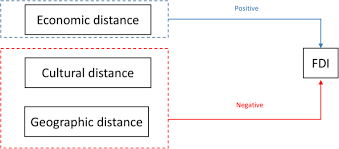
Distance has become a hindrance to economic activities across the borders in international trade and markets. There is a dire need for any multinational enterprises to consider all concepts of distance before commencing their transactions in any country. The significant distance features to look encompass of spatial and institutional features. Geographic distance has over time been related to the costs of transport incurred in remote locations business transactions as well as the LOF.
Non-geographic distance factors have also been linked to the explanations in the respective businesses across the borders. Such features include; social, cultural, economic and normative differences. According to studies in business management, the emphasis has been laid on cultural and psychic distances that are regarded the greatest determinants in the FDIs location.
International trade research recommends that the institutional and social features be considered in the business theory so as to cab the broad range of hindrances that have been linked to geographic distance. Longer geographic distances could result in the increment of transport costs, challenges while dealing with different regulations and institutions. It is likely going to be a difficulty in understanding markets with another level of economic development (Berry et al., 2010).
Want help to write your Essay or Assignments? Click here
The density of distance concepts and their effects on the FDIs may be best appreciated if viewed across the regions, functions and firms. The evaluation across the region signifies a separation point from the traditional methods of analyzing location decisions of FDI. Cultural differences refer to the disparities in norms and values between the host and the home country. It is very significant since the national values among employees and countries affect how individuals act and hence have an impact on the establishment of a firm.
To understand the cultural distance as a determinant of FDI flow, it is necessary to measure it by the aid of Schwartz’s orientation of gender and culture equality. Two known orientations are embeddedness and autonomy. Embeddedness characterizes people more collectively thus social relationships with groups of people are highly regarded as individuals work towards common goals. In autonomy, people value the uniqueness of each person, and one is entitled to their feelings and ideas.
Another important aspect is the gender equality, which is not only a social factor but has an impact on the economic development of any country. Women form a significant part of the workforce in several sectors of growth. There tends to be a positive relationship between the level of human capital, other economic conditions and the women rights (Siegel, Licht and Schwartz, 2012)
Want help to write your Essay or Assignments? Click here
The liability of foreignness as the total of costs comprises of the unseen costs associated with the engagement with new legislatures and cultures when doing business abroad unlike home. Elango (2009) asserts in his definition of LOF that it results in a disadvantageous competition for any multinational company. Generally, according to Elango, the costs incurred by an enterprise abroad would not be incurred by a similar local company. The genesis of such costs could be cultural, geographical, economic and institutional distances that lead to an increment in costs and makes it hard to succeed abroad.
LOF majors on the social expenditures of transactions overseas. Such costs are gotten from the relational, unfamiliarity and discrimination challenges faced by the foreign companies, unlike their domestic counterparts. They are innately uncertain and may be incurred even in future. Unfamiliarity costs are a reflection of poor experience or knowledge in the foreign country hence a setback to the foreign companies as likened to the local enterprises. There is a tendency for the foreign investors to pay handsomely for what the locals acquire cheaply or at zero cost.
For instance, local banks in Germany are likely to have a sigh of relief if the Bundesbank lowers the interest rates in a day’s time but British-based banks in the country may have nothing to celebrate. Such an LOF is related to the durability of its existence in the host nation. Short-term resolutions in the foreign country result to unexpected challenges that are covered in the additional costs incurred by the multinational company to realize a similar level of host-market awareness as the domestic company.
Unfamiliarity hazards result in a rise in the average cost of the foreign company, but the production level remains constant. Such as building market awareness costs should be gotten rid of with time, although they may persist if the multinational corporation managers continue adhering to the global strategy and fail to involve themselves in the civic learning (Barnard, 2010).
Want help to write your Essay or Assignments? Click here
A green field venture means starting off an enterprise from scratch, which is from a green field (Klimek, 2011). Acquiring an existing company as opposed to Greenfield venture has several merits. Firstly, it is faster. If the investor wanted the company to take a shorter time for their presence to be noted as well as compete well at entry level in the market, then this would be the best option. Greenfield ventures demand a longer period of physical construction and developing the company. The acquisition is one of the cost-effective means for the investment to realize a competitive mileage in technology, brand name, distribution and logistical advantages as it gets rid of the local competitor.
International political, economic and foreign exchange state may cause imperfections in the market thus causing the target companies to be underestimated. Several MNEs in Asia have been targeted in the recent past due to the economic crisis in the region that consequently impacts on their financial wellbeing. This has left many companies in a state of desperation for capital injections to survive competitively. The acquisition is the best strategy to solve such challenges as maneuvering through the local distribution channels, recruitment of the local employees, and it also creates a platform with a readily established market with a customer base.
Such factors shorten the time needed for the venture to break even. On the other hand, cross-border acquisitions have their shortcomings that the investor needs to consider before making the bold step. The costs of acquisition and financing are relatively too high. It can be difficult to mesh diverse corporate cultures. It may force the management to consider slimming down in order to up the economies of scale. The outcomes of such a step may not be productive to the firm since there is a tendency for individuals to try saving their jobs.
Other difficulties may emanate from the host nation’s interference with financing, pricing, market segmentation; employment guarantees favoritism and overall nationalism. An investor may decide on acquiring a joint venture. In such a form the investor accesses the local partner’s experience and skills, the government contacts and the knowledge about the local market. A joint venture is thus regarded the best way of investment (Becker & Fuest, 2011).
Want help to write your Essay or Assignments? Click here
The business location is critical for any venture to realize growth as well as experience successful operations. Choosing a business location requires precision in market research and planning. It is imperative to put into consideration several factors when making a choice for the company’s location. Several aspects are involved such as assessment of the supply chain, observation of the demographics, understanding state legislature, staying on budget and scoping the competition.
Some other factors to focus on in the research include; the company needs, employees, customers, the equipment required to deliver services among others. Talking of the company needs, most enterprises make a location choice that gives them accessibility to their customers. On this note, it is vital to consider the brand image and ask whether the location is going to be consistent with the intended brand. Establish whether the companies around are complementing or competing for the venture.
It is very necessary mostly where shopping comparisons are common. If the competitor is likely to make the environment tougher then it is advisable to shift the location. There is a need to find out whether the target area has potential employees and the rates of labor. If the business has a prospect of growth, then one should look for a building that offers room for expansion.
The business should also be located at a place where suppliers can quickly find you. One has to think also of safety too, thus, questions about the crime rate in the select area need be asked. Zoning regulations; these help determine whether one may conduct their type of venture in a given building or location. This may be found out through holding the local planning agencies (Cavusgil et al., 2014).
Want help to write your Essay or Assignments? Click here
The business location should be consistent with one’s style of operation. There is a need to determine whether the intended operation is going to be formal or informal. In cases where the customer base is local one is required to find out whether the population matches the customer profile for the business support. Find out whether the community has a stable economy for the company’s well-being.
It is vital to be cautious with a community that solely dependent on a particular company for their economy since this could lead to a downturn that is not healthy for any business. Having the knowledge about the legislature on businesses in a given location is very essential. Look into hidden costs because not many spaces are business ready thus requiring a lot of initial work be done before start-up. Determine also whether the select location qualifies you to access the government economic incentives (Hair Jr et al., 2015).
Want help to write your Essay or Assignments? Click here
Becker, J. and Fuest, C., 2011. Tax competition—Greenfield investment versus mergers and acquisitions. Regional Science and Urban Economics, 41(5), pp.476-486.
Cavusgil, S.T., Knight, G., Riesenberger, J.R., Rammal, H.G. and Rose, E.L., 2014. International business. Pearson Australia.
Elango, B., 2009. Minimizing effects of ‘liability of foreignness’: Response strategies of foreign firms in the United States. Journal of World Business, 44(1), pp.51-62.
Hair Jr, J.F., Wolfinbarger, M., Money, A.H., Samouel, P. and Page, M.J., 2015. Essentials of business research methods. Routledge.
Klimek, A., 2011. Greenfield foreign direct investment versus cross-border mergers and acquisitions: the evidence of multinational firms from emerging countries. Eastern European Economics, 49(6), pp.60-73.
Siegel, J.I., Licht, A.N. and Schwartz, S.H., 2012. Egalitarianism, cultural distance, and FDI: A new approach. Organization Science, Forthcoming.
Want help to write your Essay or Assignments? Click here
Want help to write your Essay or Assignments? Click here
How Women Entrepreneurs Can Succeed In Small Businesses
Abstract
This report presents an evaluation of how women entrepreneurs can succeed in small businesses. The report adopted a desk research approach to conduct an extended literature review on the topic. Through the desk research approach 230 pieces of literature were studied in order to retrieve the required information mainly using online desk research (external desk research).
This research approach is important for analysis of known data thereby saving time and money. Detailed analysis of existing literature was used to examine the research questions and objectives. The findings of the study noted that most women across the world face numerous challenges after starting small businesses, but a considerable number of them eventually succeed. The study found that policy makers, family support, internal motivation and academics are some of the pertinent factors towards women entrepreneurs’ successes.
Want help to write your Essay or Assignments? Click here
Introduction
Entrepreneurship is the main tool towards political, economical, and social sustainability. It contributes to economic development through personal fulfillment and innovations. Entrepreneurship provided the opportunity to accumulate personal wealth, mediate business problems, and create job opportunities. For over years, men have been excelling in both small and big businesses (Ajjan, Beninger, Mostafa & Crittenden, 2015).
This excellence has been attributed to their determined efforts, in addition to their pertinent methods to weather economic doldrums. However, this does not imply that businesses that are run by men do not crumble down. Nevertheless, it implies that men have the capability to rise up again after the collapse. On the other hand, women establish a unique way of handling businesses. They are always careful when handling business and they will take most of their time to see that they accomplish the set objectives.
In the United States, the number of women entrepreneurs is escalating tremendously. Women are alienating themselves from the long-lived stereotype that they are inferior than men (Ahl & Nelson, 2015, p.278). The government of the U.S. has been praising succeeding women entrepreneurs because they have been supporting their businesses besides them being entangled with numerous obligations such as reproductive roles and housework.
Due to affirmative action, women entrepreneurs have been able to secure subsidized loans from banks to support their businesses. The government, on the other hand, has been emphasizing women entrepreneurs have to be supported economically, as they are part of economic development.
Want help to write your Essay or Assignments? Click here
The government also has made education available to the girl child by lowering cut mark for them to join colleges and universities. In 2012, it was recorded that in the University of Atlanta, the number of female students exceeded that of the male students. However, women businesses do collapse, and once they collapse, they are not able to rise up again. Before they rise up again, women mostly undergo many operations to see them rising (Ahl & Nelson, 2015, p.279). Therefore, there has been a concern why women entrepreneurs fail in small businesses.
Several researchers have immersed in this quest to answer this question, but their answers are substantive. Much of the researches have been looking why women are choosing to be entrepreneurs. Some of the findings of some researches argue that the reasons why women entrepreneurs fail in business is because of lack of family support, cutthroat competition from men, and lack of experience or skill.
Therefore, the research wishes to look into drawbacks that specifically makes women entrepreneurs fail miserably in the business (Akehurst & Mas-Tur, 2012, p.2471). In addition, the present study will look into ways on how the problems that make women businesses fail can be reversed. Upon understanding why women fail in small businesses, the research will draw how women will reshuffle themselves toward success in small businesses.
Want help to write your Essay or Assignments? Click here
Outline of the research problem
Statement of the problem
It is notable that the number of women entrepreneurs is many in the society. These women lack the potential to exploit fully market opportunities. There are observable barriers blocking women from pursuing their dreams in small businesses. Many literature reviews indicate that the problem is persisting in the society. Elias & Nolo (2012) argue that a large number of obstacles surround women entrepreneurs. The authors argue that the obstacles that make the women entrepreneurs not to contribute much to the society.
This respective study form the researchers in the literature review in that the focus this time the focus on the social factors. There is a gap in the literature since the researchers emphasize the economic and political issues that block people from succeeding in small businesses. This is because political and economic factors are inevitable in the society. However, social factors such as interpersonal issues make women entrepreneurs to catalyze the situation.
Concurrently, the pieces of literature do not discuss the women entrepreneurs in small business. Rather, the pieces of literatures discuss the reason why men entrepreneurs fail in businesses. Although there are a larger proportion of women entrepreneurs in small business, there is an apparent limited of studies conducted with the main objective to analyze social issues that affect women entrepreneurs in small businesses.
Want help to write your Essay or Assignments? Click here
Research aim statement
The study aims to investigate how women entrepreneurs can succeed in their small businesses.
Research Objectives
The following research seeks to achieve the following:
a) Determine factors that make women entrepreneur fail in their small and medium scale businesses
b) Establish what need to be done to avert the factors that hinders small businesses of women entrepreneurs to excel
The process
The process was mainly external desk research whereby information is derived from online sources. This was practiced using business sites. However, getting 230 sources was not easy with the business sites. Therefore, the process combined the use of libraries such as Proquest and EBSOCOhost to search sources that discuss why women entrepreneurs fail in small businesses (Bruezzese, Gallagher, McCann-Doyle, Reiss & Neil, 2013, p.15).
However, the search mainly searched journals only, and not books or periodicals. Those journals from 2008 to present year were taken into special consideration, as they were attributed to being compatible with the present time.
Significance of the research
The study aims at finding the extent to which personality, political, social, environmental, and economical factors can make a woman succeed in small businesses (Reddy & Agrawal, 2012). Research aims at giving the appropriate solutions on how to avert these factors to the women entrepreneurs’ advantage. This is because the pieces of literature failed to provide the best method to make women excel in their small businesses (Collins, 2010).
There is a call in the literature review for further research to investigate the impact of policy makers, academic factors, as well as the effects of practicing managers in making small businesses of women entrepreneurs to survive in the market.
Want help to write your Essay or Assignments? Click here