

Corporate Culture and Strategy

Corporate Culture and Strategy

Want help to write your Essay or Assignments? Click here

Corporate Culture and Strategy

An organization’s mission strategy is a précis of the way in which the firm perceives its role and the beliefs the company employs in attaining its objectives. The culture of an organization signifies the professional values an organization espouses which dictate how the company interacts with its customers, partners, vendors and workers. Since the culture of the organization is a driving force in how the business organization carries out its business, it has a significant impact on developing business strategy (Hofstede, 2014).

This paper delves into the topic of culture and strategy. In this investigation of the topic, the subject of culture and strategy is analyzed exhaustively and critically. In particular, this paper provides an in-depth discussion of the relationship between company culture and strategy, importance of alignment between culture and strategy, and how national culture really influences an organization’s strategy.

Correlation between corporate culture and strategy

There is a strong relationship between corporate culture and strategy. In general, strategy is considered as a product of culture while culture, on the other hand, is considered as a product of strategy (Browaeys & Price, 2009). In spite of how good the company’s strategy is, when it really comes down to it, Schneider (2011) noted that it is the people who usually make the difference. At its core, strategy is logical and rational, simple and clear.

Strategy has to be easy to talk about and to understand. A business organization is lost if it lacks a clear strategy. In essence, strategy is the pattern of activities that a company follows as it pursues its long-term purpose. Put simply, it refers to where the company is at the moment, where the company wants to go, and how the company intends to get there (Akbar et al., 2012).

Strategy comprises a number of factors which include the following: objectives and goals of the company; mission statement and vision; and critical success factors, or the things which the company has to get right for it to succeed in its mission. It also includes core values; reputation/brand, which entails developing and communicating meaningful and powerful differences between the company’s offerings and the offerings of the company’s competitors; and positioning, whereby a company builds a preferred and valued position within the minds of its target audience (Cristian-Liviu, 2013).

Want help to write your Essay or Assignments? Click here

Conversely, culture is understood as the set of beliefs which drive the behaviours of workers. These could be things that everyone within the organization knows and shares, in addition to implicit rules. It is worth mentioning that the range of acceptable behaviours of workers in the company is rooted in these underlying beliefs (Weick, 2014). On the whole, organization culture consists of the shared values, norms as well as ideals in a business organization and it actually sets the basis and groundwork for strategy.

An important starting point of understanding the culture of a company is to understand its founding principles: that is, its legacy, heritage, the clients and markets which it serves, and its points of differentiation. Anderson, Anderson and Lee (2015) pointed out that culture of a company is an aggregation of the beliefs and mindset of the company’s workers. It is the manifestation of the mission, vision and principles which bind employees in the organization together.

In the current business world in which sell-offs, diversifications, acquisitions, expansions and mergers are becoming increasingly common, it is becoming very important to understand corporate culture in strategic decision-making. The consolidation of AOL with Time Warner did not succeed because of culture clash as did the DaimlerChrysler merger. Organization culture is a very powerful factor in an organization’s lasting success.

Want help to write your Essay or Assignments? Click here

For a strategy in a company to develop and be successfully executed, that strategy has to align fully with the corporate culture. As such, goals and initiatives need to be established within the company in order to support and establish a corporate culture which embraces the strategy of the company over time (Su, Yang & Yang, 2012). Corporate culture has a significant impact on strategy execution within the organization.

Characteristics of stability: an organization culture that is stable, a culture that would systematically support implementation of strategy, is one which promotes a culture of cooperation, unity, partnership and teamwork amongst staff members. This kind of organization culture would certainly enhance commitment amongst workers and focus on productivity in the company instead of resistance to regulations and rules or external factors which prohibit success.

Want help to write your Essay or Assignments? Click here

Flexibility and adaptability: according to Fombrun (2012), companies which remain flexible tend to embrace change and establish an environment that is open to both communication and production. This creates a model which welcomes cultural diversity and helps in clarifying implementation of the strategy. In any company, corporate culture could serve a number of different purposes such as unifying employees in the company and helping to establish a set of common rules or norms within the company that members abide by.

Goal unification: corporate cultures that are unified, strong and flexible would approach strategy execution and affect execution positively through aligning goals. In essence, goals could come into alignment when the culture of the business organization is working to focus on productivity and getting the mission of the company achieved. This might include shipping out more product items compared to the company’s main competitors, getting products delivered to the company’s clients on time, or similar objectives.

This would create a domino effect within the company which would ensure that all work carried out by every work group and employee within the organization is really focused on performance and on the company’s strategic importance (Dutch, 2013). This would allow corporate culture of the company to be in alignment with strategy execution at the most basic level. Hanson and Melnyk (2014) noted that for this unification level to work, it is important that goal setting aligns with and is supported by processes, procedures, policies and systems within the company, which would help to attain strategy execution and continuing the organization’s cultural integrity.

Want help to write your Essay or Assignments? Click here

Process implementation: part of strategy implementation and cultural alignment entails process implementation. It is noteworthy that processes include the use of technology in facilitating goal achievement as well as the results which an organization is looking for when it works with clients to satisfy their needs. Although the hard problems and needs of a company are attained most of the time, the corporate culture becomes overlooked during the process. This is where processes actually come into place and execution of the strategy slowly comes into existence to maintain and sustain corporate culture and strategies (Dutch, 2013).

Cultural alignment: when corporate culture is in alignment with implementation of the strategy, a company can operate more efficiently within the international marketplace. Corporate culture allows the senior managers of a company to work both as teams and individually in developing strategic initiatives in the company. These might include re-establishing old partnerships and creating new partnerships to continue to deliver the best services and products to an international marketplace (Slater, Olson & Finnegan, 2011).

Want help to write your Essay or Assignments? Click here

Organizational strategic alignment, in its simplest form, is lining up the strategy of the company with its organization culture. For an organization to experience organizational strategic alignment, then its goals, processes and management should align. In order to create a supportive culture, an organization should clearly define the competence of its resources by assessing whether its processes, employees and equipment could actually handle new changes. If staff members do not have the competence for handling a new strategy, then the organization should offer training to improve the skills of its workers and managers.

If there is no sufficient support and training, the relationships between managers and staff members within the organization would suffer and the company would lack flexibility. To establish a culture of support, the top managers need to be involved in organizational strategic alignment from the beginning and provide the right resources to help in ensuring success of the workers and the organization (Yarbrough, Morgan & Vorhies, 2011). Workers should commit to supporting an organization’s strategic alignment and senior managers could help ensure this success by defining the goals of the organization in a clear manner and giving incentives to help workers accept new strategies.

Want help to write your Essay or Assignments? Click here

When strategy and organization culture are misaligned, the misalignment would short-circuit performance and increase the probability that the company will not attain its goals. An organization culture which all employees within the company subscribes to will help in creating focus amongst the workers.

When workers comply with the values and beliefs of the organization, it will give a unified impression to partners, customers and vendors (Bushardt, Glascoff & Doty, 2011). The organization could then formulate a strategy knowing that every member would uniformly apply the guidelines and improve the likelihood that a strategy would succeed.  

In aligning corporate culture with strategy, the following steps are important: first, the senior managers should define their company’s long-term set of guiding principles – the philosophy and purpose –, which are essentially the organization’s identity. A strategic plan would not succeed if the strategic plan is really not supported by these key principles of the company’s core culture.

Secondly, the senior management should evaluate the weaknesses and strengths of the company as well as the external factors which could impact success (Simoneaux & Stroud, 2014). Thirdly, the executives should create the company’s vision and then set strategic goals that are measurable and specific. Fourthly, the senior management should decide the strategic priorities which are in alignment with those strategic goals. It is worth mentioning that strategic priorities are a part of the organization’s core culture.

They are basically the values and principles which could alter given that their function is to align the corporate culture with the organization’s strategy. A company’s core corporate culture has to drive the company’s strategy and align with it (Mintzberg, 2011). Fifthly, with a clear understanding of the organization’s core corporate culture, strategic goals and vision, the top managers should create an action plan with measures for guiding performance. Finally, the senior executives should turn the strategic goals into measurable outcomes. Processes and employees should be aligned with the company’s core corporate culture and strategy (Simoneaux & Stroud, 2014).  

 Want help to write your Essay or Assignments? Click here

National culture and strategy

A country’s national culture greatly influences the strategy adopted by a company. National culture has an impact on organizational strategy and implementation of the strategy, and can ultimately result in business failure or success. In essence, all national cultures have an impact on companies in both negative and positive ways, depending on the particular business, the business cycle, as well as the specific strategies being pursued (Hammerich & Lewis, 2013).

Cultural dynamics could either derail or enable performance depending on these different factors. It is important that a company’s senior management recognize the cultural factors which have a negative impact on performance and the ones which could be harnessed to foster superior performance (Hammerich & Lewis, 2013). To formulate strategy, a company needs to identify and interpret strategic issues.

In this process, the company scans, selects, interprets and validates information and establishes priorities amongst issues. The national culture of any country could actually influence this process given that it affects the nature of the relationship of a company with its environment and the nature of the relationships amongst employees in a company (Schneider, 2011). 

Whether it is big company pursuing international growth strategies or a small start-up firm in its initial phases of the growth curve, culture plays a vital role in making sure that the company does not swerve off the path and that it remains on course. Usually, driving and executing effective strategic change is a medium-term to long-term priority for a company’s management.

Likewise, the corporate culture of a company also develops with time, with a combination of active support by the company’s top leaders and voluntary cohesion and dissemination as the company’s purposes and beliefs pervade through the hierarchy. Owing to the intrinsic patience which the company’s top management requires to drive a strategic change and establish a focused culture, it is really sensible that both of them – strategic change and purposeful culture – work alongside each other and not against (Schein, 2012).

Want help to write your Essay or Assignments? Click here

Companies which are highly successful in driving strategic change and implementing it share 3 fundamental principles by which they embrace corporate culture and utilize it in the process as an enabler. Firstly, such companies are aware of differences in global cultures – this factor might be more pertinent and applicable to multinational corporations although it is equally applicable to small start-up firms that have ambitious aspirations for growth.

For instance, knowing the way that a worker in Malaysia would react to a new strategic initiative in comparison to how a worker in the Netherlands would react is of great importance in executing strategic change at the ground level (Schwartz & Davis, 2011). In essence, it implies that the overarching aspects of the strategy should be modified to fit the with local market-level ways of operation.

The second underlying principle is recognizing what culture means to different peoples – Cristian-Liviu (2013) reported that this second principle is more of a challenge for big companies with scale than to new, start-up firms. Within an organization, culture implies different things for different individuals.

In a brand consultancy company for example, the design/creative department might think that their department is really the best place to work in the organization, but the sales and marketing department whose role is to sell the design solutions, might think that the design/creative group’s capabilities are dull and outmoded. Broader changes within the company would impact employee groups in different ways and the cultural aspect of the change should be carefully measured (Schwartz & Davis, 2011).

The third underlying principle entails aligning strategic change initiatives with corporate culture – the Time Warner-AOL and DaimlerChrysler mergers were both in the same industry but still they did not succeed, they both failed. This evidently illustrates the dangers of overlooking culture as a factor when planning and executing a company’s strategic initiatives (Mühlbacher, Vyslozil & Ritter, 2014).

Although both Chrysler and Daimler produced vehicles, the styles of management and the collaboration processes in each firm were driven very much by their nation of origin; that is, the German and American cultural ethos. These 2 cultural ethoses were never reconciled and adapted in the merged organization and they clashed all the time. In essence, every form of strategic planning should take in corporate culture as a factor that impacts success, as well as manpower, finance and capabilities (Weick, 2014).        

Want help to write your Essay or Assignments? Click here

Conclusion

To sum up, there is a really strong correlation between corporate culture and strategy. Strategy is considered as a product of culture while culture, on the other hand, is considered as a product of strategy. For a strategy in a company to be formulated and executed successfully, this strategy has to align completely with the culture of the organization. Thus, goals and aims need to be established within the firm so as to support and establish a corporate culture which embraces the strategy over time.

When organization culture is in alignment with execution of the strategy, a firm can operate more efficiently within the international market. When strategy and organization culture are not aligned, then this misalignment would short-circuit performance and increase the likelihood that the firm would not accomplish its goals. National culture has a significant impact on organizational strategy and implementation of that strategy, and could eventually result in business failure or success.

References

Akbar A. S. A., Salamzadeh, Y., Daraei, M., & Akbari, J. (2012). Relationship between Organizational Culture and Strategy Implementation: Typologies and Dimensions. Global Business & Management Research, 4(3/4), 286-299.

Anderson, G. M., Anderson, M. J., & Lee, J. B. (2015). Defining Corporate Culture. NACD Directorship, 41(2), 36-37.

Browaeys, M. J., & Price, R. (2009). Understanding cross-cultural management (1st ed.). Boston, MA: Pearson Education Limited

Bushardt, S. C., Glascoff, D. W., & Doty, D. H. (2011). Organizational culture, formal reward structure, and effective strategy implementation: A conceptual model. Journal Of Organizational Culture, Communications & Conflict, 15(2), 57-70.

Cristian-Liviu, V. (2013). Organizational culture and strategy. how does it work? An empirical research. Annals Of The University Of Oradea, Economic Science Series, 22(1), 1690-1696.

Dutch, M. A. (2013). A Symbiotic Framework of Human Resources, Organizational Strategy and Culture. Amity Global Business Review, 89-14.

Fombrun, C. J. (2012). Corporate Culture, Environment, and Strategy. Human Resource Management, 22(1/2), 139-152.

Hammerich, K., & Lewis, R. D. (2013). Fish can’t see water: How national culture can make or break your corporate strategy. New York City, NY: Wiley

Hanson, J. D., & Melnyk, S. A. (2014). Culture Eats Strategy … and how to deal with it. Supply Chain Management Review, 18(4), 20-26.

Hofstede, G. (2014). Cultural dimensions in management and planning. Asia Pacific Journal of Management, 12(9):81-99.

Mintzberg, H. (2011). Patterns in strategy formation. Management Science, 24 (9): 1-18.

Mühlbacher, H., Vyslozil, W., & Ritter, A. (2014). Successful Implementation of New Market Strategies–A Corporate Culture Perspective. Journal Of Marketing Management, 3(2), 205-217.

Schneider, S. C. (2011). Strategy formulation: The impact of national culture. Fontainebleau, France: ISEAD.

Schein, E.H. (2012). Organizational culture and leadership. San Francisco: Jossey Bass, Inc.

Schwartz, H. & Davis, S.M. (2011). Matching corporate culture and business strategy. Organizational Dynamics,11(9): 30-48.

Simoneaux, S. L., & Stroud, C. L. (2014). A Strong Corporate Culture Is Key to Success. Journal Of Pension Benefits: Issues In Administration, 22(1), 51-53.

Slater, S., Olson, E., & Finnegan, C. (2011). Business strategy, marketing organization culture, and performance. Marketing Letters, 22(3), 227-242. doi:10.1007/s11002-010-9122-1

Su, Z., Yang, D., & Yang, J. (2012). The match between efficiency/flexibility strategy and organisational culture. International Journal Of Production Research, 50(19), 5317-5329. doi:10.1080/00207543.2011.618149

Weick, K.E. (2014). The significance of corporate culture. In Frost, P.J. et al. (Eds.) Organizational Culture. Beverly Hills, California: Sage Publication, 381-390.

Yarbrough, L., Morgan, N., & Vorhies, D. (2011). The impact of product market strategy-organizational culture fit on business performance. Journal Of The Academy Of Marketing Science, 39(4), 555-573. doi:10.1007/s11747-010-0238-x

Want help to write your Essay or Assignments? Click here

Tensile Testing Laboratory Report

Tensile Testing
Tensile Testing

Want help to write your Essay or Assignments? Click here

Tensile Testing

Summary          

Tensile testing is undeniably the most imperative experimental method that is used in determining the characteristics or properties of various materials for the purpose of predicting their behaviours as well as how they would respond to tension in their real world engineering applications. The specific properties of material that are determined through tensile test include maximum elongation, ultimate tensile strength as well as reduction in area.

The material properties are imperative in the selection of materials for mechanical design. In this lab experiment, a tensile tester was used to determine tensile properties of specimens of three materials namely duralumin, PVC and aluminium.

From the obtained tensile test results, duralumin properties including tensile strength (N/m2), yield stress (N/m2) and % elongation were 0.054 N/m2, 1.29231 N/m2 and 29.23 % respectively. In addition, those of PVC were 0.928 N/m2, 37.73585 N/m2 and 37.74 % for tensile strength (N/m2), yield stress (N/m2) and % elongation respectively; whereas those of aluminium were 0.083 N/m2, 0.65789 N/m2 and 65.79 % for tensile strength (N/m2), yield stress (N/m2) and % elongation respectively.

These properties show that both duralumin and aluminium are ductile and tough compared to PVC which indicate stiffness properties.  These properties are further illustrated in the stress-strain plots of each material. In conclusion, the tensile test results obtained from this lab experiment are useful in determining tensile properties of materials as well as providing valuable information concerning not only the material’s mechanical behaviours but also its engineering performance.  

Want help to write your Essay or Assignments? Click here
Introduction

The determination of the mechanical properties or characteristics of materials is done by performing laboratory experiments that are carefully designed so that they can be replicated under the same service conditions as nearly as possible. In real world applications of materials in mechanical engineering, there is involvement of myriad of factors in the determination of the nature in which application of loads can be done on a material (Czichos, 2006).

According to Ashby (2006) tensile testing is a fundamental test in material science where controlled tension is subjected to a sample until failure, and the obtained results often used for quality control and selection of materials for application. According to Hibbeler (2004), the specific properties of material that are determined through tensile test include maximum elongation, ultimate tensile strength as well as reduction in area. The material properties are imperative in the selection of materials for mechanical design (Davis, 2004).

Tensile testing is without any doubt the experimental method that is used in determining the characteristics of various mechanical materials with an intention of predicting the behaviours of such materials and how they would respond to tension in their real world engineering applications (Czichos, 2006).

The main objective of this experiment is to conduct an experimental tensile testing on various mechanical materials, i.e. duralumin, aluminium and PVC in order to determine and compare their characteristics, which can be used to predict their particular behaviours in real world engineering applications. The other main objective is to plot graphs describing the characteristics or properties of these materials as obtained in the tensile testing results.

As a result, graphs depicting the properties of these materials shall be plotted by stretching the samples of each of provided materials of known dimensions to destruction upon applying force subsequent to noting the ensuing elongation.

Thus, tensile test results obtained in this lab has many benefits because they enable a stress-strain diagram to be obtained, which is useful in determining the tensile properties of materials as well as providing valuable information concerning not only the material’s mechanical behaviours but also its engineering performance (Hibbeler, 2004).

Want help to write your Essay or Assignments? Click here

Theory

The topic covered in this lab experiment is focused to testing of tensile properties of various materials that have different compositions. Figure 1 illustrated below shows a machine used in tensile testing that resembles the one used during the laboratory experiment session. Tensile test is a destructive in nature, in which an axial is subjected to a sample of the material to be tested, and the specimen has to be of a standard shape as well as dimensions.

During a typical procedure for a tensile testing laboratory experiment, a specimen that dog-bone shaped is usually gripped at the top and bottom of the tensile machine on its two ends prior to pulling so that elongation occurs at a determined rate that is controlled up to its breakpoint (Hibbeler, 2004). Tensile testers vary mainly on the basis of pulling rate and maximum load, and their setup during an experiment could be varied for the purpose of mechanical testing of different materials through tensile test (Czichos, 2006).     

Figure 1: Tensile test 1 (A photograph of a tensile machine)

For analytical purposes, stress (σ) vs. strain (ε) is plotted from a tensile test experiment results, and this can be done either manually or automatically (Czichos, 2006). In the metric system, the usual measure for stress is Pa or N/m2, such that 1 Pa = 1 N/m2. From the laboratory experiment, the calculation of stress values is done through division applied force (F) by the cross-sectional area (A) of the machine, which is measured before the experiment is run (Hibbeler, 2004). Equation 1 and 2 below are used to calculate stress and strain values respectively.

Want help to write your Essay or Assignments? Click here

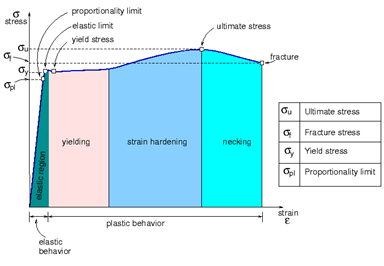
A typical stress-strain plot would look like figure 2 below, which is an example of a generalised and typical representation of a stress-strain curve for ductile metal materials (Davis, 2004). Figure 2 below indicates that the curve has four parts: elastic region, yielding region, strain hardening region and necking region, which occur in almost all materials except the strain hardening region commonly occurring in metallic materials (Czichos, 2006).       


In theory, even without the specimen’s cross-sectional area measurement during the tensile testing lab experiment, it is possible to construct a “true” stress-strain curve based on the assumption that there is constant amount of the material. Using this concept, it is possible to calculate both the true strain (εT) and the true stress (σT) using Equation 3 and Equation 4, respectively.   

Want help to write your Essay or Assignments? Click here

In the curve shown in Figure 2 above, the linear region, which is known as the elastic region depicts the region of the curve where the behaviour of the material is elastic. Equation 5 can be used to calculate the slope of the curve, which is an intrinsic property and is a constant of a material referred to as the elastic modulus (E). Its SI unit is Pascal (Pa). 

             Figure 3 shown below illustrates a typical stress-strain curve plot, and it shows that different materials, both metals and polymers portray varied properties under tension, which determines their greatest extent of deformation or ductility before fracture whereby some have very steep or relatively gentle elastic moduli.

According to Hibbeler (2004), mechanical properties of both metals and polymers are generally dependent on their molecular weights, extent of crystallinity, as well as glass transition temperature, Tg. For instance, if materials under consideration are highly crystalline and with a Tg higher than room temperature usually tend to be brittle, and vice versa (Davis, 2004).

On the other hand, when semi-crystalline polymers or materials are subjected to tensile testing, there will be an alignment of the amorphous chains usually evident for translucent and transparent materials, which have a tendency of becoming opaque after they turn crystalline.   

The stress-strain curve is used to give Young’s Modulus based on the run and rise of the slope, which is calculated similar to the gradient of a curve within the yield strength range prior to the material entering the ultimate strength phase subsequent to fracturing (Ashby, 2006)  

http://img.bhs4.com/d5/c/d5c6549d90f4b6585050489d433f06452f60fcde_large.jpg 

Figure 3: A typical stress-strain curve plot

Equipment and Procedure

Prior to beginning the experiment, the supplied guidance notes were carefully read after which the experiment setup of the tensile testing machine was confirmed to be alright. A photograph of the experiment is shown in Figure 4 below. Consequently, Figure 5 that follows is a detailed schematic diagram of a tensile testing machine showing the main parts.

Holding grips are used both at the top and bottom to hold the specimen in place firmly; load cell is used to provide the required weight depending on the sample material’s load range and sensitivity. In addition, the stationary base is used to ensure stability of the machine, while moving crosshead is used to adjust the load cell subjected to the material.

Figure 4: Experiment Setup Photograph of a Tensile Testing Machine

Figure 5: Detailed Schematic of a Tensile Testing Machine

Prior to starting the tensile test the safety guard was fitted followed by the selection of the specimen, which was then followed by the use of Dial Calliper for the width and thickness measurement of the specimen at gauge length as well as the cross-sectional area was determined.

The initial length of the specimen was measured and recorded or reference. The specimen was then fitted to the Tensile Tester followed by setting to zero the Dial Indicator, and the readings obtained for each specimen on the Vertical Scale were noted. Then the Load Nut was turned clockwise gradually in steps of 0.2 mm up to the length of 5 mm in a serial manner, and then followed by larger steps of 1 mm and 10 mm until the specimen broke.

The applied rate was kept consistent, i.e. 5 seconds were taken between each 0.2 mm of Load Nut turning followed by another 5 seconds for the readings to be recorded. The Dial Indicator value was recorded at each step, and for PVC specimen, this was done immediately after the load was change in order to obtain consistent results.

Want help to write your Essay or Assignments? Click here
The specimen elongation was checked by removing the specimen from the tensile tester and the broken ends were pushed together in order to measure the final length. The next step was conversion of the readings of the Dial Indicator into force values.  The extension of the specimens at each step was determined by subtracting the readings of the Dial Indicator from those of the Load Nut movement.

The obtained values of force and extension were consequently converted to stress as well as nominal strain values, which were subsequently plotted on the chart paper for each specimen, i.e. the steel, PVC and alloy. The yield points and tensile strengths for each specimen were noted from the charts. Finally, the elastic region gradients for each specimen were determined for subsequent comparison of the stiffness of the materials.  

Results and Discussion          

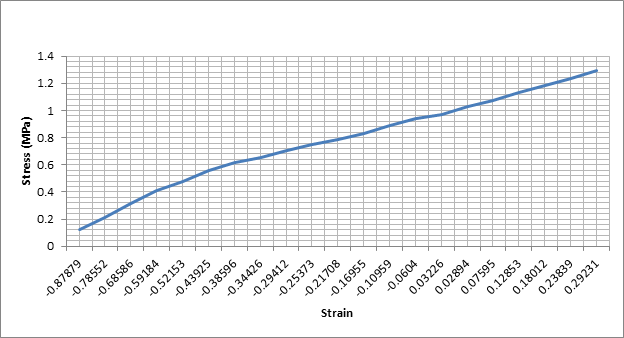
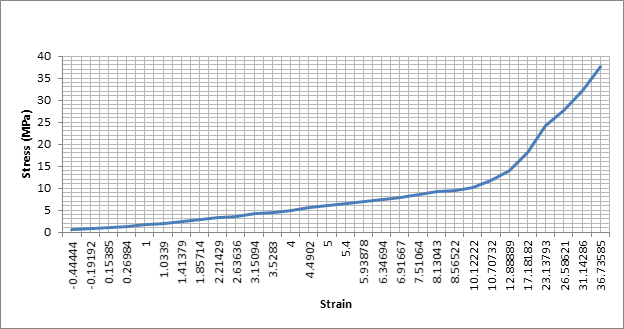
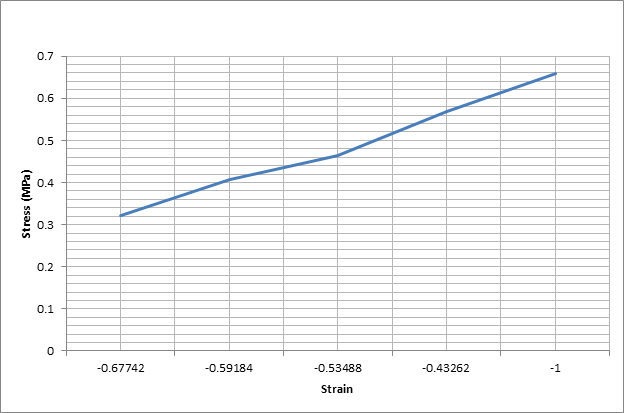
The tensile testing results are shown in table 1 below where the results of the three specimens are illustrated on properties such as force, extension, strain and stress. In addition, tensile strength, yield stress and percentage of elongation are calculated and included in the table for duralumin, PVC and aluminium respectively. Furthermore, the stress-strain curves for each of the specimens are plotted to illustrate the relationships between the two properties in Figures 6, 7 and 8.

Table 1: Data collected from experiment 1     

DuraluminPVCAluminium
Load Nut movement (mm)Dial Indicator (mm)Force (N)Extension (mm)Stress σ N/m2Nominal Strain ԑLoad Nut movement (mm)Dial Indicator (mm)Force (N)Extension (mm)Stress σ N/m2Nominal Strain ԑLoad Nut movement (mm)Dial Indicator (mm)Force (N)Extension (mm)Stress σ N/m2Nominal Strain ԑ
000000000000000000
0.21.650.2-1.450.12121-0.87870.20.360.2-0.160.55556-0.444440.20.620.2-0.420.32258-0.67742
0.41.8650.4-1.4650.21448-0.78550.40.4950.4-0.0950.80808-0.191920.40.980.4-0.580.40816-0.59184
0.61.910.6-1.310.31414-0.68580.60.520.60.081.153850.153850.61.290.6-0.690.46512-0.53488
0.81.960.8-1.160.40816-0.59180.80.630.80.171.269840.269840.81.410.8-0.610.56738-0.43262
12.091-1.090.47847-0.521510.6110.611.63934111.521-0.520.65789-1
1.22.141.2-0.940.56075-0.43921.20.591.20.612.03391.03391.2
1.42.281.4-0.880.61404-0.38591.40.581.40.822.413791.413791.4
1.62.441.6-0.840.65574-0.34421.60.561.61.042.857141.857141.6
1.82.551.8-0.750.70588-0.29411.80.561.81.243.214292.214291.8
22.682-0.680.74627-0.253720.5521.453.636362.636362
2.22.812.2-0.610.78292-0.21702.20.532.21.674.15093.150942.2
2.42.892.4-0.490.8304-0.16952.40.532.41.874.52833.52832.4
2.62.922.6-0.320.8904-0.1092.60.522.62.08542.6
2.82.982.8-0.180.9396-0.0602.80.512.82.295.49024.49022.8
33.130.10.96770.032230.532.5653
3.23.113.20.091.02890.02893.20.53.22.76.45.43.2
3.43.163.40.241.07590.07593.40.493.42.916.93875.938783.4
3.63.193.60.411.12850.12853.60.493.63.117.34696.346943.6
3.83.223.80.581.18010.18013.80.483.83.327.91666.916673.8
43.2340.771.23830.238340.4743.538.51067.510644
4.23.254.20.951.29230.29234.20.464.23.749.13048.130434.2
4.44.40.464.43.949.56528.565224.4
4.64.60.454.64.55510.22210.122224.6
4.84.80.414.84.3911.70710.707324.8
550.3654.6413.88812.888895
660.3365.6718.18117.181826
770.2976.7124.1323.137937
880.2987.7127.58626.586218
990.2898.7232.14231.142869
10100.265109.73537.7336.7358510
Tensile Strength (N/m2): 0.054 N/m2Tensile Strength (N/m2):0.928 N/m2Tensile Strength (N/m2): 0.083 N/m2
Yield Stress (N/m2): 1.29231 N/m2Yield Stress (N/m2): 37.73585 N/m2Yield Stress (N/m2): 0.65789 N/m2
% Elongation: 29.23%% Elongation: 37.74%% Elongation: 65.79%

The figures below show the stress-strain plots for each of the specimens tested;

Figure 6: Duralumin Stress-strain plot

Figure 7: PVC Stress-strain plot

Figure 8: Aluminium stress-strain plot

From the tensile test results shown in table 1 above, duralumin properties including tensile strength (N/m2), yield stress (N/m2) and % elongation were 0.054 N/m2, 1.29231 N/m2 and 29.23 % respectively. In addition, those of PVC were 0.928 N/m2, 37.73585 N/m2 and 37.74 % for tensile strength (N/m2), yield stress (N/m2) and % elongation respectively; whereas those of aluminium were 0.083 N/m2, 0.65789 N/m2 and 65.79 % for tensile strength (N/m2), yield stress (N/m2) and % elongation respectively.

These characteristics show that both duralumin and aluminium are ductile and tough compared to PVC which indicate stiffness properties. These properties are further illustrated in the graphs.

Two specimen of the materials, i.e. duralumin and aluminium produced gradients that are relatively the same in their elastic region mainly because they are both metals even though one is a pure metal while the other one is an alloy. The reason why there is a significant difference between tensile properties of the two materials and PVC (which is a polythene polymer) is that, the chemical compositions are totally different hence making them to behave differently under tension (Davis, 2004).

Constant temperature and force application rate are very important for PVC specimens because it is composed of polymers, which easily change even with slight variations of temperature or force and this makes it imperative to ensure that both temperature and force application rate are maintained constant in order to obtain consistent results (Czichos, 2006).

Want help to write your Essay or Assignments? Click here
Some of the important shortcomings of the experimental apparatus is that, when large forces are been exerted there is a likelihood of the equipment to flex resulting to some extent of displacement (Tarr, n.d.). This machine’s displacement is often mistakenly read and recorded as a displacement of the specimen, and can lead to false results. To address this challenge, the tensile machine should be firmly held on the bench to ensure that no flexing occurs when large forces are applied on the specimens (Ashby, 2006).

Conclusion and Recommendations

            By undertaking this lab experiment, I have learned a lot about the concept of tensile testing and my understanding on the same has significantly improved. For instance, I have gained more insights on how tensile properties differ between materials based on their chemical composition. In particular, the tensile properties of the three materials including tensile strength (N/m2), yield stress (N/m2) and % elongation varied considerably, especially between PVC and the other two materials (duralumin and aluminium) mainly due to their composition differences.                      

            The specific aspects of the procedure of this lab experiment that contributed immensely to my learning was about the extension or elongation variations observed between materials before they broke, whereby significant difference was observed between metal specimens and PVC specimens. Prior to doing the lab experiment I had difficulties in comprehending how the tensile testing concept is used in choosing materials for mechanical engineering applications.

However, after the lab experiment my difficulties were alleviated by understanding how tensile strength, ductility, stiffness and brittleness of materials can be determined through this concept enabling selection of appropriate materials. The lessons learned in this lab experiment can be applied in future by extending acquired experience and skills to other mechanical testing such as compression, tear and shear.

References

Ashby, M. (2006) Engineering Materials 1: An Introduction to Properties, Applications and Design. 3rd ed. New York, NY: Butterworth-Heinemann.

Czichos, H. (2006) Springer Handbook of Materials Measurement Methods. Berlin: Springer.  

Davis, J. R. (2004) Tensile testing. 2nd ed. New York, NY: ASM International.

Hibbeler, R. C. (2004) Statics and Mechanics of Materials. New York, NY: Prentice Hall.

Tarr, M. (n.d.) Stress and its effect on Materials [Online] available from http://www.ami.ac.uk/courses/topics/0124_seom/index.html. [Accessed 9 March 2016]. 

Want help to write your Essay or Assignments? Click here
Comprehensive Heart Failure SOAP Note

Comprehensive Heart Failure

Want help to write your Essay or Assignments? Click here

Comprehensive Heart Failure SOAP Note

Patient Initials: ______Mrs S. H._             Age: _57 Years______                               Gender: __ Female_____

SUBJECTIVE DATA: \

Chief Complaint (CC): “I have been experiencing shortness of breath and fatigue in the last two weeks.”

History of Present Illness (HPI):  Patient complains of shortness of breath, and general fatigue. Patient has been experiencing swelling of the feet and has been having difficulty in completing tasks that she would normally.

Medications: Synthroid 100mcg daily, Lisinopril 10 mg daily and Metoprolol 25 mg daily

Allergies: None

Past Medical History (PMH): measles at age 3, mumps at age 4

Past Surgical History (PSH): None

Family history;

Father died at age 65 y/o due to CAD.

Mother 70 y/o, alive diagnosed with hypertension

Brother (35) alive and healthy

Want help to write your Essay or Assignments? Click here

Personal and Social History:

 She is born and raised in this community. She is a college graduate with a diploma in business management. She works as an assistant in one of healthcare facilities within the community.  She lives with her daughter. She interacts with the community members. Pt denies smoking, but takes a lot of salt. The pt takes two cups of caffeine.  Pt states that she is physically inactive.

Review of Systems:

HEENT: EOMI, PERRL,

CV: RRR, S3 present, m/r/g absent

RESP: breathing symmetrical, SOB, CTAB x mild crackles

ABD- NABS, Palpable masses absent, s/nt/nd, HSMeg absent

MS: 5/5 strength

NEURO: Normal sensation to stimuli, normal gait, DTRs 2/4, Patellar and brachiorad

PSYCH: Congruent mood and appropriate

OBJECTIVE DATA:

t 98.9, HR 87, RR15, BP 114/69 Height 5’3 , weight  270ibs BMI  47.8

Gen: A&O X 3

HEENT: EOMI, PERRL,

CV: RRR, S3 present, m/r/g absent

RESP: breathing symmetrical, SOB, CTAB x mild crackles

ABD- NABS, Palpable masses absent, s/nt/nd, HSMeg absent

MS: 5/5 strength

NEURO: Normal sensation to stimuli, normal gait, DTRs 2/4, Patellar and brachiorad

PSYCH: Congruent mood and appropriate

 Labs: CBC, BMP

Imaging: CT

Want help to write your Essay or Assignments? Click here

ASSESSMENT:

Differential diagnosis (Dains, Bauman, and Scheibel, 2012):

a) Congestive heart failure

 Due to elevated blood pressure, swelling of the extremities and shortness of

b) Asthma

  Due to shortness of breathe, but not likely because patient denies history of asthma.

c)  COPD exacerbation

  Due to shortness of breath and general body weakness, but not likely because patient does not complain of productive cough.  

d) Pneumonia

 Due to shortness of breath and general body weakness, but not likely because patient denies chills, fever or coughs.  

 Final diagnoses: Congestive heart failure

 This is because the patient experiences edema, and dyspnea and shortness of breath.

Want help to write your Essay or Assignments? Click here

Plan:

Therapeutic intervention

Simvastatin 20 mg once a day

Lisinopril 25 mg once daily -continue
Metformin 1000 mg two times a day
Metoprolol 25 mg once a day

Loratadine 10mg one times daily

Glimepiride 4 mg one times daily
Follow up in two weeks

Non therapeutic interventions 

Lifestyle modification – reduced sodium chloride intake, caffeinated drinks, alcohol, clean eating, and physical activeness

Health promotion

Mammogram

Cervical screening test

Health prevention

 Healthy dietary is recommended to boost the immune system

Maintain hygiene to protect themselves from communicable diseases.

Reflections

  Congestive heart failure (CHF) is the leading cause for hospitalization in this community. There is no cure of the disease, but can effectively be managed through therapeutic and non-pharmacological measures (Esposito, Bagchi, and Verdier, 2009).  My preceptor and I were on the same page in during care delivery and treatment of this pt.  From the comprehensive assessment, I learnt that the patient was non-compliant to medication.I was assigned to research on the strategic ways that would be used to educate the patient and to ensure that she adhered to the recommended medication (Bickley, 2013

References ‘

Bickley, I.S. (2013). Bates Guide to physical examination and history taking .Wolters Kluwer/Lippincott Williams&Wilkins.

Esposito, D.,  Bagchi, A., Verdier,  J.M. (2009).  Medicaid beneficiaries with congestive heart failure: Association of medication adherence with healthcare use and costs. The American journal of managed care 15(7); 437-445

Dains, J.E., Bauman, L.C., Scheibel, P. (2012). Advanced Health Assessment and Clinical Diagnosis in Primary Care.

Want help to write your Essay or Assignments? Click here

A Social Issue or Governmental Concern

A Social Issue or Governmental Concern

Want help to write your Essay or Assignments? Click here

A Social Issue or Governmental Concern

Introduction

            Obesity is currently a serious social issue that is increasing rapidly. Whoever considered both woman and children to have different perceptions about their body index, the knowledge in surgical and medical issues that are connected to this disease (Li, et.al.2015). It is important to establish that the US is considerably experiencing a larger growth of obese generation, a factor that needs address.

Thesis:

            Obesity is a fast growing epidemic due to several factors such as poor diet, lack of physical activity and stress and has become a serious social issue requiring greater government involvement through nutritional content regulation and increased physical education in schools.

Obesity as a Governmental Concern

It is essential to determine that obesity as a health problem has had a considerable amount of economic impact within the health care system of the United States of America. This can be attributed to the increasing prevalence of overweight individuals that are directly associated with costs for a nations. These costs are incurred by the government in the development of preventive, diagnostic and treatment approaches that are connected to this disease (Li, et.al.2015).

On the other hand, the indirect costs that nations are bound to experience includes the wages that are lost by individuals who do not have the capacity to work since they are diagnosed with this ailment including the value of the future costs that a state is bound to encounter as a result of this ailment, a factor that makes it more of a governments concern as well. Additionally, it is imperative to determine that nations divert resources with the aim of dealing with the challenges that these issues present in a nation thus affecting the economic state of a nation.

Governments are additionally pushed in the acquisition of healthy foods that are more available, with the aim of reducing the supply chain and the promotion of other foods. The government is also obligated to develop awareness programs that encourage the population of healthy feeding in order to mitigate the effects of this disease, encourage physical activity and make the changing of policies easier for individuals who preset such illnesses. In other words, the government is forced to use its potentials in changing the social causatives of obesity

Obesity has been found to affect the health, economy, and social status of different individuals including the economic nation. This can be depicted as individuals who present this illness spend on medication including the government’s efforts aimed at managing this disease. The government in handling this situation is forced to pool several resources aimed at training the healthcare professionals on how to help in managing obesity (Li, et.al.2015).

The health professionals help patients on decreasing their weight stigma and encouraging patients on the need of being sensitive through an approach that involves education. The healthcare professionals are then trained and equipped with appropriate skills in managing this disease. This has seen the development of an obesity management approach that teaches the patients on how to diet and manage the disease. These approaches remain effective in managing obesity in a nation, a factor that requires a joint effort of both the health and government sectors. This determines the fact that obesity remains a health concern in a state.

Want help to write your Essay or Assignments? Click here

Obesity as a Social Issue

            Obesity is characterized as a condition that allows the accumulation of excess fats in the body. However, when people accumulate unnecessary weight as a result of this disease, it results into a social factor since it develops several implications within the society, legal, economic, religious and political elements (Li, et.al.2015). In determining the social aspects of obesity in Americans, it is essential to consider that Americans have turned out to be conscious about obesity currently than they did in the past, with many considering it as a societal issue that is viewed to be serious as compared to smoking or drinking.

The rates of Obesity has immensely grown, thus resulting in other nutritional related chronic diseases including the significant burdens that families, healthcare systems and the community encounter in caring for patients with this disease.

It is additionally important to consider the fact that individuals who are obese are viewed differently in the society. The society is more likely to consider them as suffering from unwanted illnesses, a factor that depicts the fact that these individuals are prone to suffer from discrimination and prejudice in different societies (Li, et.al.2015). On the other hand, obese people are considered to also have few friends, lower employment and education opportunities.

Following sources, we considered the perceptions of women especially those who suffer from obesity and their levels of knowledge on the medical and surgical elements as related to this disease as social (Li, et.al.2015). This has seen many of overweight women grow in large numbers, a factor that has caused them to underrate their body mass index (BMI). Since a majority of women that are obese are faced with the challenge of underrating their body mass index.

This can be depicted in the less educated women who we considered whom as having issues that result in the underestimation of their BMI. As depicted in the research, several of these women do not consider knowing their BMI status (Li, et.al.2015).Women are more likely to suffer from obesity without considering to it. It is now essential to call for support systems among the medical fraternity in administering advice to this population.

It is essential to consider that there are some misconceptions that have been developed and that have dominated policy initiatives directed towards combating and managing obesity. Several schools of thought believe that diet restrictions and the element of weight stigmatization may be ineffective in the fight against obesity (Li, et.al.2015).

However, it is important to consider applying psychological science in enacting new regulative approaches that aid in weight management in the local and national level. This essentially discourages individual’s willpower that is in strategies developed to fight obesity and encourage the initiation of policies that support environmental changes that nurture health for the populace.

In managing diabetes, it is vital to consider that there have been misconceptions dominating the policy initiatives in mitigating this disease. This determines the fact that the misconceptions dwelt on diet restrictions and weight stigmatization as not effective in mitigating this disease. In addressing this health concern, there is a need of inclusively incorporating psychological science in helping patients with weight management.

Studies have discovered that there is a need of employing scientific policies in improving the health of patients who suffer from this disease (Li, et.al.2015). This encourages the patients to develop a willpower approach in fighting obesity, whereas there is a need of encouraging policies that support environmental changes in nurturing a healthy society for all. Working conditions require that employees develop a healthy lifestyle that entails eating healthy foods, exercise and inclusion of education.

As determined in this paper, Obesity has turned out to be a health concern since it affects the economic, health, and social lives of individuals in a nation. In a nut shell, obesity is a social concern that has grown rapidly over the years. This a major cause for concern in the long list of issues that obesity can lead to.

Many people do not realize just how damaging obesity can be to their body and their overall health. It is in our hands to put an end to obesity and the extra toll that it is taking on the lives of US citizens conclusively. Let’s change the trend of obesity by making the initiative to live better lifestyles so that we can build towards a healthier America.

Want help to write your Essay or Assignments? Click here

  • Conclusion

As determined in this study, Obesity remains a fast growing epidemic due to several factors such as poor diet, lack of physical activity and stress and has become a serious social issue requiring greater government involvement through nutritional content regulation and increased physical education in schools. Obesity has been found to affect the health, economy, and social status of different individuals including the economic nation (Li, et.al.2015).

This can be depicted as individuals who present this illness spend on medication including the government’s efforts aimed at managing this disease. However, it is important to consider applying psychological science in enacting new regulative approaches that aid in weight management in the local and national level.

This essentially discourages individual’s willpower that is in strategies developed to fight obesity and encourage the initiation of policies that support environmental changes that nurture health for the populace. This therefore determines the rationale behind this ailment being a social issue and a governmental concern that is widely affecting several nations both socially, economically, religiously and politically.

References

Li, W., Buszkiewicz, J. H., Leibowitz, R. B., Gapinski, M. A., Nasuti, L. J., & Land, T. G. (2015). Declining Trends and Widening Disparities in Overweight and Obesity Prevalence among Massachusetts Public School Districts, Retrieved from http://www.medscape.com/medline/abstract/26270317

Want help to write your Essay or Assignments? Click here

Ethics of Sex Selection: Research Paper

Sex Selection
Sex Selection

Want help to write your Essay or Assignments? Click here

Sex Selection

Introduction

            For decades, sex selection has been a controversial issue. Choosing the sex of a child is often viewed as a justifiable act since there is no harm done to anyone. I believe that gender selection creates balance in a family and it is culturally viewed as a desirable practice that seeks to  fulfill social norms. However, there are ethicists who believe that sex selection reinforces the idea of sexual discrimination within our societies (Caulfield & Brownsword, 2012).

This explains why there are renewed efforts from civil societies and government to analyze arguments presented by different authors who either support or oppose the idea of  sex selection. 

This essay analyzes the meaning of human dignity from two different perspectives. Furthermore, the essay examines how human dignity is defined by our expression of choices and as an inherent value of the society. Based on a case study, the essay describes the social attitudes, norms and circumstance that influence such choices, and their impact on our understanding of human dignity. The essay presents justifications of particular actions concerning sex selection and analyzes some of the features of human dignity that can be put at risk due to actions arising from these two perspectives mentioned therein above.

The concept of human dignity

Human dignity is defined based on the belief that dignity is inherent; hence, human beings posses specific capabilities that are not found in other creatures. It is these features that help to distinguish human beings from other creatures. However, choosing a child’s sex does not define the inherent dignity of human beings. Permitting gender selection is considered as discrimination against a specific gender making it less valuable (Chapman &Benn, 2013).

There are various social reasons for sex selection. Some of these reasons include having a family balance, replacing the deceased child, cultural reasons et cetera. However, these reasons do not define human dignity especially in situations where boys are preferred more than girls. (Kalfoglou et al, 2013).

Kalfoglou et al (2013) views sex selection as an idea that reinforces sexual discrimination. As a result, human dignity is viewed as a situation where a certain gender is prevented from existing and the action is perceived to be justifiable because most people have not been victims of this cruelty. Therefore, individuals created by choice have do not have a reason to complain.

In spite of the reasons that seek to justify sex selection, it is considered to undermine human dignity; thus, causing harm to the wider society. Sex selection has often led to gender disparities in many countries especially in Asian countries such as China and India. This trend has led to patriarchal societal agreements perceived to discriminate girls and women (Mudde, 2010).

The social attitudes, norms and circumstances that influence such perspective

Due to advanced technology, sex selection culture has become popular and this has had a negative impact on females. Parents who are able to access technology have the ability of controlling the sex of their children; hence, they are able to escape the societal stigma of failing to give birth to a son. Many parents avoid giving birth to girls since they are viewed as individuals not worth living .Parents perceive that sex selection gives them the ability to choose what type of children they want in terms of sex. However, this process equates children to products (Webb, 2014).

Sex selection can make parents not to accept some of their shortcomings; hence, lowering the child’s self esteem. Having a strong preference for a specific sex can cause harm for the unwanted sex including rejection and killings to avoid societal blames and eliminate shame. However, proponents of this idea argue that it is normal for such ideas to be rejected at the first instance especially when people are unfamiliar with the idea.

Those opposing the idea of sex selection argue that that having children is not a right that one can put conditions to as children should be viewed as gifts from God (De Melo-Martín, 2013). These arguments are based on our cultural beliefs.

According to Caulfield & Brownsword (2012), traditional patterns of giving gifts recommend that a gift should be taken without putting any condition to it. A gift is something should be accepted unconditionally and the same case applies to children. From a cultural perspective, sex selection promotes the idea of treating children as a commodity, which is more or less similar to buying and selling of children. Choosing some of the features one wants is acceptable only to products like cars or other commodities, but this concept does not apply to human beings. Therefore, sex selection is often used to discriminate a specific gender.

Justification of specific actions in relation to human dignity

Proponents of sex selection argue that everyone has the right to live his life as he pleases so as long as the person does not cause harm or infringe upon other peoples’ rights. The harm principle implies that individuals opposing sex selection need to prove that the action is going to cause harm to others.  In this case, sex selection does not cause harm to anybody. Proponents of sex selection argue that the practice is considered harmful based on sociological and psychological assumptions .They further argue that sex selection is an act that is contrary to religious or moral beliefs (Smolin, 2013).

A report by The Task Force on ethics and laws highlights the common objection arguments used to reject the idea of sex selection. The report indicates that sex selection is compared to mocking God. However, such arguments have been applied to all medical innovations. . It started by rejecting the use of chloroform to relieve pain associated with childbirth. This act was viewed as going against God’s will. Such arguments also applied to the use of inoculation (Li & Pantano, 2013).

Ironically, previous medical innovations viewed as going against God’s will have become part of acceptable medical practices; hence, such objections have not been taken seriously. In fact, such arguments are considered as religious claims .Proponents of sex selection argue that individuals should only refrain from the idea if it contravenes their religious beliefs, but laws should not be imposed on people based on other people’s religious views (Dondorp et al, 2013).

Human dignity that can be jeopardized by actions arising from this perspective

            Defining human dignity based on our expression of choices affects public opinion about such ideas. If these perspectives are not comprehensively analyzed through research, public opinion will be flawed. The main concern is that people can use limited philosophical analysis to influence policy discussions .

The definition of human dignity should not be derived from the fact that it is an individual choice, but the practice should be viewed from both public and professional bioethical discussions as recommended by Ethics Committee of the American Society for Reproduction (Medicine, 2015).

Human dignity as a societal inherent value

In the second perspective, it is worth noting that the society often values children’s inherent worth. This limits some of the parents’ choices regarding gender selection. Parents who consider gender selections are said not to uphold societal norms and values which is the societal description for human dignity. According to McGowan & Sharp (2013), parents who select their children’s sex because of non-medical reasons are considered to be immoral in the eyes of the society.

From this perspective, human dignity is viewed as pride in oneself or having the sense of self worth as a human being to live a meaningful life .Therefore, any situation that compromises or humiliates this position is considered as a threat to human dignity. Choosing a particular gender over the other for non-medical reasons places expectations on a specific child, and this fails to recognize the personhood of an individual.

Therefore, sex selection fails to adhere to individual inherent characteristics .Children are often viewed as their parent’s property yet they are their own person .Putting too much expectations on the selected children does not give them the respect they deserve; hence, making them not to be autonomous as human beings are supposed to be (Claassens et al., 2013).

Parents who select the sex of their children view their children as a different person instead of the individual the child is suppose to be. Wudarczyk et al (2013) argues that choosing the sex of a child is failing to respect the human intrinsic values of the individual child. In summary, children need to be valued based on their intrinsic worth as human beings. In other words, the values of children should not be attached to specific characteristics.

Social attitudes, norms and circumstances that influence such perspective

In western societies, there is no preferred sex, but selection of sex is based on creating gender balance in the family by having both boys and girls. These common occurrences are observed in Australia, Sweden, and the UK. Even though sex selection does not have negative effects in these countries, Asian countries like China, Korea and India are faced with challenges associated with sex selection due to cultural beliefs. These countries prefer boys to girls and this has led to  more than 10 million abortions within the last 20 years (Moskovian, 2013).

Activists in Asia are calling for the ban of sex selection. However, due to the different reasons parents in the UK and India have for choosing the sex of their children, banning sex selection which is a worldwide practice will not change the situation especially in India. So long as there are religious and economic incentives attached to boys, banning sex selection will not have any effect especially in Asian countries.

Given the fact that majority of UK population would still prefer their first children to be boys, sex selection technology will be misused to fulfill desires of these parents. In Asian countries, banning sex selection will not change the cultural norms being practiced in these regions (Dyal, 2014).

Justification of specific actions in relation to human dignity

There are claims doing rounds that sex selection does not promote the inherent human value, and this is considered as an intuitive reaction, but not a reasonable moral response. The fact that certain human actions are unnatural does not necessary make these actions morally wrong. For example, heart transplant is unnatural but it is meant to save human life (De Melo-Martin, 2013).

The fact that those opposed to the claims that selection of sex should be applicable for medical purposes are not considerate to the fact that medical technologies helps couples with sex-linked genetic disorder to bear a healthy child. This does not translate to misuse of technology to fulfill their personal desires. Furthermore, those in support of sex selection argue that this practice eliminates girls in a humane way as compared to other methods like abortion or neglect, meaning that girls whose birth can be avoided will not be exposed to oppression or discrimination (Tregenza-Parker, 2013).

Want help to write your Essay or Assignments? Click here

In the current health care systems, physicians provide services that do not have direct medical benefits, but add value to individuals who seek for such services like cosmetic surgeries and ultrasound. The same view is applicable when it comes to sex selection. Offering sex selection services is also viewed as misuse of limited medical resources, but offering other services like face-lifts is not considered as s misallocation of limited medical resources. According to WHO Press (2011), the idea of sex selection has been misrepresented in most cases.

The most common argument is that sex selection causes social imbalances of sexes in India and China. The concern whether sex ratio is a threat to the western societies is more of a intuitive reaction devoid of concrete evidence .The idea of calling sex selection a sexist sin is not justifiable because most parents who prefer choosing the sex of their children do so based on the fact that they are motivated by the idea of having children from both sexes. People who believe that raising a boy is different from a girl are those who base their thinking on cultural values of children whereby girls are considered to be different from boys (Cooley &Chesnokova,2011).

Human dignity that can be jeopardized by actions arising from this perspective

The facts that arguments against sex selection are more about their consequences, these arguments are based on assumptions; hence, it is not easy to prevent some of the consequences from happening. It is not essay to draw legal lines to permit some forms of sex selection while limiting others. The main worry in such a situation is how parents are likely to spend their money on technology to ensure that their children are born with the specifications they want.

This can often lead to misuse of technology. The other concern is that if sex selection is acceptable, it will make one sex preferable than the other. As a result, it will make it hard to promote anti-discriminatory measures in several countries (Lee, 2016).

Conclusion

It not surprising that sex selection is controversial. , Different people justify their reasons for gender selection viewing it as a desirable practice that seeks to fulfill societal norms. Others view sex selection as a practice that reinforces discrimination while at the same time it goes against the inherent nature of human value. These two perspectives can describe human dignity from different views.

The case study of sex selection helps us to understand some of the social attitudes, norms and circumstances that can influence our choices and how sex selection from these two perspectives can impact on our understanding of human dignity based on the justification presented in support of this action.

Some of the justifications presented in the essay are likely to influence the perception of individuals in understanding the meaning of human dignity; hence, influencing our actions. In conclusion, it is important to define human dignity from a multi-dimensional perspective as compared to defining it from isolated arguments to accurately establish its meaning.

References

Caulfield, T., & Brownsword, R. (2012). Human dignity: a guide to policy making in the Biotechnology era? Nature Reviews Genetics, 7(1), 72-76.

Chapman, A. R., & Benn, P. A. (2013). Noninvasive prenatal testing for early sex identification: A few benefits and many concerns. Perspectives in biology and medicine, 56(4), 530-547.

Claassens, J. et al (2013). Searching for Dignity: Conversations on human dignity, theology and disability. Toronto. Sun media.

De Melo-Martín, I. (2013). Sex selection and the procreative liberty framework. Kennedy Institute of Ethics Journal, 23(1), 1-18.

Dondorp, W., De Wert, G., Pennings, G., Shenfield, F., Devroey, P., Tarlatzis, B., & Diedrich,

K. (2013). ESHRE Task Force on ethics and Law 20: sex selection for non-medical reasons. Human Reproduction, 28(6), 1448-1454.

Cooley, D. & Chesnokova, I. (2011). Sex Selection Abortion in Kazakhstan: Understanding a Cultural Justification, Developing World Bioethics 11, (3). 159–60.

De Melo-Martin, I. (2013). The Ethics of Sex Selection. Ethics and Emerging Technologies, 90.

Dyal, M. (2014). Whether sex-selection for non-medical reasons, using pre-implantation genetic diagnosis, should be permitted in the UK. University of Birmingham.

Ethics Committee of the American Society for Reproductive Medicine. (2015). Use of Reproductive technology for sex selection for nonmedical reasons. Fertility and Sterility, 103(6), 1418-1422.

Kalfoglou, A. L. et al (2013). Ethical arguments for and against sperm sorting for non-medical sex selection: a review. Reproductive biomedicine online, 26(3), 231-239.

Lee, M. Y. K. (2016). From the case of sex discrimination to the ideas of equality and equal opportunities. In Ethical Dilemmas in Public Policy (pp. 111-127). Springer Singapore.

Li, Q., & Pantano, J. (2013). The Demographic Consequences of Gender Selection Technology. Review of Economics and Statistics, Vol. 95, (5): 1549–1561.

McGowan, M. L., & Sharp, R. R. (2013). Justice in the context of family balancing. Science, Technology & human values, 38(2), 271-293. Current opinion in psychiatry, 26(5), 474.

Tregenza-Parker, G. (2013). Sex Selection for Family Balancing? A Legal and Ethical Analysis.

Smolin, D. M. (2013). Sex Selection, the Missing Girls of China and India, and the Challenges of Technological Control of Procreation. Regent JL & Pub. Pol’y, 6, 49.

Moskovian, A. (2013). Bans on Sex-Selective Abortions: How Far is Too Far?. Hastings Constitutional Law Quarterly, 40(2).

Mudde ,A. (2010).‘Before You Formed in the Womb I Knew You’: Sex Selection and Spaces of Ambiguity, Hypatia 25 (3).563–64.

Webb, D. C. (2014). The Sex Selection Debate: A Comparative Study of Sex Selection Laws in the United States and the United Kingdom. South Carolina Journal of International Law and Business, 10(1), 6.

WHO Press (2011). World Health Organization, Preventing Gender-based Sex Selection: An Interagency Statement OHCHR, UNFPA, UNICEF, UN Women and WHO. Geneva. WHO Press

Wudarczyk, O. A.et al (2013). Could intranasal oxytocin be used to enhance relationships? Research imperatives, clinical policy, and ethical considerations.

Want help to write your Essay or Assignments? Click here

Personal and professional development Portfolio

Personal and professional development

Want help to write your Essay or Assignments? Click here

Personal and professional development

Professional development entails a person developing himself or herself in his or her role to completely understand the job that he/she does and the way in which that person can improve. It is notable that professional development entails enhancing the necessary skills in order to perform one’s role as effectively as possible and as Armstrong (2010) pointed out, it is something that would continue all through a person’s working life.

When thinking about personal development, one thinks about the skills needed to achieve the required results, both in the person’s role and for life in general. Ordinarily, personal development is about improving one’s talents as well as potential, both in the place of work and outside the place of work (Cook &Hunsaker, 2011). This learning portfolio entailed filling out a total of five Activity Reflection sheets for Lecture Topics 1 through 6. Entries 1, 2, 3, 4 and 5 provide a summary of the activity reflection sheets.

Want help to write your Essay or Assignments? Click here

In essence, each entry highlights the things that I learned from the activity and includes relevant examples which prove my learning and how I am intending to use the skills that I developed all through the activity in the future at my place of work. On the whole, this learning portfolio provides evidence of my progress as well as ongoing performance and is therefore of major importance to me.

Want help to write your Essay or Assignments? Click here

How Organizational Structures Support or Impede Innovation

Organizational Structures

Want help to write your Essay or Assignments? Click here

How Organizational Structures Support or Impede Innovation

Organizational structures acts as the main guideline of how to run activities like supervision, coordination and task allocation. Also, it defines the flow of information in diverse levels of management (Swan, 2007, P. 177). On the other hand, innovation entails changing the organization’s processes or coming up with new ideas to improve the company’s performance.

Therefore, for change to take place, the organizational structures should be active to avoid confusion. Moreover, the management should have a positive attitude to embrace changes which occur as a result of the transformation process. Innovation depends on the employee’s flexibility, adequate information and communication systems and proper project management.

Want help to write your Essay or Assignments? Click here

For change to be effective, people should have knowledge about various matters. According to the epistemology of possession, knowledge is a personal property of an individual, who interprets the meaning of data according to perceptions, experiences, and previous understanding. Various people with different past experiences are likely to draw different conclusions from the same information. Since knowledge is based on an person, what individuals agree on as true is driven by those in power since their justifications often have a lot of weight.

For instance, in western medicine, clinicians who claim about the best treatments, basing their knowledge on scientific research override the competing claims which come from less powerful groups applying alternate therapies (Newell et al., 2009, P. 15). The sales persons can use support innovation by sharing ideas from customers because they are in a position to understand the customers’ needs. These thoughts help the organization to come up with better products to suit the market’s needs.

Additionally, the firm tries hard to maintain a fairly flat organizational structures to avoid many rules and regulations. Moreover, the firm did not have a human resource department, and would employ its workers formally through the word of mouth. These features help in recruiting the most competent workers because recruitment considers a person’s ability to apply his knowledge in diverse areas. Moreover, the organization ensures that there are adequate resources for implementing in all technologies to facilitate project implementation.

Organizations use ICT to carry out knowledge work. However, the human agency, physical properties of some ICTs and institution within which the people make their work influence the effect of ICT on education. Research shows that technology determines the type of organizational structure.

The organizational structures have the ability to support or impede innovation in some ways. Change starts with the management of awareness that different people possess. If workers conduct the improvements appropriately, people will learn to embrace and apply the change correctly (Camison & Villar-Lopez,204, P. 100).

References

Camisón, C. and Villar-López, A., 2014. Organizational innovation as an enabler of technological innovation capabilities and firm performance. Journal of Business Research, 67(1), pp.2891-2902.

Swan, J., 2007. Managing knowledge for innovation. In Rethinking knowledge management (pp. 147-169). Springer Berlin Heidelberg.

Want help to write your Essay or Assignments? Click here

Regionalism and Decentralization

Regionalism and Decentralization

Regionalism and Decentralization

Abstract

Decentralization is a longstanding but still developing concept that is yet to find a coherence definition and measurement model. The lack of mutual definition of decentralization and a measurement model makes it difficult to implement it and monitor the outcomes of the same in countries that have adopted it. This explores the concept of decentralization, with particular interest in Kenya which recently adopted devolution in its new Constitution of 2010.

The first part of the paper deals with the definition of decentralization. While the definition of the decentralization is still an issue, the paper defines it as the transfer of power and resources away from the central government. The concepts in this definition include ‘transfer’ and ‘decentralized system’. The second part of the paper deals with objectives.

The concepts under this subheading include; definition, measurement, and effectiveness. The third subheading is types of decentralization. This is a very important part of the paper as it distinguishes between the various designs and their effectiveness. The concepts under this subheading include; delegation, deconcentration, devolution, fiscal decentralization, political decentralization, and administrative decentralization.

The fifth subheading is on measuring decentralization. Concepts include ‘interrelated’ and ‘confirmatory factor analysis’. The paper has explored literature from various authors on the subject. The definition and types of decentralization are based on theoretical framework, while measurement is based on empirical studies.

Definition of decentralization

Whereas developing governments such as Kenya are shifting to decentralization as a way of promoting service delivery, the definition of decentralization remains an unsettled issue. In essence, there’s no mutual agreement in regards to the definition of decentralization and the manner in which decentralization should be measured. Nevertheless, most scholars refer to decentralization as the transfer of power and resources away from the central government (Schneider, 2003). A decentralized system is one in which a central authority plays a lesser role in one or all these dimensions.

Kenya is an elaborate developing country that recently adopted a devolution policy in its 2010 Constitution. The Constitution provides for fiscal, administrative and political decentralization through the creation of a new layer of county governance. The sweeping policy changes in Kenya have resulted in a new regime of governance comprising of a national government and 47 county governments (Boex & Kelly, 2011).

The 2013 elections marked the official launch of decentralization, which resulted to the election of 47 governors and county assemblies. This system of decentralization has presented both benefits and limitations in governance. The aim of decentralization in Kenya is to promote public participation in governance.

Objectives

This paper looks into decentralization with a keen eye on its definition, types and measurement models. The aim of the paper is to establish the effectiveness of decentralization in developing countries with a close interest on Kenya’s context. This paper demonstrates that decentralization is neither bad nor good when it comes to macroeconomic stability, equity, or efficiency, but rather is outcomes highly depends on institution-specific model (Litvack, Ahmad & Bird, 1998).

Types of decentralization

Care must be observed when defining decentralization since it takes different dimensions and forms. There are varied institutional restructurings encompassed in the term, decentralization, thus highlighting the possibilities of many variants operating simultaneously in a country or even a sector. When establishing different types of decentralization, it is important to distinguish among devolution, delegation and deconcentration (Litvack, Ahmad & Bird, 1998).

Devolution involves the transfer of management, financial and decision-making authority by the central government to quasi-autonomous governance units. Kenya has a devolved government, in which responsibilities for services have been transferred to county governments. County governments have power to make investment decisions and raise their own revenue.

Delegation, on the other hand, refers to a form of decentralization in which public administration functions and decision-making responsibilities are transferred from the central government to local units of government. Although these units are not entirely controlled by the central government, they have an ultimate accountability to it. In this design, the local government acts as an agent of the central government and thus aims at fulfilling the interests of its principal.

The third type of decentralization is deconcentration, which involves the transfer of certain central government responsibilities to regional units. This type does not involve the transfer of authority to local units, implying that there will be minimal limitations or benefits of decentralization to be realized.

Schneider (2003) suggests three core dimensions of decentralization: political, administrative and fiscal decentralization. These dimensions determine the degree to which intergovernmental relationships are devolved, deconcentrated or delegated (Litvack, Ahmad & Bird, 1998). Political decentralization involves the transfer of political functions of governance from the central government to regional governments.

Political decentralization theories deal with aggregation, contestation, participation, articulation, organization, and mobilization of interests. According to Fox and Aranda (1996), a decentralized political system is one in which local political issues and actors enjoy partial independence from the central authority. Administrative decentralization involves the transfer of autonomy from the central government to regional governments.

Public administration theories focusing on decentralization deal with modern bureaucracies. In the Kenyan context, the Constitution provides for devolution, which gives autonomy to the county government to exercise control and power over their territories. There are great hopes that decentralization will impact positively on service delivery, job creation and governance.

However, Kenyan citizens are not in a proper position to participate fully in governance due to difficulties encountered in accessing basic information about project implementation, expenditures, budgets, policies, and local development priorities.

 Fiscal decentralization involves the transfer of fiscal impact from central government to regional authorities. Fiscal federalism theories focus on maximization of social welfare, with the ultimate goal of promoting distributive equity, allocative efficiency, and economic stability. Critics of fiscal federalism argue that fiscal decentralization focuses majorly on demand efficiency while ignoring supply efficiency (Prud’homme, 1995).

In addition, fiscal federalism assumes certain hypotheses that are not applicable in developing countries. For instance, whereas fiscal federalism assumes that taxpayers in all jurisdictions express their interests through their votes, this is not what happens in Kenya. Voters in Kenya usually cast their votes in line with their political party, tribal, or personal loyalties.

Measuring decentralization

Efforts towards measurement of decentralization are still in their formative stage (John & Chathukulam, 2003). This is because of the lack of common standards for measuring decentralization and also the little agreement concerning the very meaning of decentralization (Vengroff & Salem, 1992).

Vengroff & Salem (1992) adopted a hypothesis that decentralization leads to quality governance in developing countries. For purposes of providing an empirical ground for a comparative evaluation, the authors established a model based on the commitment, intensity and scope of decentralization in a country. In their comparative assessment, the authors found that decentralization in Tunisia resulted to good governance.

Further studies on measurement of decentralization were done in the early 21st Century by John and Chathukulam (2003) and Schneider (2003). According to Schneider (2003), the three dimensions of decentralization are closely interrelated. Nevertheless, it is not clear as to the extent to which these dimensions are interrelated. This ambiguity may cause confusion when measuring the outcomes of each dimension in a system such as Kenya where all dimensions are applied.

Schneider (2003) proposes a measurement model for decentralization. The author, however, cautions on the shortcoming of this model in regards to the likelihood of one dimension simultaneously picking up elements of the other dimensions. Confirmatory factor analysis was utilized in testing the hypothesis that all the dimensions consist of measurable indicators. Indicators for political decentralization include state and municipal elections.

Indicators for administrative decentralization include transfers and taxation as a percentage of subnational revenues and grants. Indicators for fiscal decentralization include county revenues and expenditures as percentage of national revenues and expenditures respectively.

Conclusion

Effective decentralization can be achieved if there are sufficient resources and powers from the central government, and measures are implemented to enhance accountability of bureaucrats to elected representatives and accountability of representatives to the citizenry (Manor, 1995).

Accordingly, a properly balanced decentralized system can produce such benefits as reduced absenteeism by local government officials, reduced corruption, enhanced two-way information flow between the government and the public, increased public participation in governance, and greater responsiveness (Speer, 2012). On the other hand, decentralization has such limitations as the inability to promote poverty alleviation.

References

Boex, J., & Kelly, R. (2011). Fiscal Decentralization in Kenya: A Small Step or Giant Leap?.

John, M. S., & Chathukulam, J. (2003). Measuring decentralisation: the case of Kerala (India). Public Administration and Development, 23(4), 347-360.

Fox, J. A., & Aranda, J. (1996). Decentralization and rural development in Mexico: community participation in Oaxaca’s Municipal Funds Program. Center for Global, International and Regional Studies.

Litvack, J. I., Ahmad, J., & Bird, R. M. (1998). Rethinking decentralization in developing countries. World Bank Publications.

Manor, J. (1995). Democratic decentralization in Africa and Asia. IDS bulletin, 26(2), 81-88.

Prud’Homme, R. (1995). The dangers of decentralization. The world bank research observer, 10(2), 201-220.

Schneider, A. (2003). Decentralization: conceptualization and measurement. Studies in Comparative International Development, 38(3), 32-56.

Speer, J. (2012). Participatory governance reform: a good strategy for increasing government responsiveness and improving public services?. World Development, 40(12), 2379-2398.

Vengroff, R., & Salem, H. B. (1992). Assessing the impact of decentralization on governance: a comparative methodological approach and application to Tunisia. Public administration and development, 12(5), 473-492.

Want help to write your Essay or Assignments? Click here

Nursing care: Concept Analysis Critique

Nursing care: Concept Analysis Critique

Nursing care: Concept Analysis Critique

Introduction

 The concept analyzed in this article is nursing care. Evidently, nursing scholars, theorists, and healthcare professions have varying interpretations of the concept. However, in the middle of these disparities, nursing care is a vital aspect of nursing practice and a beneficial factor for both patients and nurses.

Several studies have explored the meaning of the concept (from both nurses and patients perspective) with the aim of identifying the relationship between nursing caring and patient satisfaction. Most textbooks, scientific articles, ethical codes and legal documents use the term nursing as a synonym to caring which are characterized as a nurse’s main ethical obligation (Dalpezzo, 2009).

Therefore, the aim of this concept analysis critique is to help clarify the vague concepts such that every person using it speaks the same thing. This is important in healthcare discipline because it helps people to develop knowledge related nursing concepts.

The overall intention of this analysis to provide a meaningful nursing care concept that can be used by nurse researchers and theorists to get its deeper insights and to identify better means that can be used to assess this complex nursing concept. The specific aims for this concept analysis article critique is; a) to clarify the nursing care concepts, b) identify the strengths of this article in clarifying the nursing concepts and c) to identify the weakness and d) to highlight its implication for practice.

Strengths

The concept analysis criterion background and purpose is clearly described which is to explore the concepts of nursing care and its essence with the aim of developing an operational definition of nursing care (Dalpezzo, 2009, p. 256). Also, the article analyzes the relevant literature to determine the definitions of the nursing care concept terms and in arriving at the core defining attributes of the nursing concept.

For instance, the researcher uses Dictionary.com Unabridged v 1.1, 2006a and the American Heritage Dictionary of the English to define the term ‘care’ and ‘nursing.’ The article also explores the basic definitions of the words ‘caring’ and ‘nursing’ in major nursing models and nursing theories (Dalpezzo, 2009, p. 259).

The author also explores the definition of the concept nursing care from the allied health literature; where he reviewed 16 randomly selected peer-reviewed articles. This research ensured that the analysis of the concept is done extensively, making it clear, distinct and is unambiguously differentiated from the other nursing concepts.

  The author develops the definition of the nursing concept in logically, and the discussions of the empirical referents and antecedents are clear. For instance, the author begins by identifying the purpose of the study. This is followed by a brief description of Walker and Avant’s concept analysis method. To start with, the rationale for the selection of the concept nursing care is well outlined which is the lack of clear definition within the nursing literature (Dalpezzo, 2009).

The article describes the purpose of the analysis and clearly identifies the uses of the nursing care concepts in different disciplines.  The author also determines concepts defining attributes which include a) nursing care procedures- those needed by patients, b) nature of nursing care – including the high quality of care, nursing skills, safe, holistic and evidence-based, and c) the core functions of nursing care including listening, assessing, preventing, advocating. 

The concept is further developed by reviewing additional cases to identify the antecedents and the consequences and to define the concepts empirical referents. This extensive research to define nursing care concept ensures that the analysis of the concept is accurately developed and illuminated (Dalpezzo, 2009).

Weakness

  Nursing discipline has set forth an explicit desire to serve the public and commitment to the overall well-being of the society. Therefore, concept analysis is performed to refine the definition of nursing care, with the aim of differentiating it from other similar or dissimilar concepts. The concept analysis of nursing care outlines the focus and boundaries of nursing discipline and also highlights the aspects of the concept that are significant to nursing practice, and can be traced back to the nursing field fundamental concepts(Dalpezzo, 2009).

The terms, meanings, usages, definition and attributes are derived from the nursing care concept analysis is derived from dictionaries, thesauruses, Walker and Avant (2005) method and the current literature. The term nursing care is used throughout the disciplines allied to health, but its meaning is not clear. There are varied themes of nursing care concepts in the literature which present the world’s views and perceptions about nursing care.

However, the concept analysis is limited in that the definition of nursing care concept is a context- based activity; however, the activities differ between the operational environments and the measures or methods used to assess the nursing care outcomes (Koy, Yunibhand, Angsuroch, 2015).

 Also, the concept analysis is limited because the attributes gathered from the literature are the only ones used to define nursing care concepts. For instance, the description of nursing care concept from the literature ranges from general conceptions of just being helpful to include divine oriented interventions.

Therefore, the lack of clear definition of nursing care concept in the context of socio-cultural and religious aspects is the greatest dilemma associated with quality nursing practice because it hinders nurse’s efforts to meet patient’s socio-cultural needs. Therefore, future nursing care concepts should put into consideration the cultural contexts (Koy, Yunibhand, Angsuroch, 2015).

Implication for practice

  Caring is a complex universal phenomenon and is deeply rooted in the primitive society. For instance, women care for their children and other dependent members of the family. Women involvement in all aspects of care is common in many cultures (Sarpetsa, Tousidou, & Chatzi, 2013). Also, the word ‘nursing’ is highly connected to the term ‘care.’ 

Nurses deliver nursing care to other people with the aim of maintaining and promoting their health during illness, ordeal or disability. Care is an important element of nursing; and that the conception of the term ‘care’ in nursing affects the way it is delivered. Therefore, people’s perception, experiential, and socio-political aspects of nursing influence provision of care (Schrijvers et al., 2012).

Nursing care is a continuous phenomenon that follows human existence since the time they are born to death.  According to Institute of Medicine (IOM) study, nursing care is patient-centric and is directly linked to quality and safety. Nurses have the potential to foster a quality healthcare environment through various ways (Kvist et al., 2014). Nursing care starts with non-verbal communication between the nurses and patients.

It has been found that emotions expressed by nurses towards their patient have an effect on their outcomes, with positive emotions improving their recovery rate. Also, it is through emotional empathy, a respectful, and trusting relationship with the patients is established. Patient-centric care provides a distinct advantage of consistent daily assessment of the patient’s health condition which allows the nurses to detect slightest changes in patients health that require them to proactively make some modifications to the patient care plan when needed (Cheung et al., 2008).

Addressing the variance in nursing care perception is important when interpreting inconsistencies of the concept in nursing literature because it affects patient care outcomes. Nursing care also influences the quality of interaction by the healthcare team (Samina et al., 2008).

While caring is vital between patients and nurses, it is equally important for the healthcare staff because it helps the team to adapt and work together and to understand each person’s individual responsibilities and to provide constructive feedback. Every nurse is a leader because they are in a unique position to make a difference in patient’s recovery. The concept of nursing care facilitates communication, especially when implementing care plans for the patients (Sarpetsa, Tousidou, & Chatzi, 2013).

At administration level, nurses utilize their hands on experience (nursing care) to identify the most effective strategies to delegate the available healthcare recourses to ensure positive patients outcome. Therefore, this concept analysis ensures that one gain the knowledge and technical know-how so that they car skilfully integrate their knowledge into practice (Sarpetsa, Tousidou, & Chatzi, 2013).

Understanding the concepts of nursing care helps one understand the nursing discipline, its culture and the changes needed to make changes that positively impact on the patient’s health outcomes. Tapping into the sufficient knowledge developed by the nursing care concepts analysis, nurses can foster a combination of personal skills, evidence-based practice to collaboratively improve patient outcomes (Schrijvers et al., 2012).

References

Cheung, R. B., Aiken, L. H., Clarke, S. P., & Sloane, D. M. (2008). Nursing care and patient outcomes: international evidence. Enfermeria Clinica, 18(1), 35–40.

Dalpezzo, N.K. (2009). Nursing Care: A concept analysis. Nursing Forum 44(4); 256- 264

Koy, V., Yunibhand, J., Angsuroch, Y. (2015). Nursing care quality: a concept analysis. International Journal of Research in Medical Sciences 3(8): 1832- 1838 DOI: http://dx.doi.org/10.18203/2320-6012.ijrms20150289

Kvist, T., Voutilainen, A., Mäntynen, R., & Vehviläinen-Julkunen, K. (2014). The relationship between patients’ perceptions of care quality and three factors: nursing staff job satisfaction, organizational characteristics, and patient age. BMC health services research, 14(1), 466.

Samina, M., GJ, Q., Tabish, S., Samiya, M., & Riyaz, R. (2008). Patient’s Perception of Nursing Care at a Large Teaching Hospital in India. International Journal of Health Sciences, 2(2), 92–100.

Sarpetsa, S., Tousidou, E.,  & Chatzi, M. (2013). The Concept of” Care” as Perceived by Greek Nursing Students: a Focus Group Approach. International Journal of Caring Sciences, 6(3), 392.

Schrijvers, G., van Hoorn, A., & Huiskes, N. (2012). The care pathway: concepts and theories: an introduction. International Journal of Integrated Care, 12(Special Edition Integrated Care Pathways), e192.

Want help to write your Essay or Assignments? Click here