

Product Innovation and Management

Product Innovation and Management

Want help to write your Essay or Assignments? Click here

Product Innovation and Management

Product and target market

In this report, we have three classes of products for review: telecommunication services, phone devices, and accessories. Each of these broad product categories has its own characteristics and individual trends within each age group and target market. The target demographic for these products is the baby boomers age group. The baby boomers demographic refer to the people born between the years 1945 and 1960.

This is a ready target market for such products since they have the disposable income to afford such commodities, they are present in social media, tech savvy, make purchases to improve their lives, they buy goods for both themselves and others, and are responsive to hipster advertising approaches (Patel, 2017). As such they are a perfect market for the products of choice and can conveniently respond to marketing and make purchases.

Markets – what does the competitive landscape for your product look like?

Main product segments

The main product segments for this analysis are telecommunications services, phone devices, and phone accessories. For further analysis, the focus of this report shall be the various features, competition, and trends in the three market segments identified above.

The main reason for this selection of these segments is that they have a great potential for growth in the target market of baby boomers (Deloitte Touche Tohmatsu Australia Ltd, 2014). In this regard, therefore, the expected growth, as well as the habits and characteristics of the baby boomers present a great combination for the product of telephone devices.

Product Innovation and Management

Want help to write your Essay or Assignments? Click here

The target market for the chosen products is baby boomers. It is among the most attractive consumer segments for the choice product of telephone devices. The demographics of the chosen market allow for the potential consumers to purchase the products often. For instance, baby boomers are known to love technology and they will invest in the products repeatedly (Deloitte Touche Tohmatsu Australia Ltd, 2014, p. 6).

Additionally, the baby boomers will invest in not only themselves but also others. The main beneficiaries of their investments are the generations X, Y, and Z, who are mainly their children and grandchildren through the gifting of mobile phones (Patel, 2017; Deloitte Touche Tohmatsu Australia Ltd, 2014, p. 7).

The trend in the telephone market in Australia has been one depicting a dwindling use of feature phones and telephone booths. The decline of such telephone devices has, however, resulted in the sharp increase in the uptake of smartphones (Market Line Advantage, 2017). Such trends have led to spectacular growth records, where the value of the mobile industry was at $3,405.9 million in 2016.

However, after the explosive growth over the past few years, the industry is expected to grow at a decreasing rate. Industry estimates place the growth rate at -1.9% for 2021 (Market Line Advantage, 2017). However, customer desires and expectations that directly target the baby boomers could shift this trend. A growth of features and innovations that the baby boomers find helpful could offshoot the expected decline in growth trend in a different direction.

Product Innovation and Management

Want help to write your Essay or Assignments? Click here

Major competitors and their products

Within the mobile smartphone and other related devices segment, there is a notion of an increased competition. However, trends and market data show that there are four major competitors in the mobile devices industry: Apple, Sony, Microsoft, and Samsung (Market Line Advantage, 2017). However, for the target market of baby boomers, they are more inclined towards the use of Samsung products as opposed to the preference for Apple phones as in the case for the millennials (Deloitte Touche Tohmatsu Australia Ltd, 2014).

Trends in the types of products being developed and launched

Trends in the phone devices segment. Over the years, trends in the mobile devices industry are coming together to prove a unified theme for the mobile devices in the industry. For the most part, for example, there is an increase in the screen size as well as the processing power and memory capacity of the mobile devices. As such, there is an increase in the efficiency of such devices across the market.

With the increase in efficiency, performance, and computing power of the smartphones, there is a trend to take over jobs previously held by other devices. The target market of baby boomers is identified as being responsive to products that make their lives easier (Deloitte Touche Tohmatsu Australia Ltd, 2014, pp. 8 – 9). As such, these trends of the developing devices should help in marketing the products to the target market.

Product Innovation and Management

Want help to write your Essay or Assignments? Click here

Trends in the telecommunication services segment

The telecommunications services segment of the industry is comprised of both the wireless and the fixed line telecommunications market. As such, the industry volume, operations, and trends are determined by the combination of subscribers to both the fixed line telephones and mobile telephone services (Market Line Advantage Australia, 2017). Various trends are observed in both the fixed line and wireless product variants, as well as in the telecommunications services industry segment.

Among the key trends includes the changeover between the two main products. In this regard, there is a noticeable change, where the number of subscribers to the fixed line telecommunications services has been dwindling over the years. Concurrently, the number of users subscribed to the wireless mobile networks have been increasing over the same period (Market Line Advantage Australia, 2017).

Another observable trend in the telecommunications services is the increase in the quality of services. Over the years, there has been a significant increase in the efficiency and capabilities of the telecommunications sector in the country and globe as well. The milestones achieved by the telecoms companies are mainly attributed to the growth in technology that supports their operations and service delivery to the increasing number of subscribers (el-Darwiche, Péladeau, Rupp, & Groene, 2017).

The growth in the service delivery is as a result of modernization of infrastructure and the improvement of technical skills among staff. In addition, the involvement of multiple firms in the business has increased the competition in the industry. As a result, the involved companies have to stay on top of their game to ensure they have a competitive edge over the other players.

Product Innovation and Management

Want help to write your Essay or Assignments? Click here

Looking into the future, experts place continued competition, and involvement in related industries as among the key trends to be observed in 2018 onwards. PWC Australia predicts the intensification of the competition by the telecoms companies operating in the country. In addition, there is supposed to be an improvement in the technology to enable better access to services such as a broadband network.

There is also an expectation to see the involvement in various sectors such as e-commerce and government to citizen services (PricewaterhouseCoopers Consulting (Australia) Pty Limited, 2018). Given these predicted trends, the telecommunications sector is expected to experience exponential growth in the foreseeable future, unlike the other comparable products and segments.

Trends in the phone accessories segment

The exponential growth of the mobile phone accessories market is directly related to the rise and growth of the usage of mobile phones. In this regard, most of the trends in the phone accessories are directly related to the growth in the mobile phone market, as well as the growth in technology. A case in point is the growth in the demand for quality headphones to accessorize the capability of modern smartphones as music players (Allied Market Research, 2016).

Such demand led to shifts in the manufacturing processes, where most mobile phone companies bundle earphones together with the phones. However, some consumers require more superior services to accessorize the music and instead purchase alternative headphones by more prominent companies with established products.

Product Innovation and Management

Want help to write your Essay or Assignments? Click here

Another mobile phone accessory case where  the trend is connected with the trends in the mobile telephone industry is the mobile phone cases industry. In the recent past, there have been numerous companies that have been established, whose sole concentration is on the research and development of mobile phone cases.

Such companies are using the latest technology in a bid to improve both the design and functionality of the cases (Allied Market Research, 2016; Market Line Advantage, 2017). In this regard, the business of the mobile phone cases is one that is expected to grow, either in tandem with the mobile phones or by a greater margin given the high demand for multiple smartphone cases by numerous individual users.

References

Allied Market Research. (2016, October 3). Mobile Phone Accessories Market to Reach $107.3 Billion by 2022, Globally. Retrieved from PR News Wire: https://www.prnewswire.com/news-releases/mobile-phone-accessories-market-to-reach-1073-billion-by-2022-globally—allied-market-research-595639141.html

Deloitte Touche Tohmatsu Australia Ltd. (2014). Mobile Consumer Survey 2014: The Australian Cut – Revolution and Evolution. Retrieved from Deloitte Australia Ltd: http://landing.deloitte.com.au/rs/deloitteaus/images/Deloitte_Mobile_Consumer_Survey_2014.pdf

el-Darwiche, B., Péladeau, P., Rupp, C., & Groene, F. (2017). 2017 Telecommunications Trends: Aspiring to digital simplicity and clarity in strategic identity. Retrieved from PWC Strategy&: https://www.strategyand.pwc.com/media/file/2017-Telecommunications-Trends.pdf

Market Line Advantage. (2017, March 28). Australia – Mobile Phones. Retrieved from Market Line Advantage: http://advantage.marketline.com.ezproxy.lib.rmit.edu.au/Product?ptype=Industries&pid=MLIP2324-0002

Market Line Advantage Australia. (2017, July 19). MarketLine Industry Profile: Telecommunication Services in Australia. Retrieved from Market Line Advantage Australia: http://advantage.marketline.com.ezproxy.lib.rmit.edu.au/Product?pid=MLIP2416-

Patel, N. (2017, April 26). Forget Millennials. 7 Reasons Why Baby Boomers Are the Ideal Target Market. Retrieved from Quick Sprout: https://www.quicksprout.com/2017/04/26/forget-millennials-7-reasons-why-baby-boomers-are-the-ideal-target-market/

PricewaterhouseCoopers Consulting (Australia) Pty Limited. (2018, February). Five trends for Australian telecoms in 2018. Retrieved from PricewaterhouseCoopers Consulting (Australia) Pty Limited: https://www.pwc.com.au/publications/pdf/five-trends-australian-telecoms-2018.pdf

Product Innovation and Management

Want help to write your Essay or Assignments? Click here

Individual Differences in the Workplace

Individual Differences in the Workplace

Want help to write your Essay or Assignments? Click here

Individual Differences in the Workplace

These are my instructions and attachments for my case assignment.  The 3 references are 2 movie clips from office Space & article attached which all are in email below.

In this first Case Assignment, you will be viewing two clips from the movie “Office Space.” These videos demonstrate work attitudes, factors that can shape those attitudes, and the end effect on work behavior. As you watch the clips, make some notes about examples you see that give you some clues about the different characters and:
Job satisfaction
Attitudes toward management
Attitudes toward co-workers
Organizational Commitment
Work environment and conditions (such as physical surroundings)

View the following two movie clips from the movie Office Space:

Movieclips. (2015, August 11). Office Space (1/5) movie clip: Did you get the memo? (1999) HD [Video file].
Retrieved from https://www.youtube.com/watch?v=jsLUidiYm0w&feature=youtu.be

Campo, Will. (2014, September 15). Office Space opening traffic [Video file].
Retrieved from https://www.youtube.com/watch?v=fk2YRpLnmdU&feature=youtu.be

Individual Differences in the Workplace

Want help to write your Essay or Assignments? Click here

Read the following article from the Trident University Library: Attached to email

Riordan, C. (2013) The power of “thank you”: 3 steps to a culture of gratitude. HR Specialist, 11(17),7.

After reading the above article, background material, and reviewing your notes on the videos, consider the following questions:
How would you characterize the general work environment at Initech?
What are Peter’s attitudes about working at Initech? What are the likely causes of those attitudes?
How does he feel about his supervisors?
Do his co-workers show similar attitudes?
What do you predict would be the effect of these attitudes on job commitment, absenteeism, and turnover? Why?

Now, write a 3- to 4-page paper discussing the film clips and the above questions. A good way to organize your paper would be to divide it into the following sections:

Introduction that briefly describes the situation at Initech. (one paragraph)
The Environment at Initech (including supervision style and physical environment)
The observed job attitudes of Peter and his co-workers
The likely outcomes of those attitudes
Conclusion that makes one recommendation for a change that Lumbergh could make that would improve job satisfaction among employees at Initech.
Be sure to support your arguments with references to the background readings and use specific examples from the clips to illustrate your main points.
Be sure to review your TurnItIn Originality report and score is less than 15%.

Individual Differences in the Workplace

Want help to write your Essay or Assignments? Click here

Assignment Expectations
The Case papers in this course will be evaluated using the criteria as stated in the Case rubric. The following is a review of the rubric criteria:

Assignment-Driven: Does the paper fully address all aspects of the assignment? Is the assignment addressed accurately and precisely using sound logic? Does the paper meet minimum length requirements?

Critical Thinking: Does the paper demonstrate graduate-level analysis, in which information derived from multiple sources, expert opinions, and assumptions has been critically evaluated and synthesized in the formulation of a logical set of conclusions? Does the paper address the topic with sufficient depth of discussion and analysis?

Business Writing: Is the essay logical, well organized and well written? Are the grammar, spelling, and vocabulary appropriate for graduate-level work? Are section headings included? Are paraphrasing and synthesis of concepts the primary means of responding, or is justification/support instead conveyed through excessive use of direct quotations?

Effective Use of Information: Does the submission demonstrate that the student has read, understood, and can apply the background materials for the module? If required, has the student demonstrated effective research, as evidenced by student’s use of relevant and quality sources? Do additional sources used provide strong support for conclusions drawn, and do they help in shaping the overall paper?

Citing Sources: Does the student demonstrate understanding of APA Style of referencing, by inclusion of proper citations (for paraphrased text and direct quotations) as appropriate? Have all sources (e.g., references used from the Background page, the assignment readings, and outside research) been included, and are these properly cited? Have all sources cited in the paper been included on the References page?

Individual Differences in the Workplace

Want help to write your Essay or Assignments? Click here

Self-employed Business Income

Self-employed Business Income

Self-employed Business Income-Schedule C

Instructions

Use the IRS.gov website and interactive tools, linked in Required Resources, to complete all related self-employed schedules, based on the scenario information below.

Complete the tax forms required for a sole proprietorship return.

Determine if Jacob’s business is eligible for any tax credits.

Determine eligible business deductions.

Analyze official rules and instructions to correctly compute SE tax and SE deduction.

Interpret official rules and instructions to record correct entries on tax forms.

Scenario:

Jacob Weaver is a contractor operating as a sole proprietorship (EIN 12-3456789).

2016 Gross income: $243,322.25.

Business expenses:  Fuel for equipment $64,080.00

                                 Repairs and maintenance  $17,342.00

                                 Lubricants for Equipment  $9,670.00

                                 Insurance  $6,500.00

                                 Wages  $6,300.00

                                 Vehicles  $1,768.00

                                 Legal and Professional Expenses  $1,750.00

                                 Taxes and Licenses  $1,412.00

                                  Advertising  $300.00

Clients owe him a total of $53,000, for work completed in 2016.

2016 estimated tax payments were $18,000.

He is using a bedroom in his house as a home office. (Square footage of home 5,600  Office 240 sq. ft.)

He has one half-time employee, Martin, who had been unemployed since returning from Afghanistan, and is disabled.

Martin worked for Jacob for 20 hours a week, for 41 weeks of 2016.

He earned $10,500.

Jacob had to spend $7,350 for disabled access equipment for Martin.

Want help to write your Essay or Assignments? Click here

Evaluating and Entering an International Market

Evaluating and Entering an International Market

Want help to write your Essay or Assignments? Click here
Evaluating and Entering an International Market

Evaluating and Entering an International Market for “John Lewis Company” (China or United States)

You are the manager of a UK-headquartered company of your choice. The company seeks growth opportunities and considers expanding further into the global marketplace. A first screening of international markets led to a short list of two potential target country markets – one developed and one emerging economy. The board of your company is asking you to develop a global marketing plan for one of those countries. Your colleague is asked to write a marketing plan for the other country. The board would like to see both plans before making a final decision which country to target.

Preparation for Final Report

Choose a partner in your workshop. In workshops with odd numbers, there can be a group of three students.

Together, decide on an actually existing company that is headquartered in the UK and that is successfully operating in
the UK domestic market. The company might or might not have collected experiences with international markets.

Together, choose two countries from the list below – one developed and one emerging country market – and decide
who of you is working on which country. Note: In groups of three students, please choose three countries. The
company that you chose should not already be operating in the countries that you are selecting.

Together, work on the ‘report outline‘ to receive feedback from tutors and peers. For more information on
formative assessment see slides 24-30.

Want help to write your Essay or Assignments? Click here

Final Report

Individually, write a global marketing report: Assess the market attractiveness of the one country that you have
chosen for your company and offer strategic and tactical suggestions of how to best enter this market. Follow the
Global Marketing Plan Framework described in this slide deck (slides 13-23).

The report should include information on the company; information on the potential target markets’ macro and micro environments; recommendations on the market entry strategy and target customer; recommendations on how to adapt (or not adapt) the marketing mix for this country market. It should also include an invest – not invest recommendation. Do not consider costs/budgets.

Want help to write your Essay or Assignments? Click here

WORKPLACE MOTIVATION

WORKPLACE MOTIVATION

Want help to write your Essay or Assignments? Click here

Workplace Motivation

Attached is Maslow’s Hierarchy of Needs and Herzberg’s Two-Factor Theory for Resources:

Alanis Business Academy (2012) Maslow’s Hierarchy of Needs.Episode 21. Retrieved at https://www.youtube.com/watch?v=wx3qR3gLh60 or https://youtu.be/wx3qR3gLh60

And

Alanis Business Academy. (2013) Episode 84; Frederick Herzberg’s Two-Factor Theory of Motivation. Retrieved from https://www.youtube.com/watch?v=UB2wiubO0fM or https://youtu.be/UB2wiubO0fM

You read about some very traditional theories of motivation such as Maslow’s Hierarchy of Needs and Herzberg’s Two-Factor Theory. There is sometimes a challenge in applying these theories.

Begin with some personal reflection. Consider a time at work when you felt highly motivated. Apply Maslow’s Hierarchy of Needs and Herzberg’s Two-Factor Theory to your situation. Think about what motivates you personally. Can you apply Maslow’s and Herzberg’s theories to yourself? For this assignment, you will discuss these ideas in a hypothetical situation in which you are offered the opportunity to work remotely, that is, telecommute to your job.

Want help to write your Essay or Assignments? Click here

Goals of Financial Management

Goals of Financial Management

Want help to write your Essay or Assignments? Click here

Assets

A company must satisfy its customers in order to succeed. A company also needs to sell products and services at a profit. (Non-profit and public organizations are not covered in this course.)

Companies have both tangible and intangible assets and need both of these types.

Goals of Financial Management

Should financial managers focus only on long-term sustainable value or should they account for the short-term demands of shareholders seeking immediate gain? Let us look at an example. A relatively new company without actual profits or a solid business strategy called V.A. Linux (ticker symbol LNUX) went public December 9,1999, at an initial price of $30 per share, and its stock hit $320 per share the same day. In the year 2000, its stock hit a low of 6.

There are numerous stories just like V.A. Linux. In general, maximizing value is a short-term proposition and one that does not always fit every situation in the short term.

Working to maximize shareholder wealth is a simple and obvious management mandate. Complications surface when managers try to balance short-term and long-term goals, sustainable performance, social responsibility expectations, ethical and legal behavior, and sometimes personal objectives. This course will touch on all of these complicating factors.

Goals of Financial Management

Want help to write your Essay or Assignments? Click here

Financial Environment

Financial managers are not independent operators. Financial institutions make their decisions in larger financial environments.

Financial managers need to understand the environment within which their businesses operate. You will look at the markets in which capital is raised and securities are traded and priced, and you will examine institutions that operate in these markets. In the process, you will also explore the principal factors that determine the level of interest rates.

People and organizations with borrowing needs often use the services of different financial intermediaries. This involves analyzing different existing types of financial markets such as primary and secondary markets, equity and bond markets, money markets and capital markets, and some of the recent trends in the financial markets.

It is important to consider different financial intermediaries, which not only efficiently transfer money between borrowers and savers, but essentially create new financial products. There are major types of intermediaries with highly specialized functions in our financial environment.

Goals of Financial Management

Want help to write your Essay or Assignments? Click here

Financial Statement Analysis

There are four basic financial statements: the balance sheet, the income statement, the statement of retained earnings, and the statement of cash flows. These statements contain a lot of information that should be dissected and analyzed to help managers to draw conclusions regarding the overall financial performance of the company.

Ratio Analysis

It is useful to anticipate future conditions and to plan actions that will improve a firm’s future performance. The primary method used to analyze financial statements is ratio analysis. The most important ratios to analyze can be grouped into liquidity ratios, asset management ratios, debt management ratios, profitability ratios, and market value ratios.

Financial Statement Forecasting Techniques

This assessment will focus on some of the techniques used to forecast financial statements as a critical part of the overall financial planning process. Financial forecasting usually starts with a forecast of the firm’s projected sales based on projected or pro forma financial statements. These statements can also provide ratios to be used in evaluating alternative business plans and strategies. Consider the uses and limitations of the additional funds needed (AFN) formula, which is used to estimate additional funds needed to support a higher projected level of sales, as well as the need for a comprehensive approach to forecasting and an understanding of financial and non-financial factors in the financial environment.

Want help to write your Essay or Assignments? Click here

  • Assets.
  • Goals of financial management.
  • Financial environment.
  • Financial statement analysis.
  • Ratio analysis.
  • Financial statement forecasting techniques.

Question to Consider

To deepen your understanding, you are encouraged to consider the questions below and discuss them with a fellow learner, a work associate, an interested friend, or a member of the business community.

  • Examine a large department store company that has stable sales and a well-established product line (for example, Macy’s). Imagine the following: The store does not foresee growth in future sales, and the company’s target markets are primarily in the United States. If this company plans to move product overseas at a lower cost, what financial and social factors should they be concerned with?
Library Resources
  • Brigham, E. F., & Houston, J. F. (2016). Fundamentals of financial management (14th ed.). Boston, MA: Cengage.

Want help to write your Essay or Assignments? Click here

Financial Ratio Analysis

Financial Ratio Analysis

Want help to write your Essay or Assignments? Click here

Financial Ratio Analysis

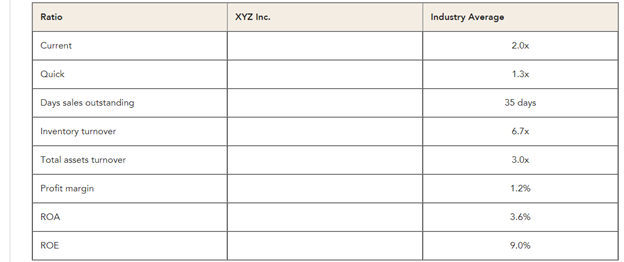
Using the XYZ Balance Sheet and Income Statement linked in the Resources and the table provided below, complete the following for XYZ Inc.:

  1. Calculate the indicated ratios for XYZ.
  2. Construct the DuPont equation for both XYZ and the industry.
  3. Use your analysis to outline XYZ’s strengths and weaknesses.
  4. Say XYZ had doubled its sales as well as its inventories and common equity during 2013. Do you think this would this affect the validity of your ratio analysis? No calculations are necessary.

Want help to write your Essay or Assignments? Click here

Library Resources
  • Brigham, E. F., & Houston, J. F. (2016). Fundamentals of financial management (14th ed.). Boston, MA: Cengage.

Want help to write your Essay or Assignments? Click here

Revenue Forecasting Essay Paper

Revenue Forecasting
Revenue Forecasting

Want help to write your Essay or Assignments? Click here

Revenue Forecasting

Using the same hypothetical manufacturing company described above, address the following questions related to forecasting the performance of the company:

  • How would you forecast revenue, profitability, and asset management, such as inventory control and accounts receivable, for a hypothetical manufacturing company?
  • What ratios would you analyze?
  • What techniques would you use? Why?
  • What non-financial factors would be important in your analysis?

Use research from at least two references to support your ideas.

Use research from at least two references to support your ideas.

Revenue Forecasting

Want help to write your Essay or Assignments? Click here

  • Length: Your document should include 3–6 typed, double-spaced pages to cover all of the parts of the assessment. In addition, include a title page and references page.
  • Written communication: Written communication should be free of errors that detract from the overall message.
  • Style and Formatting: Apply APA style and formatting to cite your references.
  • Resources: You must use at least four references, at least two references supporting Part 2 and two references supporting Part 3.
  • Font and font size: Times New Roman, 12 point.
Library Resources
  • Brigham, E. F., & Houston, J. F. (2016). Fundamentals of financial management (14th ed.). Boston, MA: Cengage.

Want help to write your Essay or Assignments? Click here

Investment Analysis

Investment Analysis
Investment Analysis

Investment Analysis

Want help to write your Essay or Assignments? Click here

For this part of the assessment, imagine that you are looking into investing in a manufacturing company, such as a car company or a steel company. Your goal is to create a plan for determining the potential strength of an investment in the company (investment analysis) and determining how the company might perform over a selected period of years (forecast).

After considering a potential investment in this manufacturing company, address the following:

  • What are some of the qualitative factors that must be considered when selecting a company in which to invest?
  • What financial ratios would you examine, and why?
  • What non-financial factors would you examine, and why?

Use research from at least two references to support your ideas.

Want help to write your Essay or Assignments? Click here

Library Resources
  • Brigham, E. F., & Houston, J. F. (2016). Fundamentals of financial management (14th ed.). Boston, MA: Cengage.

Want help to write your Essay or Assignments? Click here