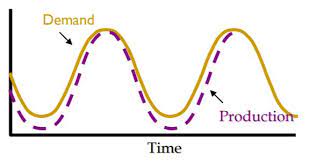
Chase strategy on the other hand involves the idea of companies balancing production capacity and the demand from time to time. This strategy can involve the hiring and firing of employees with changes in demand. The strategy may result to unhappy employees due to the high rates of layoffs (Olhager, 2013). However, many firms are able to save on costs since inventory can be held as low as possible.
From the given data, the cost breakdown when chase strategy has been used can be represented as below.
Month
Demand
Production
No. of Extra hired workers
Total cost arising from the added workforce (in $)
January
600
600
5
5,000
February
700
700
10
10,000
March
800
800
15
15,000
April
700
700
10
10,000
May
600
600
5
5,000
June
500
500
0
0
July
600
600
5
5,000
August
700
700
10
10,000
September
800
800
15
15,000
October
900
900
20
20,000
November
700
700
10
10,000
December
600
600
5
5,000
Totals
8,200
8,200
110
$ 110,000
When chase strategy will be used in this scenario, the demand of the products will coincide with the production level. This was due to the ability of the firm to hire new workforce that will ensure that there will be more production that meet the current demands of the consumers. Every extra employee can be able to produce 20 extra units every month.
Since there will be 110 employees who would be required to fill the gaps, then a total of $ 110,000 would be needed to compensate them. Since there will be 110 employees, each producing 20 units in a month, there will be a total of 2,200 extra units that will be produced by the extra workforce. This would not be the case when the level strategy will be applied. It is an added advantage and profit for the firm.
Level Strategy
Level strategy in production involves the kind of plan that seeks to maintain a stable production rate or employment level. Companies must either lower or raise inventory levels as they seek to satisfy the demands emanating from the consumers (Olhager & Johansson, 2012). When the demand is deemed to be low, the firm maintains a steady workforce and a constant rate of output.
Through doing this, the firm will be able to achieve a higher inventory level than the amount that will be presently needed. Even when the rate of demand is increasing, the firm still will continue to maintain a steady rate of production and still be able to use the surplus from the inventory as a means of handling the increase in demand. One of the alternatives used by the level strategy is the use of backorder or backlog (Bevly et al., 2016).
In this case, the firm may promise to deliver the units or products at later stages when they will be readily available. The level strategy is usually used by firms that aim to meet their demands while at the same time maintaining their output. When this strategy is used several issues come up. For instance, there is always the cost of excess inventory, overtime costs, as well as the loss of goodwill from consumers.
Month
Demand
Production
No. of Extra hired workers
Total cost arising from the added workforce
January
600
700 (200 from inventory)
0
0
February
700
500
0
0
March
800
500
0
0
April
700
500
0
0
May
600
500
0
0
June
500
500
0
0
July
600
500
0
0
August
700
500
0
0
September
800
500
0
0
October
900
500
0
0
November
700
500
0
0
December
600
500
0
0
Totals
8,200
6,200
0
0
For the level strategy, the production and workforce are fixed. Any extra units produces will be stored in the inventory awaiting the high season. The demand was 8,200 while the firm would produce only 6,200 units. There is a deficit of 2,000 units which will be needed to satisfy consumer demands. This is a massive loss in case this strategy was used. In case the company would have agreed to be flexible in their business activities, hiring workforce as well as increasing production would produce a positive change in the financial returns.
Conclusion
From the analysis, chase strategy seems more profitable than the level strategy. However, the concept of hiring and firing workforce seems unethical. From a firm’s perspective, though, the technique can be very valuable to produce grater profits than the level strategy. From an insightful perspective, a combination of the chase and the level strategy can be very effective in meeting organisational policies and goals. This can be termed as a hybrid or a mixed strategy approach. It can assist the firm to meet the required demand while at the same time lowering the costs as opposed to the use of pure chase or level strategies.
References
Bevly, D., Cao, X., Gordon, M., Ozbilgin, G., Kari, D., Nelson, B., & Redmill, K. (2016). Lane Change and Merge Maneuvers for Connected and Automated Vehicles: A Survey. IEEE Transactions on Intelligent Vehicles, 1(1), 105-120.
Olhager, J., & Johansson, P. (2012). Linking long-term capacity management for manufacturing and service operations. Journal of engineering and technology management, 29(1), 22-33.
Want help to write your Essay or Assignments? Click here
The importance of reputation to British American Tobacco
The importance of reputation to British American Tobacco
Introduction
BAT (British American Tobacco) is a multinational Tobacco organisation that has its headquarters in London and operates in approximately 180 countries across the globe (Vance, 2011). The company has had several controversies in the past, which have in a number of ways deteriorated its reputation (Vance, 2011). These include the; Canadian class action lawsuit, HMRC fine due to oversupplying, Australian lawsuit, bribery in Kenya, Burundi and Rwanda, and Pakistan lobbying efforts, among others (Freeman & Chapman, 2010).
However, the company has put several measures to rebuild good reputation, owing to its benefits in the current ever-changing business environment. This essay therefore discusses the importance of reputation to BAT and how health issues affect its operations.
The importance of reputation to British American Tobacco
Reputation refers to opinions and perceptions that people, or customers have about a specific entity. BAT can enjoy many benefits for having a good reputation. To start with, a good corporate reputation is important for BAT because the company can use it as a promotional and marketing tool. In reference to Diermeier (2011), customers always remember unique or outstanding services and products, and they never forget or forgive products or services that fail to satisfy them.
However, if BAT products, for example, satisfy the needs of its target audiences, then these audiences can act as unofficial spokespersons of the company by convincing their friends and relatives to try the products. As such, it can be concluded that a good corporate reputation can reduce the advertising costs of BAT because the company does not need to spend a lot of money on employing or seeking services of agencies of advertising to convince its target audiences.
Moreover, with a good reputation as an already established brand, consumers of tobacco are more likely to prefer being associated with BAT, an indication that a good reputation can act as a promotional and marketing tool for BAT.
Secondly, according to Morphet (2015), a good reputation enhances integrity and credibility. Acknowledging that reputation describes its identity or organisation culture, BAT can become a credible organisation, and prove its integrity whenever people talk negatively about its products or services. This implies that instead of spreading bad reviews and warnings about the company’s products, customers can recommend and promote BAT’s businesses.
Thirdly, a good corporate reputation establishes confidence, trust, superb customer relationships and loyalty (Diermeier, 2011). BAT can enjoy this benefit by avoiding all sorts of controversies and scandals. However, in reference to Morphet (2015), achieving untainted reputation is not about avoiding scandals and controversies; it is more of satisfying the needs of target audiences.
As such, by building a good reputation through observing continuous perfection, BAT can earn a strong sense of security. This implies that the company’s customers can be assured that they will always get satisfactory results if they consume BAT’s products.
Fourth, having good reputation enables an organisation to increase its business opportunities (Komisarjevsky, 2012). As such, having a good reputation can enable BAT to not only attract customers, but also catch the attention of interested business partners and investors. In other words, having a good reputation can help BAT to generate many possibilities for expansion and growth of its business.
Moreover, according to Komisarjevsky (2012), a good reputation can enable a company to survive in a highly competitive market. This implies that with a well-established reputation, BAT is likely to lessen its worries about customers switching to other tobacco providers. This is because the company’s outstanding reputation can make consumers to prefer its products regardless of how expensive they might be because they trust that the products can satisfy their needs.
From a different perspective, Morphet (2015) postulates that a good reputation is important to the careers of CEOs. As such, by having a good reputation, the CEO of BAT is likely to benefit because it is likely to evaluate the CEO’s performance, and make necessary changes. This is because the reputation of an organisation is directly linked to the performance of a CEO (Komisarjevsky, 2012).
Megatrends in Tobacco industry: Health Issues surrounding BAT
Health issue is one of the megatrends in the tobacco industry, which affect BAT’s business operations (McInnes & Lee, 2013). This issue can be discussed further by looking at how regulation, legislation, education, among other factors affect the operations of BAT across the globe. With regards to regulation, World Health Organisation (WHO) drafted a convention on tobacco control measures to ensure high health standards (Lueddeke, 2016).
This convention acts as a regulatory strategy, which not only addresses the addictive tobacco substance, but also promotes awareness of the side-effects the consumption of tobacco has on human health (Miller & Cross, 2014). It holds that tobacco creates a global health epidemic, and this has resulted in many governments across the globe developing a series of restrictive measures such as standardised packing, and bans and warnings of consuming flavoured tobacco (McQueen, 2013).
Health-based regulations, for example, those requiring organisations to print messages such as ‘smoking kills’ or ‘smoking is harmful to your health’ on their packets, and banning of advertisements related to tobacco affect the competitiveness of BAT and other companies operating in the industry (McInnes & Lee, 2013). Additionally, the enactment of WHO convention regulations that are not evidence-based increase complexity and costs and interfere with the ability of tobacco companies (Proctor, 2012).
Education is another factor linked to the health issues in the tobacco industry. Public education and awareness of the health issues of tobacco consumption continues to increase in all parts across the globe (Lueddeke, 2016). For instance, the well-financed anti-smoking education programmes in schools, social media, and societies provide emotionally engaging, detailed, and prominent information about the hazardous effects of smoking tobacco, thus, reduce the demand for tobacco products (McQueen, 2013).
Such programmes also warn target audiences that tobacco companies entice people to smoke their products through different types of advertisements (Freeman, Hawkes & Bennett, 2014). However, some companies in the industry have been in the forefront in sponsoring programmes associated with youth drinking as a way of building their reputation in the public eyes and minds (Proctor, 2012).
This includes partnering with governments and less sophisticated public health groups, and this has enabled them to reduce the opposition of their industry operations in different regions (McInnes & Lee, 2013). This clearly indicates that their purpose is not to reduce youth smoking, but instead serve the tobacco industry’s needs, for example, marginalisation of public health advocates, control of harsh regulations on them, participation in policy making, and diffusion of opposition from educators, among others (Lueddeke, 2016).
In other words, it is evident that in the current tobacco business world, despite the increasing efforts in anti-smoking education and public awareness, little success has been achieved from the anti-smoking campaigns. This indicates that the demand for tobacco companies’ products is still on the rise.
With regards to legislation, many health-related laws have been adopted pursuant to the Tobacco Act by governments across the globe to control the sale, manufacturing, labelling, promotion, and consumption of tobacco (McQueen, 2013). However, public consultations are pursued whenever new laws are developed (Freeman, Hawkes & Bennett, 2014).
One of the new laws regulating the tobacco industry is Tobacco Products Labelling Act which stipulate the health-related labels that must be displayed tobacco products. This law reduces the smoking rates, thus reducing the demand for tobacco products of BAT and other companies in the industry (Lueddeke, 2016). Additionally, the 2010 Prevent All Cigarette Trafficking Act, which some of its acts is still under litigation prohibits mailing of tobacco products and requires mail order and sales retailers to comply with requirements pertaining age verification (McInnes & Lee, 2013).
For instance, this law requires retailers to pay appropriate taxes for tobacco products. However, due to health concerns, many governments across the globe have and continue to raise taxes associated with tobacco business pursuant to Tobacco Act (Proctor, 2012). This law not only reduces the demand for tobacco products from companies such as BAT, but also increases the price of tobacco products and restricts companies from expanding to countries with stringent tobacco laws (Miller & Cross, 2014).
However, despite taking appropriate health-related measures through regulations, legislations, and education or public awareness, the issue of tobacco addiction still remains a difficult issue to solve in many countries across the globe (McQueen, 2013). The addicted victims continue to boost the tobacco business because they can do without it.
However, most governments across the globe have taken effective rehabilitation measures to counter the issue of tobacco addiction, which in a number of ways have proved to be successful (McInnes & Lee, 2013). Therefore, the issue of health reduces the demand of tobacco products, thus, reduces growth and expansion of BAT and other companies operating in the tobacco industry.
Conclusion
The benefits of reputation to BAT include; reduces the advertising costs, enhances integrity and credibility, establishes confidence, trust, superb customer relationships and loyalty, enables an organisation to increase its business opportunities, and is important to the careers of CEOs. Regulation, legislation, education, among other factors affect the operations of BAT across the globe. These factors reduce the demand for tobacco products, thus, restrict the growth and expansion of BAT in its global tobacco business.
Freeman, B., & Chapman, S. (2010). British American Tobacco on Facebook: undermining article 13 of the global World Health Organization framework convention on tobacco control. Tobacco control, 19(3), e1-e9.
Freeman, M. D. A., Hawkes, S., & Bennett, B. (2014). Law and global health. Oxford, United Kingdom: Oxford University Press.
Komisarjevsky, C. (2012). The power of reputation: Strengthen the asset that will make or break your career. New York: American Management Association.
Lueddeke, G. R. (2016). Global population health and well-being in the 21st century: Toward new paradigms, policy, and practice. New York: Springer Publishing Company.
McInnes, C., & Lee, K. (2013). Global Health and International Relations. New York, NY: John Wiley & Sons.
McQueen, D. V. (2013). Global handbook on noncommunicable diseases and health promotion. New York, NY: Springer.
Miller, R. L. R., & Cross, F. (2014). The legal environment of business. Australia: South-Western.
Morphet, J. (2015). Applying leadership and management in planning: Theory and practice. Bristol, UK: Policy Press.
Proctor, R. (2012). Golden holocaust: Origins of the cigarette catastrophe and the case for abolition. Berkeley: University of California Press.
Vance, B. (2011). BAT British American Tobacco. Oxford University Press.
Want help to write your Essay or Assignments? Click here
Low-caloric foods which have already been frozen and can be warmed in a microwave have over the recent past continued to receive wide acceptance by consumers prompting many big food manufacturing companies to embark on expansion strategies both in the production potential and market share (Wall & Griffiths, 2012). The economic aspect in the demand estimation of the firm’s food for managerial and marketing decisions is to be covered in this paper.
The basis of the assignment is on focused on two regression models or equations highlighting two marketing options, and the data used in the demand estimation is for the month of April from 26 supermarkets that sell the firm’s foods. Thus, for effective marketing decisions to be made it becomes inevitable to adopt a multifaceted approach by considering a wide range of factors that have potential to influence the demand and supply of the firm’s foods (Frank, 2013; Samuelson & Marks, 2013).
Calculations
In demand estimation, it is very imperative to apply analysis of demand in managerial economics to achieve the biggest market share possible (Sullivan & Sheffrin, 2013; McGuigan, Moyer & Harris, 2014; Metcalf, 2015). The demand estimation of either a single a multiple products in the market are very essential to provide a firm’s management as well as marketers with necessary market insights (Frank, 2013; Metcalf, 2015).
This is a very important step in devising and planning for an appropriate marketing strategy based on informed decisions that are data based as evidence (Frank, 2013; Sullivan & Sheffrin, 2013).
For the first option, the regression equations or model used in the calculation of the firm’s demand elasticities as well as the allowable standard errors and regression statistics are shown below:
Elasticity Implications
The implications of elasticity have far reaching effect on the quantities demanded as well as supplied in a market (Pettinger, 2012). According to Samuelson and Marks (2013), reiterate that this is because it provides important insights on demand estimation and making vital marketing decisions on whether the firm should embrace a discounting strategy or increasing or decreasing prices for its foods for increased generation of revenue.
Elasticity implications are a true manifestations of the law of demand to determine market equilibrium, whereby this phenomenon concurs with the law of demand and market dynamics, which outlines that demand is inversely related to prices whereby the former increases with a decrease in the latter and vice versa (Wall & Griffiths, 2012; Samuelson & Marks, 2013).
According to Frank (2013), calculation of elasticitiees allows the determination of the nature of demand in the market whether it is elastic or inelastic and also if it is absolute or in absolute value so that the sensitivity of consumers to prices can be established for an appropriate pricing strategy to be devised. The calculated elasticity values are shown in the table:
Pricing Recommendations
The firm’s price demand elasticity obtained through calculations is a 1.19 absolute value, which means that it is elastic. According to Wall and Griffiths (2012), this elasticity implies that price discounting is definitely that more appropriate marketing strategy that the firm can adopt. This is mainly because, this strategy has a very high potential to optimize market expansion and increase sales significantly (Frank, 2013).
This means that, by the firm reducing the prices of its foods, a significant influence of the foods supply and demand as well as sales levels. As a result, income elasticities of 1.62 and 1.11 are obtained through demand estimation calculation for both option 1 and option 2 respectively, which means that both are elastic an indication that the is a significant influence of the quantities demanded by consumers based on per capita income (Wall & Griffiths, 2012; Metcalf, 2014).
Therefore, in a market where consumers’ sensitivity to changes in prices is high because of their per capita income provides the company with an effective economic condition to embrace reduction of prices or provision of discounts in order to increase sales (Pettinger, 2012; Metcalf, 2015).
The Demand Curve
The firm’s calculated demand and supply based on the changing factor, that is, the price as well as the plotted firm’s demand and supply curves assuming that, apart from prices all other factors that affect the foods’ demand remained constant. Therefore, firm’s food prices utilized in plotting demanded and supplied food quantities of the firm are increasing at a fixed interval of 100 cents between 100 and 600.
Equilibrium Price and Quantity
According to Wall and Griffiths (2012), the determinant of market equilibrium is the relationship between the market demand and market supply. For instance, the market equilibrium for the food prices of the firm foods obtained through calculations is equivalent to the equations quantity supplied and for quantity demanded. Therefore, the intersection at where the two curves meet is referred to as point P, and which at the market equilibrium price value of 384.48 (Frank, 2013; Metcalf, 2015).
The most significant factors that can cause a shift in demand as well as supply curves are prices and income per capita within the region considered for statistical analysis of market dynamics (Wall & Griffiths, 2012). For instance, when the prices of the firm’s foods is decreased by 300 cents from 500 cents to 200 cents, an inelastic demand of 0.44 in demand elasticity results leading to an increased supply of demanded units of the firm’s foods by 284,400.
According to Wall and Griffiths (2012), this phenomenon concurs with the law of demand and market dynamics, which outlines that demand is inversely related to prices whereby the former increases with a decrease in the latter and vice versa. Alternatively, there is a likely for the supply and demand curves of firm’s foods to be shifted by consumer income whereby decreasing consumer income levels, especially during a recession leads to an outright decrease in demand (Pettinger, 2012; Wall & Griffiths, 2012).
In conclusion, it is evidently clear that demand regression equation calculations are an ideal technique for the estimation of demand in the market for food products and in particular low-calorie and microwavable foods. Therefore, these calculations and modeling as well as demand plots can be can be a very important way through which informed marketing decisions can be made. However, it is also imperative to consider other factors that inform purchasing decisions in order to come up with an appropriate marketing strategy for the expansion of the firm’s market share as well as continue gaining more market competitiveness.
References
Frank, R. (2013). Microeconomics and Behavior, (7th ed.). New York, NY: McGraw-Hill.
McGuigan, B. P., Moyer, R. C., & Harris, F. H. (2014). Managerial economics: Applications, strategies and tactics, (13th ed.). Stamford, CT: Cengage Learning.
This report will analyse the Adidas Company. This report provides an analysis and evaluation of effective marketing planning process, techniques for controlling marketing activities, contemporary marketing techniques, and their use in global and international markets. Furthermore, the report examines the skills of marketing managers and their role in the effective management of the marketing team, value of a brand from a number of different stakeholder perspectives, and the organisation’s marketing campaigns in different international markets.
Methods of analysis will include SWOT analysis, marketing controls, and international marketing trends. Results of analysis depict that Adidas has abundant opportunities and strengths, but suffers from a number of weaknesses and threats. The report finds that Adidas has taken advantage of its strengths and opportunities to develop effective marketing plans that have assisted them to achieve their marketing objectives.
The Adidas Company has adopted marketing controls, such as annual control, profitability control, and strategic control that have helped in spotting deviations in its marketing activities and provided timely remedies to the variations. Adidas has implemented contemporary marketing techniques, such as email marketing, PR marketing, mobile marketing and the use of social media that have assisted in growing awareness of its new products in different international markets.
Marketing manager skills, such as excellent communication skills, problem solving skills, and project management skills are noted to be vital in offering effective management to marketing teams. Stakeholders, such as employees, suppliers, and customers play a significant role in influencing the value of the Adidas brand. The various stakeholders participate in building the brand equity.
The Adidas has tailored its marketing campaigns to suit the different international markets. The company uses local athletes from various countries and influencers of markets to promote its new products, X 15 and ace 15 in different international markets. The report recommends that Adidas should design products that are affordable to several customers and implement marketing techniques that promote and differentiate its products from its competitors.
Introduction
The purpose of this report is to analyse the effective marketing planning processes and evaluate techniques for controlling marketing activities of the Adidas Company. This report also studies the contemporary marketing techniques and their use in global markets, examines skills of a marketing managers, and evaluates their role in providing management to the marketing team. Furthermore, this report assesses the impact and value of the Adidas Company brands from diverse stakeholders perspectives. In addition, this report looks into the marketing campaigns the Adidas Company has employed in different international markets.
The competitive global market calls for companies to plan their marketing activities, establish their strategies and accomplish their objectives more effectively. The contemporary marketing techniques aim to create a link between the customer and the organisation. Companies attract customers through social media content significant to their needs or writing newsletters that have valuable information.
Businesses that employ contemporary marketing techniques are seen to be successful in achieving their objectives than those companies that rely on conventional marketing techniques. The report will utilise references from the company website and other research articles. Besides examining the Adidas Company marketing strategy, this report will look at modern strategies that the company can utilise to expand its international markets.
Effective marketing planning process
Companies in all industries require marketing plans to succeed. Effective marketing planning process offers companies guidelines on how to market and trade their new products in the market within a specific period. The marketing plans guides the company in choosing an appropriate target market and then fulfill the customer needs in that segment. Moreover, the marketing planning process establishes the promotional strategies that can boost the sales volume of the company products.
The Adidas Company is an international corporation that designs and fabricates sports shoes, outfits, and accessories. The company is a leading sportswear in Europe and the global market. The Adidas Company has adopted a three divisional structure for its Adidas brand. The divisions include sport performance, sport heritage, and sport style. The adidas sport performance division centers on novelty, functionality, and design.
Furthermore, the division designs products for sports performance market, but have design appeal that pushes the consumers to wear the products off the playing field. The adidas sport heritage division includes adidas original products that aim to expand the exclusive and valid heritage of adidas to the lifestyle market. The sport style division is a fashionable assortment that consists of men’s and women’s shoes, clothing, and accessories.
The division targets young consumers who are looking for fashion-oriented sportswear products. The three divisional structures assist the Adidas Company to design and market innovative products, which satisfies the needs of varied customers. The Adidas has introduced new products like X 15 and Ace 15. X 15 is designed for players who control and bringing order to a chaotic game, while Ace 15 is designed for players who cannot be controlled.
Therefore, the Adidas Company requires an effective marketing planning process that would establish a target market for its new products and formulate plans of marketing its products and fulfilling the needs of that market. The marketing planning process is achieved through five fundamental steps. The five steps include objective and goal setting, assessing organisational resources, evaluating risks and opportunities, developing marketing strategy, and implementing and monitoring marketing plans (Adidas 2016).
Objective and goal setting
This initial stage of marketing planning process includes setting of goals and objectives the company wants to achieve. The company should link the marketing plan with its mission statement and determine the primary target audience. Moreover, the company should establish the profit margin it wants to achieve after implementation of the marketing plans (Social care institutes for excellence 2013).
The Adidas Company has developed a global brand in sporting products industry by designing quality new products that seeks to fulfill the expectations of customers. The Adidas Company has developed objectives that will assist the company to expand the global market of its new products. The company objectives include market penetration, which would aid in attaining market share in the global markets that the company competes.
The market development objective will enable the company to capture new business markets and respond to the needs of customer segments. In addition, the product awareness objective would offer visibility and realization of the company new products. The company objectives conform to its mission statement that states that the Adidas Company endeavor to be the global leader in sporting products industry with brands built on passion for sports and a sporting lifestyle (Chartered Management Institute 2015).
Assessing organisational resources
Marketing plans are influenced by internal factors, such as organisational resources. The organisational resources include capacity in manufacturing, advertising, finance, and technology. Assessment of these resources will enable organisations to locate their strengths and limitations. Strengths aid organisations to develop objectives, establish plans for accomplishing objectives, and gain from marketing opportunities. On the other hand, resource limitation might hold back an organization from benefitting on marketing opportunities (MLF4 2012).
The Adidas Company has several strengths that assist it to achieve its objectives. The company has strong financial position that is attributed to its several stores around the globe that make the company to achieve a profit of billions of dollars annually. The company trades its products from company owned stores, online stores, and supermarket stores. The effective distribution system enables the company new products to be available through diverse channels. The Adidas Company has increased consciousness of its new products through supporting major sports organisations, such as UEFA, NBA, world cup, and Olympics. The Adidas Company has uitilised YouTube to create videos that promote consciousness of its new products. Moreover, Adidas created videos that used David Beckham to promote its new products X 15 and Ace 15 (Nadeau et al. 2015).
However, the company has some limitations that prevent it from taking advantage of marketing opportunities. The company faces a risk of over dependency on outsourcing. The Adidas Company has subcontracted a bigger percentage of its production to third party manufacturers, such as Asia to benefit from easy accessibility of raw materials and fair labour cost. The premium prices of X 15 and Ace 15 sporting shoes due to inventive technology and manufacturing techniques have made the products exorbitant to deprived customers, particularly in developing countries (Adidas 2015).
Evaluating risks and opportunities
Nevertheless, the company has myriad of opportunities that will aid in fulfilling its marketing plans. The shifting lifestyle, taste, and preferences of rising economies have increased demand of premium brands. Furthermore, the company can extend its product line that will unlock new opportunities and attain an edge over its rivals through differentiation. In addition, the Adidas Company can integrate backwards that will aid in protecting their patent rights and combine their research and development division with the operational division in order to enhance brands innovation and development (Teach a man to fish 2014).
Nonetheless, the Adidas Company faces threats that might influence its marketing plans. Despite Adidas being a global brand, it still faces strong competition from other premium brands, such as Nike. Moreover, local companies and substitutes provide standard competition to Adidas brands. The over dependency on outsourcing its production has made supplier to have more bargaining power than the company (Institute of Risk management 2013).
Developing marketing strategy
Marketing strategy assist organisations to win market shares and converse to target market the advantages and aspects of a new product. Furthermore, the marketing strategy communicate the general value to their customers (Planning effective marketing strategies 2013).
The Adidas Company utilizes online marketing and other promotion campaigns to communicate their legacy of innovation and technology to customers. The company uses celebrities in its online marketing. Adidas use players like Mesut Ozil to promote its Ace 15 sporting shoes. Adidas argues that Ace 15 is built to control and suited to players like Mesut who bring order to a chaotic game. On the other hand, Adidas use players like Gareth Bale to promote its X 15 sporting shoes. The X 15 is built to give thorough traction to energetic and agile players in the world. The Adidas has adopted sports marketing through sponsoring sporting events that offer many opportunities to the company, such as new products promotion and brand consciousness. In addition, the Adidas utilises search engine optimization (SEO) tools to optimize its website by considering the key words used by people in search engines. The strategy has generated high consumer traffic for Adidas. Furthermore, Adidas place banner advertisements on other webpage that has promoted awareness of its new products (Khankaew et al. 2015).
Implementing and monitoring marketing plans
After developing the marketing plans, organisation follow the steps outlined in the plan towards achieving the stated objectives. The organisation provides continuous assessment to evaluate whether adopted strategies are achieving the objectives and goals. The Adidas Company stresses flexibility when implementing their marketing plans. The environmental opportunities and threats might not match with the company expectations. Shift in consumer demand, extension of distribution channels, and changes of supply costs might influence the outcomes, thus should be included into the monitoring of the plan (MLF4 2012).
Needs and techniques for controlling marketing activities
For Adidas Company to effectively control its marketing activities should adopt control systems that provide standards for assessing performance in each division of marketing. The outcomes of marketing departments, such as interactive advertising and marketing research department cannot be evaluated by similar standard because they are not similar. Hence, Adidas should implement control system that has matching standard for each department.
Furthermore, effective control system should be able to discover variation and report them to the management. The control system should also recommend possible remedies that can correct the deviations. In addition, the control system should be easily understandable by employees and cost-effective to the organisation. A control system that is customized to Adidas specifications provides comprehensive information that is significant to the company line of business (Adidas 2015).
Annual plan control
Annual plan control assists Adidas to evaluate its current marketing activities and outcomes to ensure that the yearly sales and profit objectives are attained. The annual plan control detects any variations on the performance of its X 15 and Ace 15 products and suggests possible corrective actions. The annual plan control utilizes tools, such as sales analysis, market share analysis, market expense analysis, and financial analysis to evaluate marketing activities and detect any deviations (Adidas 2015).
Profitability control
Profitability control helps Adidas Company to establish the definite profitability of its X 15 and Ace 15 products, market segments, and distribution channels. The information generated from profitability control will influence the company decision on extension, reduction, or deferment of its marketing activities.
The profitability control will identify the functional expenditure, allocate the functional expenditure to the marketing entities, and prepare income statement for every marketing entity. Therefore, the profitability rely on the of sales and marketing cost analysis in determining the profitability and expenditure of the marketing entities (Adidas 2015).
Efficiency control
The efficiency control aids the Adidas Company to enhance the effectiveness of its marketing activities, such as video marketing, network marketing, and blogging. The efficiency control assesses and reduces the marketing expenses of the marketing activities. Efficiency and profitability control are closely connected. Higher profits signify efficient management of the marketing activities (Adidas 2015).
Strategic control
The strategic control ensures that Adidas marketing objectives and strategies are suited to the present and predicted marketing environment. Furthermore, the strategic control will evaluate if the company is pursuing the opportunities presented by the distribution channels, products, and markets. T
he company management should continuously utilize the strategic control because the continuously shift in marketing environment might render the company objectives, strategies, and policies obsolete. Moreover, the strategic control examine the company marketing efficiency by employing tools, such as marketing audit and marketing effectiveness ranking appraisal (Adidas 2015).
Contemporary marketing techniques and their use in Global and International markets
Companies seek to expand their market share by venturing into global markets that are unsaturated and that offer the companies with several growth opportunities. Companies use contemporary marketing techniques to promote their new products in international markets. Most companies recognize they have limited markets when they concentrate in their local markets.
Hence, companies respond by looking international opportunities to raise their market share and customer base. The emergence of technology that crosses both cultural and national boarders presents the companies with the opportunity of utilizing technology to promote their products in global markets.
Moreover, the technology has resulted to development of contemporary marketing techniques, such as email marketing, social media, blogs, and public relation marketing that aid companies to market in global and international markets. Adidas Company has responded to customer migration to online world by embracing email marketing to promote its new products. Adidas utilizes email marketing to connect with current and prospective customers (Direct Marketing Association 2014).
Public relation marketing increases the awareness of the new products offered by Adidas and advances the company reputation in the media. The public relation marketing also publicizes new products introduced to the market by the company. The PR is responsible of writing press releases, newsletters, and speaking about the organisation in public meetings, which help in promoting the image of the company (Introduction to Public Relation 2012).
Social media sites, such as face book, and twitter offer Adidas exclusive opportunity to interact with customers and promote its new products. Adidas has utilized social media networks to increase consciousness of its new products, X 15 and Ace 15.In addition, studies suggest that companies who participate in social media platforms and mobile marketing enjoy higher loyalty from their customers.
Moreover, Adidas has embraced mobile marketing by acquiring an Australian fitness app maker, Runtastic. The app maker have over 130 million downloads and 75 million registered members globally, and is offered in 17 languages, thus giving Adidas a platform to market and promote its new products (Mobile Marketing Association 2014).
Adidas has shifted its bulk of its marketing budget into online marketing through focusing on instantaneous content and online video. The company has developed Adidas’ digital newsroom that aid in promotion of its new products. The brand newsroom aid the company to create quality contents that is unique and form emotions. Furthermore, the digital newsrooms create content that is tailored to its audience and it is delivered promptly and to the accurate standards (Adidas 2015).
Marketing manager skills and their role in the effective management of the marketing team
Technology advancement has altered the role of marketing to a point that the duties of present marketing managers vary significantly from those of some years ago. Nowadays marketing managers should understand how trends, technology, and social media work in the marketing mix. However, there are essential skills that marketing manager must possess to enhance their management and performance of marketing roles.
The Adidas Company success greatly depends on the effective management of its marketing managers to devise strategies that enhance new products promotion and increase sales. The marketing manager should possess excellent communication skills and create open and operating channels of communication. Strategic thinking is a vital skill that assists marketing managers to reflect and solve challenges with exceptional perspectives.
Furthermore, the marketing manager is able to make decisions based on long-term viewpoint and recognize how to handle the exclusive needs of each member participating in the project. The marketing managers are faced with the need to handle challenges from clients, team members, and the management. Excellent problem solving skills enable the marketing manager to handle swiftly the challenges from the three stakeholders.
In addition, the marketing managers are required to hone their project management skills to guide their teams in realizing their objectives and taking advantage of social media opportunities (National careers Service 2012).
Marketing managers play a vital role in providing effective management to their marketing teams. The marketing managers develop departmental targets and individualize them for each departmental staff. Moreover, they demonstrate how the individual targets would assist the department and the organisation as whole.
The marketing managers also identify the distinctive behavior of the team members and encourage them to achieve their targets by utilizing their unique traits. In addition, the marketing managers conduct performance appraisal of their marketing teams and congratulate them in departmental meetings when their transitional targets are achieved. This strengthens the significance on their individual capacities (National careers Service 2012).
Impact and value of a brand from a number of different stakeholder perspectives
Brand equity can enable companies to set premium prices to their products because customers believe that products with famous names are better than products with unrenowned names. Customer-based brand equity results when customers recognize the brand and hold exceptional brand association in their mind. Adidas has positioned itself as a premium brand and customers are willing to pay more for its products. The positive customer-based brand equity has offered Adidas long-term revenues and capability of charging premium prices for its new products (Angulo-ruiz 2014).
Employees play vital role in developing brand equity. Adidas recognizes its employees as major stakeholders in building the value of its brand. Adidas involves their employees in decision-making process and boost their satisfaction in order to attract the best talent that would help in designing new products. In addition, suppliers aid companies to have excellent reputation in the market. The brand equity of the Adidas Company assists in attracting reliable suppliers who might not be willing to render their services to unbranded firms (Cornell University ILR School 2013).
Organisations marketing campaigns in different international markets
The competitive environment prompts companies to develop marketing campaigns that will increase the brand consciousness and sales. However, due to diversity organisations should tailor their marketing campaigns to suit the international audience when expanding to international markets. The Adidas Company has used different marketing campaigns to promote its X 15 and Ace 15 products in different international markets.
The Adidas has promoted its new products in the US market by utilising online marketing that feature top players of National Hockey League (NHL) and National Football League (NFL). Moreover, the company has initiated major basketball marketing campaigns that resulted to a significant increase in its sales. The online purchasing has made it easy for consumers to purchase products directly from manufactures.
Adidas has adopted online purchasing by placing links on other websites like Google homepage that create high consumer traffic to the company website. The links help to promote product awareness to potential consumers. Furthermore, use of SEO tools to optimize the company website has made it visible to new consumers (Tesseras 2014).
The Adidas has used the Chelsea FC’s players and collaborated with the British Paralympics Association to promote its new products in the UK market. This year Adidas launched a marketing campaign dubbed I am here to create that comprised a sequence of films that featured several sporting celebrities. The marketing campaign aired in fifty countries during broadcast of UEFA champion league and the Grammys awards.
In China market, the campaign featured the local players that have the power of influencing the market. The marketing campaign helped to promote the X 15 and Ace 15 sporting shoes that Adidas launched to the market. Adidas has embraced Web public relations (WPR) by placing news of product or service launches on company’s website and review sites for consumers to read. Furthermore, Adidas uses direct e-mail for its online promotion. Both WPR and direct e-mail have helped adidas in promoting its new products to consumers (Department for culture, media, and sport 2012).
Conclusion
A company success is greatly attributed to the effective role played by is marketing function. Adidas effective marketing planning has guided the company to develop business activities that helps in achieving its organisation objectives. Marketing control systems have aided Adidas to assess its marketing activities and offer swift remedies to detected deviations. The Adidas Company has embraced contemporary marketing techniques, such as social media that have significantly enhanced its new products awareness. Furthermore, the Adidas marketing techniques that are tailored to different international markets have been successful in promoting its new products.
Recommendation
Customers are noted to be satisfied with the design and durability of the Adidas products, however in aspects of price; Adidas should design products that are affordable to deprived customers, especially in developing countries. Moreover, the company can provide special offer of price in a certain period to boost its sales and attract more customers. In addition, Adidas should develop more marketing campaigns and techniques that promote and differentiate its brands from competitors.
Online marketing,Top player brand ambassadors,Sponsoring teams
References
Angulo-ruiz, F., Donthu, N., Prior, D. & Rialp, J. (2014) ‘The financial contribution of customer- oriented marketing capability’, Academy of Marketing Science [online] 42 (4), 380-399. Available from [17 October 2016]
Institute of Risk management (2013)A risk management standard [online] available from <https://www.theirm.org/media/886059/ARMS_2002_IRM.pdf> [17 October 2016]Khankaew, C., Ussahawanitichakit, P. & Raksong, S. (2015)A CONCEPTUAL FRAMEWORK OF ALTERNATIVE MARKETING STRATEGY AND MARKETING OUTCOMES‘Allied Academies International Conference’ Academy of Marketing Studies [online] 20(2), pp. 1-16
Mobile Marketing Association (2014) ‘MMA and adidas publish The Mobile Marketing Playbook to Drive Global Marketing Efforts’Marketing WeeklyNews [online], pp. 179
Nadeau, J., O’Reilly, N. & Heslop, L.A. (2015) ‘Cityscape promotions and the use of place images at the Olympic Games’Marketing Intelligence & Planning[online] 33(2), pp.147
Planning effective marketing strategies for a target audience– Adidas (2013) Business Case Studies LLP, London [online] available [17 October 2016]
Opportunity costs stem from trade-offs that exists as a result of scarcity of resources. It is necessitated by decisions to make choices between one or several options that must be given up for one alternative to prevail (Bouman, 2011). Opportunity cost in economics is the costs of the opportunity missed as a result of the alternative given up. It can be expressed in monetary terms or in any other terms of time and it includes both implicit and explicit costs (Mankiw, 2014).
The opportunity costs of watching Good Times are the costs that would be forgone as a result of the choice made to watch Good Times in concert. The alternative costs of watching Good Times are watching the Hot Stuff that basically costs $150 as the entry fee besides the time required to drive to the concert. The implicit and explicit costs of watching Hot Stuff have been valued at $225 while other costs include the hours needed to drive to the location to watch the Hot Stuff concert.
Since the explicit costs have been estimated to be $150 then the implicit costs would be $225 – $150 which equals to $75. The opportunity cost of watching Good Times can be estimated to be $75. But the cost of the hours that would be forfeited in case of travelling to watch the Hot Stuff would also have to be considered. The hours required to prepare for the exam are also valuable and the choice of watching Good Times means that those valuable hours would be saved. The opportunity costs of watching Good Times is watching Hot Stuff.
Opportunity-cost analysis has a lot of practical applications in business operations as long as scarcity of resources exists. The value of the next second best alternative must be considered when deciding the product to be rolled up from the factory. Opportunity costs are never reflected on the Balance Sheet nor in the income statement but the costs are real and must be considered (Mankiw, 2014). The only problem is that quantifying opportunity costs is rather difficult as it relates mostly future events besides most people overlook it (Waggoner, n, d).
To conclude, the opportunity costs of making any decision is literally what is given up as a result of the decision. Opportunity costs are made up of implicit and explicit costs. In economics, profits are calculated based on opportunity costs while in accounting, only explicit costs are used. It is worth noting that opportunity costs is the value of the best alternative, for example the opportunity costs of going to college would be the wages that may have been earned, or the value of the experience that would have been gained or the value of all the activities that one may have missed while studying, or the money paid for tuition or the interest that would have been earned.
The opportunity cost is the value of one alternative not the value of all the aggregate hence the opportunity costs would be one of the most valuable alternative listed. Due to scarcity, resources are limited and only one alternative among many others must be selected. Either the time or the income is always limited due to scarcity hence the opportunity cost in economics is the costs of the opportunity missed as a result of the alternative given up.
References
Bouman, J. (2011). Principles of Microeconomics, Columbia, Maryland.
Mankiw, N. G. (2014) Principles of Economics, Cengage Learning
During this era of digital advertising, podcasting has undoubtedly become a substantial channel through which consumption of digital content take place (McNurlin, 2009). An example of using a podcast as an advertising tool include the use of Apple iTunes app through which advertisers can upload their promotional media clips that are viewed by subscribers as they stream their preferred digital content (O’Brien, 2013).
The possible revenue model of podcasting would be through subscriptions whereby a fee is paid, and the difference between podcast and traditional advertising is that the former is based of digital content consumptions (McKeen & Smith, 2014). Some examples of mobile applications possible for use in podcasting include Apple iTunes app, Oracle, IBM among others.
Podcasts allows brands to communicate to a captive audience. With lifestyle on-the-go, the power to have the podcasting on demand allows companies and brands tell their story anywhere at any time, which helps to establish authority in your industry and create advocates brand along the way.
You can use podcasts to assume a greater engagement to your current and potential customers, providing an email address associated with the podcast where people can respond directly to the content. This will also give you material for new content. In the next episode you can answer questions or deal with the feedback you received.
References
McKeen, J. D. & Smith, H. A. (2014). Making IT Happen: Critical Issues in IT Management, Wiley Series in Information Systems. New York, NY: Prentice Hall.
McNurlin, B. (2009). Information Systems Management in Practice (8th ed.). New York, NY: Prentice Hall.
O’Brien, J. (2013). Management Information Systems: Managing Information Technology in the Internetworked Enterprise. Boston, MA: Irwin McGraw-Hill. ISBN0-07-112373-3
In the modern world, there exists stiff competition in the global business arena on the perception of the entrepreneurial marketing. Recently, many organizations work in business environments that consist of increased uncertainties, reduced ability to foresee, fluid companies and industries jurisdictions. The competitive advantage has also been featured by the major factors such as contradiction, chaos, complexity, and change. These factors have the significant impact on marketing in an international know-how economy where clients are becoming tougher.
What appears to be apparent to the readers or researchers about the traditional marketing activities is where they are not in a position to opposite for entrepreneurial companies competitiveness amidst antagonism. Therefore, it can be noted that entrepreneurial marketing is view as a paradigm that combines certain aspects of the entrepreneurship and marketing into a comprehensive theory where marketing turn out to be a procedure used by the organizations to conduct themselves entrepreneurially.
There is a developing evidence to sustain the concept that organizations which are competitively advantaged are those which are betrothed like entrepreneurial marketing. That means that the marketing ways that are used by the entrepreneurs show the innovative orientations. The approaches vary in their connection or impact on the enterprise performances.
It becomes severe for a new business to comprehend the entrepreneurial marketing activities to apply and therefore it becomes significant to attain diversity of successful outcome and in due course for increased performances.
Lincoln marketing associates are described as the beehive of marketing operations, and it has been achieving a lot of concentration. Lincoln marketing associates top management and the working staffs use the innovative and creative marketing techniques to compete fairly in the market arena. Therefore the top management together with the workers requires taking on to the cord of conducts that guarantee the growth and application and development of the dimensions of the entrepreneurial marketing strategies.
The idea of entrepreneur marketing appears to have not been paid a lot of attention even if it is considered of great significance factor that counts in the development and extraordinary performances of the entrepreneurial companies. The general objectives of this essay are to discuss into details the dimensions of entrepreneurial marketing strategy.
Problem statement
The diversity in the competitiveness arena inside the marketing business environment has created competition for the companies to be terrible. The urge for an adequate comprehension of the entrepreneurial marketing strategies and the employment to the entrepreneurial organizations has continuously become a subject of vital concern to many researchers, employees and entrepreneurs of the business enterprises. The inadequacy of attention paid to the entrepreneurial features such as pro-activity, opportunity recognition and innovative poses a significant challenge to the Lincoln marketing associates.
The entrepreneurial pro-activity is serious to build an edge over the rivals. It entails the capability and the attitude that permits the control and the implementations of services, products or even the processes in front of the principal competitor in the global market within the same industry. On the contrary, entrepreneurial corporations are challenged with continuous dynamic changes in political, social, economic and technology thereby coming up with a congruent requirement to re-plan their entrepreneurial marketing operations to suit the changes.
Entrepreneurs are inclined to adhere with the uncertainties business as chances represent the probability of returns. The pursuit of these returns is challenged by the potential of risk over the underestimated efforts. As companies strive to pursue such chances, the top management of a given company is countenanced by the technical solving tactics, decision-making potentials and the potential to choose the right chances which make sure a competitive edge is higher than that of their principal rival.
The entrepreneurial firms are plagued with the problem of selecting from key projects that will maximize their performances, bearing in mind that not or corporations services or products innovation come to be successful, due to the fact of a high rate of return.
The concept of entrepreneurial marketing
The phrase entrepreneurial marketing comes from two different fields that are used to explain the marketing system of companies pursuing chances in dangerous market conditions always under the limited resources. To comprehend the entrepreneurial marketing, it is vital first to introduce the meaning of the expression entrepreneurship and commercialization.
The established conceptualizations of marketing hearts on the onset of operations which smooth the progress of the exchanged connection. According to the American Marketing Association, “Marketing is the process of planning and executing the conception, pricing, promotion and distribution of ideas, goods, and services to create exchanges that satisfy individual and organizational goals.”
Recently, an entrepreneur is becoming heroes in the recessionary period and the capability or the potential to work and develop an enterprise in an uncertain business environment which is of greater significance to the community. On the other hand, the term entrepreneurship is defined as the “process of creating value by bringing together a unique package of resources to exploit an opportunity.”
The system entails the set of operations that are essential to identify a chance, describe a business idea, look into the required resources, get those resources and control and reap the business.
The theory of entrepreneurial marketing explains the principles, tactics, and cord of conduct of an entrepreneur in addressing their problems and looking for business chances. It shows various ways to envisaging the venture by itself, its linkage with the marketing place and the purpose of the marketing functions inside the company or as a plan entrepreneurial pose or cord of conduct in marketing that is characterized by corporations.
Enterprises work in business environment represented by high uncertainties and low probability of forecasting categories of forces such as contradiction, complexity, change and chaos. Entrepreneurial marketing is defined as the “effectual actions or the adaptations of marketing theory for the unique needs of the firms.” The valid activities sited address many marketing issues simultaneously. These problems include resource constraints, risk, innovation, and opportunities.
Dimensions of entrepreneurial marketing strategy
Pro-Activeness
Researchers have argued that the pro-activity is an original cord of conduct built which shoe a relatively firm propensity to impact the business environmental changes. Other says that the pro-activity have a positive effect on a person as well as an enterprise performance.
The pro-activity helps the owner and the managers to be able to define their organizational objectives and their vision and the mission statement they will use to enable them to attain their strategic objectives. Therefore, Pro-Activity can be explained as a state of thought and will be broadly be driven by an individual perception to maintain the organization’s mission, vision and to attain the planned goal, (Hooi, Ahmad, Amran, and Rahman, 2016)
It is imagined that the vision towards the formulation of the strategic restriction for recreating, impacting and influencing the nature of which they work in line with their foreseeable future. The entrepreneurial pro-activeness can also be viewed as the awareness of the firm. Scholars suggest that the entrepreneurial pro-activeness does not continue living or have to turn out to be unsuspected to rich clients and where the new process of processing that may be unidentified to other tend to be practicable.
Pro-activeness portrays the entrepreneurial enthusiasm to control competition by combining the aggressive and proactive moves. For example by establishing new services or product ahead of the competitors and working in the imaginations of the forecasted demand so as to build change and shape the nature of doing business. Furthermore, encompassing proactive orientations entails the satisfactory and the discovery of the unarticulated requirements of clients by gathering them and the competitor based data.
The dimension of pro-activeness is stated to show the top management orientation in following improved competitiveness, and it entails the risk-taking, initiative, boldness, and the competitive aggressiveness. The pro-activeness portrays a stable active connection with the performance.
The entrepreneurial pro-activeness is not enough for it to be associated to the know-how of organizing the transformation of inputs to output for making sure that high performance is recorded. It makes the entrepreneurs look into the past, present and the future with same passion, using the historical pattern to describe and fully comprehend the present and to confront and build its own pro-active in future.
Pro-activeness is creating change, initiative taking, achievement oriented, foreseeing the evolution towards a serious condition and early preparation before the emergence of short risks. It reveals itself by the activities in the creation of the “stated belief” and the implantations of individual’s attitudes.
The tendency of the pro-active offer a company the potential to imagine the changes or the requirements in the market arena and be amidst the first to operate on them and the first to apply it is assured of excellence performance.
Opportunity recognition
The concept of entrepreneurial marketing stress on takings on the chances regardless of the resources available. Chances portray themselves unnoticed to the market positions which are capable for the sustainment of profit potentials. Pursuit and recognition of opportunity are marketing operations significant to the success of a company. Marketability is estimated by the degree of firmness which links to the abilities and resources of the business.
It is the firm tendency to show the best opportunity that establishes success, (Shane, and Nicolaou, 2015). Even if the opportunity may come randomly, the entrepreneurial marketers have the propensity to survey for new chances proactively. Being pro-active and having the willingness to be lead the way allows the entrepreneurial companies to serve the unsatisfied requirements and take gain of upcoming chances before the competitors.
Creativity and innovation are vital tools that help the entrepreneur’s companies to change opportunity onto the reality. Chances pay a fundamental role in the company’s ability to choose the best opportunity that establishes success, (Maine, Soh,. and Dos Santos, 2015). Opportunities are viewed as a goal phenomenon which exist sovereignty of the entrepreneur and as such be inherent in a flowing exposure that is outside the entrepreneur awaiting exploitation and discovery.
It is suggested that a firm market knows how establishes whether the innovation is employed at best era, under little idea perceptions. The marketing know-how provides as a restriction, stopping the companies from extravagating resources in vain. Also, it allows the organization to take the best of its time, direct the firm towards its success.
The availability of the chances is likely to show a relationship between the rates of the changing business environment, indicating the demand for the marketing personnel to connect in heightened categories of both actions for the discovery and search. Moreover, the exploitations of the chances include the continuous adaptations and the learning by the marketing staffs prior, during and after the formal employment of the innovative ideas.
Opportunities portray unidentified marketing positions which are the sources of sustainable income potentials. They are consequential from the market imperfection, where the know-how relating to the defect and how to take advantage of them are differentiating the entrepreneurial marketing.
Innovation
The concept of entrepreneurial marketing is found in the ideas and the innovation development that are linked to the intuitive comprehension of the market demands. It can promote the essential core competencies for a proactive company that finds innovative ways for the clients. Innovativeness is explained to the dynamic organizations that discover new chances rather than just make the most of the recent strengths. Therefore, it seems necessary to an innovative effort that is capable of expanding the customer’s wants, (Boso, Cadogan, and Story, 2012)
Scholars have argued that innovativeness entails promoting the spirit of supporting research, creativity, development, establishment of new product and services, technological leadership, experimentations and developing new processes. An innovation-oriented marketing operation helps the company to aim at concepts that lead to new processes, products, and markets.
The degree to which flourishing the companies places innovation in its marketing operations can grow from highly innovative new market know-how. Companies may select to aim at the original lines of marketing since the organization may not have the asset to attain or sustain the industry requirements. An entrepreneur shows a general openness to the introduction, and they also portray a single domain in the research that compares entrepreneurial marketing, corporate marketing, and the traditional marketing.
It can be said that, in the scenario of the entrepreneurs, the marketing plans take over from the traditional marketing ideas by the innovation shown by the entrepreneurs of today, flexibility, and creativity, (Pahnke, McDonald, Wang, and Hallen, 2015)
Innovation consists of positive technical knowhow concerning how matters can be done better that the previous state of creativity. Being innovative will assist the companies to increase new ventures and sole proprietorships opportunities and successfully finalize in a changeover economy. It helps firms determine a leading competitive position and can have enough money to a new venture and change to receive an edge in the market.
Firms that sustain the culture of innovation have a higher probability to maintain a competitive market and dynamic in a way that it is by an intuitive comprehension of the marketing demands. Creativity and innovations are conditions intrinsic in the purpose of the entrepreneurship and show a company needs to improve techniques which may impact in the establishment of products, technological systems, and processes.
Scholars argue that innovativeness has to turn out to be a pre-requisite for an organization’s core competencies and survival. It seems specifically significance to SMEs with limited assets. Innovativeness is a significant determinant of a company’s performances.
Calculated risk taking
The authority of risk taking entails the willingness to use the substantial asset for exploiting the chances by using business plans based on the effects which may vary with risk. Companies which have taken on the entrepreneurial marketing develop the calculated take, rational and weigh uncertainties, (Lückenbach, Baumgarth, Schmidt, and Henseler, 2016)
Companies that have taken on the entrepreneurial marketing developments are not speculators but are risk takers who comprehend that the innovation in the current technological, social and economic environment is intrinsic unsure and needs the rational laying a bet on the long shots. One technique for managing risks is to operate in coalition with other groups, that the companies thought will offer the complimentary potential and assist tilting the loss to other people.
Customer intensity
The dimension of client’s strength creates on what is seen as the driving factor of marketing in the corporation. The client-centric-orientation applies the innovative manner to build and maintains the customer based relationship, (Lechner, and Gudmundsson, 2014).Some of the researched studies explains that the organization successes are which placed on a greater stressing of the customer intensity. On the contrary, it has additionally opts those extreme clients orientations might slow down the burst through of the innovation which builds markets and disrupt equality.
It is because the fundamental changes are out in front of the client. Customer orientation has its base in introductory services marketing text in that the significance of customer focused workers was a physical sign of quality for the company and its services. Since then, the ideology of customer orientation inside the company has been examined by various researchers and authors. Indeed, some of them see the client directions as the “pillar of marketing,” (Anning-Dorson, 2016)
Value creation
The optimal point of the entrepreneurial marketing is the innovative value creation. It is assumed that the value creation is the precondition for the relationship and transactions. The work of the marketing workers or the marketers is to find out the unused resources of the client value and to build a first integration or asset to bring into being value, (Amit, and Zott, 2012).
It is because, the paramount ability to see and utilize chances is argued that the companies that take on the entrepreneurial marketing system are well able to recognize good-looking entrepreneurial prospects and use them by leveraging innovation to improve the sacrificed merits and reduce the sacrificed costs that result in paramount value for the client, (Dess, Lumpkin, and Eisner, 2014).
Resource leveraging
The primary challenges that occur for the new business as far as marketing is concerned are the limited of personal and financial resources. The insufficiency requires a thorough monitoring of the marketing expenditures and constrains the intensity and the range of marketing operations within the new business that can be pursued, (Hallbäck, and Gabrielsson, 2013).
The entrepreneurs can deal with this challenge by trying to attain additional assets like the bank’s loans, venture capital, and trying to meet the optimal impact of the limited resources. Two approaches can be reviewed on how to deal with the scarcity of the resources. The first one is the strategies and techniques that are used to minimize the amount of asset used for a given marketing operation.
They entail; strategies for creating a coalition with other firms and the free rising plan. The second ones are the strategies and methods that need only a few assets yet assure to regenerate higher return in the marketing arena. They include step by step development plan, adoption of a niching strategy, low-cost guerilla methods in marketing, (Becherer, and Helms, 2016)
Implications of the findings
The study has shown that the entrepreneurial marketing is a multi- dimensional assembly whose features have an important, optimistic power on the greater performance of the Lincoln marketing associates. The essays portray that the seven dimensions of the entrepreneurial marketing strategies that is the resource leveraging, value creation, customer intensity, risk taking, innovation, opportunity recognition, and the pro-activeness by the Lincoln marketing associates will improve the performance.
Moreover, the essay confirmed that the entrepreneurial pro-activeness is the fundamental driving factor to attain the core competencies. The aggressive steps and system by the establishment of the new products or services ahead of the key rivals determines the core competencies firm exposure to other companies within the same industry, (Franco, and Haase, 2013)
Additionally, the entrepreneurial company’s pursuit and recognition of the chances are the marketing operations that are significant to the performance. Therefore going by the latent marketing chances by looking innovative explanations to improve core competencies. A chance of a company aims at the capability to choose the good chances to establish success. Thus the Lincoln marketing associates chances recognition potential has an enthusiasm result on the performances, (Alegre, and Chiva, 2013)
Bibliography
Alegre, J. and Chiva, R., 2013. Linking entrepreneurial orientation and firm performance: The role of organizational learning capability and innovation performance. Journal of Small Business Management, 51(4), pp.491-507.
Amit, R. and Zott, C., 2012. Creating value through business model innovation. MIT Sloan Management Review, 53(3), p.41.
Anning-Dorson, T., 2016. Interactivity innovations, competitive intensity, customer demand and performance. International Journal of Quality and Service Sciences, 8(4).
Becherer, R.C. and Helms, M.M., 2016. The Role of Entrepreneurial Marketing in Improving Market Share for Small Businesses Facing External Environmental or Resource Challenges. Journal of Business and Entrepreneurship, 27(2), p.119.
Boso, N., Cadogan, J.W. and Story, V.M., 2012. Entrepreneurial orientation and market orientation as drivers of product innovation success: A study of exporters from a developing economy. International Small Business Journal, p.0266242611400469.
Dess, G.G., Lumpkin, G.T. and Eisner, A.B., 2014. Strategic Management: Text and Cases.
Franco, M. and Haase, H., 2013. Firm resources and entrepreneurial orientation as determinants for collaborative entrepreneurship. Management Decision, 51(3), pp.680-696.
Hallbäck, J. and Gabrielsson, P., 2013. Entrepreneurial marketing strategies during the growth of international new ventures originating in small and open economies. International Business Review, 22(6), pp.1008-1020.
Hooi, H.C., Ahmad, N.H., Amran, A. and Rahman, S.A., 2016. The functional role of entrepreneurial orientation and entrepreneurial bricolage in ensuring sustainable entrepreneurship. Management Research Review, 39(12).
Kuratko, D.F., 2016. Entrepreneurship: Theory, process, and practice. Cengage Learning.
Lechner, C. and Gudmundsson, S.V., 2014. Entrepreneurial orientation, firm strategy and small firm performance. International Small Business Journal, 32(1), pp.36-60.
Lückenbach, F., Baumgarth, C., Schmidt, H.J. and Henseler, J., 2016. Identity, customer needs or risk-taking? Empirical analysis of the impact of brand, market and entrepreneurial orientation on the performance of Social Entrepreneurship Organisations (SEOs).
Maine, E., Soh, P.H. and Dos Santos, N., 2015. The role of entrepreneurial decision-making in opportunity creation and recognition. Technovation, 39, pp.53-72.
Pahnke, E.C., McDonald, R., Wang, D. and Hallen, B., 2015. Exposed: Venture capital, competitor ties, and entrepreneurial innovation. Academy of Management Journal, 58(5), pp.1334-1360.
Shane, S. and Nicolaou, N., 2015. Creative personality, opportunity recognition and the tendency to start businesses: A study of their genetic predispositions. Journal of Business Venturing, 30(3), pp.407-419.
Want help to write your Essay or Assignments? Click here
Organizational success is to a great extent determined by the approach taken in corporate organization, its strategy and corporate capabilities. A company’s strategy determines a company’s direction in achieving its objectives while its core capabilities denote the unique factors that differentiate it from competitors. These two aspects are directly related to the organization’s performance as they determine how well an organization can compete. This paper is a comparison of five Asia-Pacific companies to determine how they differ strategy, capabilities, role of government and organizational structure. These include Mitsubishi Corporation, Hitachi Technologies, Huawei, SECOM and Samsung.
Discussion
Mitsubishi Corporation
Mitsubishi’s strategy involves creating corporate value for stakeholders in order to promote societal value and growth potential.
In terms of capabilities, Mitsubishi outperforms its competitors through its diverse businesses. The company operates in different industries including metals, energy, infrastructure, chemicals, and logistics among others. Diversity is known to promote organizational stability based on distribution of risk (Brady, Doyle Noonan, 2013). Triland Metals contributes greatly to the company’s financial performance.
Mitsubishi is considered as being among the world’s biggest multinational. The company therefore has capabilities related to its popular brand name, which makes its products attractive to customers. Mitsubishi invests heavily on research and development and this has contributed to the development of high quality products. Its financial strength also gives Mitsubishi a competitive edge.
Like most multinationals in Asia-Pacific, Mitsubishi has received considerable government backing during its rise. Based on the stable relationship between the owner and the government in its days of formation, Mitsubishi benefited from tax subsides, financial support and government contracts (Reference for Business, 2016). Connections with government officials ensured that Mitsubishi enjoyed favors that led to its rapid growth.
Mitsubishi’s corporate structure is significantly bureaucratic, given that it is a large organization with many businesses. The section heads and group CEOs of the various businesses all report to the chief executive. Each group CEO then has different division heads under his leadership. Mitsubishi’s corporate structure is presented below.
Hitachi Technology
Hitachi has grown considerably over the years, becoming one of the most influential multinationals in Asia-Pacific. This is expected to improve, based on its new strategic approach which involves collaborative creation with customers. The strategy consists of a social innovation business in which the company encourages customers to get involved in the company’s innovation process.
Through the creation of regional ‘fronts’ which promote contact with customers, the company ensures that the needs of customers are met as effectively as possible. To enhance performance of the social innovation model, the company aims at spreading it to all its acquired businesses.
Hitachi’s technological innovation efficiency remains one of its major capabilities. Accordingly, Hitachi can compete well in the market and provide the best quality products for its customers. High level financial performance is a great capability for Hitachi because this means that the company is capable of investing in quality business processes, research and development and the provision of quality products. Financial reports for the company indicate that the company made sales worth 2,000 billion Yen and net income worth 172.1 billion in 2015. The company’s net income is projected to grow to over 400 billion Yen by 2018.
Hitachi’s corporate culture aims at reducing hierarchies and promoting a decentralized system. This is a unique structure compared to other Asia-Pacific organizations which tend to be highly centralized. According to JETRO, increased globalization has led to a move towards decentralization in Asia-Pacific businesses, with the objective of promoting management efficiency and enhancing business outcomes. The corporate structure is illustrated as follows:
Huawei
Huawei is recognized for its rapid growth, having created a strong impact within a short period of time. In doing so, Huawei’s strategy involves research and development, which the company invests heavily on to ensure that it offers innovative solutions for its customers in terms of technology and internet solutions. Targeted innovation dominates its strategy, in a bid to satisfy its customers. To achieve this, Huawei maintains a strong research team to ensure that it maintains technological leadership in a globally competitive environment.
Huawei’s greatest capabilities lie in its innovative products, technology manufactured competence, brand strength and a global customer base. Huawei’s products are popular across the globe, based on their high quality and performance. This has also contributed to the company’s strong brand, thus enhancing its global performance to a great extent. Huawei’s manufacturing efficiency ensures that the company can produce high quality products to meet customer needs. High profitability potential helps the company effectively meet its obligations while its investment in research and development capabilities have ensured that the company produces innovative products that appeal to customers.
Huawei’s success in the United States has been hampered by its association with the Chinese government, thus raising security issues. It is alleged that the company’s policies on cyber security have been influenced by government involvement. As a result, Huawei has undergone security audits to determine its business suitability in the United States. Its future still remains unclear, given the lack of trust by the US government.
In terms of corporate structure, the company has been divided into group functions including enterprise business group, carrier, consumer, and service business groups. Each of the group leads answer directly to the CEO or rotating CEO. The rotating CEO structure is a structure in which the company has a different CEO every six months. There are three CEO: one is the founder while the other two are rotating CEOs. Depending on the CEO in office, he or she is considered the highest officer within the company. This structure is shown as below.
SECOM PLC
SECOM’S strategy involves the use of diversity and innovation in providing the most reliable security solutions. The company is known for its high quality security systems and tools that they provide for all sectors, ranging from simple security cameras to high level security infrastructure. High product quality and customer satisfaction drive the company’s strategy.
In terms of capabilities, SECOM PLC prides itself as a strong force in security technology. This signifies strong expertise in developing security solutions, installations and maintenance. Accordingly, SECOM has a large market share and this has a significant role in promoting performance.
SECOM has a team of highly qualified engineers, with the ability to develop, install and maintain security devices and systems. The company’s innovative model of national accounts plays an imperative role in enhancing customer service. Customers are provided with service accounts and provided with support from the company based on where they are located.
SECOM’s organizational structure takes on a centralized strategy in management, where the management regional office functions report directly to the head office. The section heads respond to the managing director and have several levels under them, making the system highly bureaucratic. The corporate structure is provided by SECOM as below.
Samsung
Samsung follows the vertical integration strategy, which involves owning the production line, from the supply of raw material to final production. Samsung has developed strong capabilities in terms of its supply chain. The company manufactures its own parts including chips, processors and screens using specialized manufacturing innovations that it has mastered over the years.
Samsung owns extensive factories in which it produces mass quantities of phone and TV parts, some of which are sold to competitors in the market. Vertical integration ensures that a company can benefit from low production costs and also enhances efficiency. This strategy gives Samsung a competitive advantage in that by controlling the manufacture of the chips, Samsung is confident that the quality of the parts will be high and consequently the quality of their products.
Samsung has numerous capabilities and core competencies. The first capability is its financial capacity, which has been built over the years to make Samsung a highly profitable company. This ensures that the company has adequate financial resources to manage operations, invest in research and development and to promote business continuity. The second capability is its strong brand which is known across the world. Samsung’s phones and TVs are highly popular, with over one third of Europe owning a Samsung TV (Samsung Profile, 2016).
The third capability is its innovation capacity, fueled by a persistent culture of research and development. Samsung invests heavily in R&D in order to ensure that the quality of its products is maintained at the best possible standards. Another capability is its ability to undertake mass production through its massive plants. Samsung is also well endowed in human resource capabilities, employing approximately 14,000 employees in Europe (Samsung Profile, 2016).
The influence of the government on Samsung’s growth is evident. South Korea invested highly in Samsung during its initial days of international expansion through providing the company with financial support, waiver of tax rebates and promoting a friendly business environment. As a result, Samsung grew to become one of South Korea’s largest corporations, contributing over 20% of the country’s gross domestic product. Therefore, the influence of Samsung on the government is immense and Samsung is known to receive protection from the government (Harlan, 2012). This may promote its future performance business continuity.
The corporate structure at Samsung is considerably horizontal and subdivided in terms of divisions within the company. Each division head answers direct to the CEO as seen below.
Comparison
The companies discussed above portray strong dedication to customer satisfaction, mostly achieved through the development of innovative products resulting from research and development investment. Each company maintains a dedicated R&D department aimed at developing quality products and new innovations to promote success. However, the companies differ in terms of how they approach sustainability and thus ensure business survival in the face of increasing competition.
Mitsubishi’s approach involves investing in diversity, which according to Johnson et al (2014), ensures that a company can manage its risks more effectively. When a company uses diversity as a strategy, successful business segments can effectively complement others when they are not performing well due to various factors in the business environment (Grant, 2016).
Hitachi’s approach towards sustainability is exemplified in the company’s quest to identify future needs of customers in order to ensure that they are effectively met. The social innovation model presents a unique strategy towards promoting customer satisfaction and consequently increased profitability (Weber, Weggeman & Van Aken, 2012). SECOM, Samsung and Huawei’s approaches are closely related because they focus on customer satisfaction through innovation.
Notably, customers are drawn to companies that provide them with unique products and constant research and development is needed to ensure that this is achieved (Woojung & Taylor, 2016). These companies invest considerable amounts in research and development in order to develop innovative products for their customers. As far as Samsung is concerned, vertical integration stands out in its strategy, being the only company that has a considerable influence on its supply chain.
By owning and controlling manufacturing bases in which phone and TV components are manufactured, Samsung can quickly develop innovative ideas into new products ahead of its competitors (Kambara, 2013). Furthermore the company saves on costs for buying the components and gains revenue from supplying other companies in the sector. While each company takes its own approach to strategy, the ultimate goal is to enhance customer satisfaction and hence improve on profitability and market growth (Fitzgerald & Jiangfeng, 2015).
The core capabilities of the organizations differ widely across a myriad of factors as established in the various company profiles. It is notable that all the companies have managed to create a strong brand name internationally, which is critical in promoting their survival in the industry. Secondly, their financial performance is a major strength for all the companies, with each aiming at providing the best quality products to promote profitability.
Manufacturing capabilities are demonstrated in each of the companies and so is the human resource capacity as a core capability in promoting innovation. Unique models applied by each company also stand out in the analysis of capabilities as follows: Diversity for Mitsubishi, innovation efficiency for Hitachi and Huawei, expertise in security solutions for SECOM and a strong brand name and manufacturing efficiency for Samsung. Based on their unique capabilities, these companies have managed to be successful in the market and make considerable profits based on their activities.
The nature of the organization’s corporate structure determines its performance to a great extent as it influences power distribution and organizational efficiency (Hitt, Ireland & Hoskisson, 2012). The rise in decentralization as evidenced in the companies discussed is an illustration of what is put forth by Sheldon & Malcom (2011), that Japanese companies are increasingly discovering the impact of decentralization on performance efficiency on international firms.
SECOM PLC however maintains a centralized system unlike other organizations which have separate functions for each regional office. At SECOM, various departments report to the corresponding department at the head office. The sales department for example reports directly to the marketing department at the head office, as opposed to reporting to the regional head. A centralized structure insinuates that the management of the organization is done centrally (Wong, Ormiston & Tetlock, 2011).
This may impact the organization through slow decision making and bureaucracy, thus reducing performance potential (Musibau, 2016). On the same note, the use of a vertical corporate structure which consists of lengthy reporting lines as evidenced by SECOM, Mitsubishi and Samsung is evident. This raises the question on whether decisions are harder to make in these organizations, compared to horizontal corporate structures where fewer reporting lines exist as in the case of Hitachi and Huawei.
The role of the government in Japanese and Chinese governments in supporting multinational companies to expand internationally is inevitable. Pearce (notes establishes that in the initial years, organizations received support from the government in expanding their operations, in a bid to encourage international expansion. In the case of Hitachi, Samsung and Mitsubishi, the government was particularly influential in their international expansion.
Samsung’s consequent control of the government is an indication that government influence can contribute significantly to organizational performance. The corporation is considered untouchable because its contribution to the country’s income is high enough to render the country disoriented if withdrawn, hence the notable protection. The Korean government has in many instances been accused of favourism towards Samsung, letting the company get away with regulation issues (Marlow, 2015)
Conclusion
The companies compared in this paper effectively illustrate why an effective strategy is instrumental in an organization’s performance. Based on their innovative and dedicated strategies, each of the five organizations has managed to surpass expectations, by being among Asia-Pacific organizations that are leading in global performance.
Secondly, core capabilities play the role of driving business based on a company’s major competencies. This is evidenced in the discussion, where all the companies compared have a unique set of characteristics that have contributed to their growth internationally.
Thirdly, the corporate structure of an organization to a great extent influences performance and a decentralized structure is considered more desirable in managing modern day organizations compared to centralized structures (Malaurent, Yan & Avison, 2016). It is also notable that government control has been influential in the expansion of a majority of the firms discussed. Accordingly, the government continues to influence these organizations, thus impacting their performance.
The discussion brings out unique observations for each company discussed. These can be summarized as follows.
Mitsubishi emerges as an example of global leadership based on diversity. Literature on diversity suggests that diverse companies tend to survive better in the competitive world and are more resilient to harsh economic conditions.
Hitachi establishes that customer centrism is the modern approach to enhancing competitiveness. Through adopting the social innovation model to increasingly focus on involving customers in the innovation process, Hitachi demonstrates that customers are key contributors to strategy.
Huawei demonstrates that targeted innovation could be useful in high technology organizations where new trends keep emerging. Through investing heavily in research and development, Huawei has successfully identified opportunities for growth by providing solutions for contemporary technology users. This has contributed greatly to its rapid growth.
SECOM’s value in expertise emerges as a strong factor in driving success. SECOM is not only innovative but it also strives to promote sustainability through ensuring that the solutions they provide to clients serve them effectively, through setting up a customer support system.
Samsung’s success in the global arena and consequent classification as an ‘untouchable’ is a clear demonstration that government influence can have a significant impact on an organization’s success. Samsung has a form of ‘insurance’ in government backing and its survival is largely assured based on government support. Samsung also provides a valuable lesson on vertical integration and could be an ideal example of how companies could save on costs by managing their supply chains.
Reference list
Brady, G, Doyle, E, & Noonan, L 2013, ‘Trade Sophistication Indicators: Balancing Diversity and Specialization’, International Advances In Economic Research, 19, 4, pp. 425-438, Business Source Complete, EBSCOhost, viewed 5 December 2016., Retrieved from web.a.ebscohost.com/ehost/pdfviewer/pdfviewer?vid=5&sid=5e213d24-a4ae-4751-a805-50b99d0d3d2c%40sessionmgr4008&hid=4209
Ellman, M, & Pezanis-Christou, P 2010, ‘Organizational Structure, Communication, and Group Ethics’, American Economic Review, 100, 5, pp. 2478-2491
Fitzgerald, R & Jiangfeng L 2015, Strategic capabilities and the emergence of the global factory: Omron in China, Asia Pacific Business Review, 21 (3), 333-363
Fitzgerald, R & Rowley, C 2015, Multinational Companies from Japan : Capabilities, Competitiveness, and Challenges, London, Routledge.
Fitzgerald, R, & Rui, H 2016, ‘Whose fall and whose rise? Lessons of Japanese MNCs for Chinese and emerging economy MNCs’, Asia Pacific Business Review, 22, 4, pp. 534-566, Business Source Complete, EBSCOhost.
Grant, R. M 2016, Contemporary Strategy Analysis: text and cases, 9th edn. Chichester, Wiley & Sons.
Hitt, Ireland & Hoskisson, 2012, Strategic management process and case, Retrieved from https://kafebisnis2010.files.wordpress.com/2011/11/strategic-manag-concept-n-case-hitt-et-al.pdf
Ichimura, S 2015, Japan and Asia: Economic Development And Nation Building, Singapore, World Scientific
Johnson et al 2014, Exploring Strategy: text and cases, 10th edn, London, Pearson.
Kambara, H 2013, Production Outsourcing and Firm Performance: An Empirical Analysis of Japanese Manufacturers, Journal of Business Studies Quarterly 1, pp. jbsq.org/wp-content/uploads/2013/09/September_2013_1.pdf
Malaurent, J, Yan, L & Avison, D 2012, Reopening the Centralization-Decentralization Debate: A Comparative Case Study Of ERP Implementation In Two Chinese Petroleum Companies, Retrieved from www.pacis-net.org/file/2012/PACIS2012-106.pdf
Marlow, I 2015, South Korea’s chaebol problem, Retrieved from
Musibau, A, et al 2016, ‘How Organizational Structure Aids Business Performance’, Clear international Journal Of Research In Commerce & Management, 7, 8, pp. 64-68, Retrieved from web.a.ebscohost.com/ehost/pdfviewer/pdfviewer?vid=9&sid=5e213d24-a4ae-4751-a805-50b99d0d3d2c%40sessionmgr4008&hid=4209
Pearce, R 2012, China and the Multinationals: International Business and the Entry of China Into the Global Economy, New Horizons in International Business Series, Northampton, MA: Edward Elgar Publishing.
Reference for Business, Mitsubishi Corporation – Company Profile, Information, Business Description, History, Background Information on Mitsubishi Corporation, http://www.referenceforbusiness.com/history2/23/Mitsubishi-Corporation.html#ixzz4RyUgENHH, Retrieved from www.referenceforbusiness.com/history2/23/Mitsubishi-Corporation.html
Samsung Profile 2016, Welcome to Samsung Electronics Europe. Class notes.
Sheldon, SK & Malcom, YL 2011, China’s Changing Workplace: Dynamism, Diversity and Disparity China’s Changing Workplace: Dynamism, Diversity and Disparity, London, Warner Publisher Routledge.
Takahito, K & Kazuyuki, M 2016, Centralization or Decentralization of Decision Rights? Impact on IT Performance of Firms, RIETI Discussion Paper Series 06-E-032, Retrieved from www.rieti.go.jp/jp/publications/dp/06e032.pdf
Weber, M, Weggeman, M, & Van Aken, J 2012, ‘Developing What Customers Really Need: Involving Customers In Innovations’, International Journal Of Innovation & Technology Management, 9, 3, p. -1. Retrieved from web.a.ebscohost.com/ehost/pdfviewer/pdfviewer?vid=7&sid=28072e93-bc79-45d1-be0e-3d486059aa5e%40sessionmgr4008&hid=4212
Wong, E, Ormiston, M, & Tetlock, P 2011, ‘The Effects Of Top Management Team Integrative Complexity And Decentralized Decision Making On Corporate Social Performance’, Academy Of Management Journal, 54, 6, pp. 1207-1228. Retrieved from web.a.ebscohost.com/ehost/pdfviewer/pdfviewer?vid=10&sid=28072e93-bc79-45d1-be0e-3d486059aa5e%40sessionmgr4008&hid=4212
Woojung, C, & Taylor, S 2016, ‘The Effectiveness of Customer Participation in New Product Development: A Meta-Analysis’, Journal Of Marketing, 80, 1, pp. 47-64, Business Source Complete, EBSCOhost, viewed 8 December 2016.
Competition in an industry presents itself in various ways. Thus, a company should always seek a means of gaining a competitive advantage over its competitors. Michael Porter’s industry analysis approach is a useful mechanism of ascertaining where the power in a market lies. In the lead industry, there are several companies producing lead products which mean that the competition is high. Rivalry within the industry is high because of the high rate of substitution within the industry.
The threat of substitution, according to Michael Porter, regards a situation where the clients of a company can get a similar product that fulfills a similar need from a different source at comparatively lower prices (Yeonshin et al., 2016). That means that the customer base of the organization will be affected. The threat of substitution increases because the product is also imported by other companies which render the competition even stiffer.
Gaining a competitive advantage against the competition requires that Swansea TV embraces a new marketing strategy and that is digital marketing. The use of this mechanism will increase the company’s ability to connect to more clientele which will increase the customer base of the organization. The following are mechanisms that Swansea will use to gain traffic over the Internet:
Referral traffic
Persuading other websites to connect to Swansea TV website is costly and time-consuming. For example, some will demand remuneration for creating traffic while some may not agree. Averting this situation is possible through the use of referral traffic. That can be done by creating website content that is good to the extent that other sites seek linkage from the Swansea TV website (Barry et al., 2015).
An instance can be traced back to the Google’s Panda update regarding the kick in the proverbial teeth. The content was attractive so much that eBay was willing to purchase. Having attractive content on the website will require prolific content writers who are creative and innovative.
Implementation of schema micro data
Corredoira and Sood (2015) define schema markup as a code or semantic vocabulary put on a website with the purpose of helping search engines provide much more informative outcomes. Therefore, the schema can tell the search engine the meaning of the data on a website and not just what it says. For the users, this is helpful while they search the internet. For Swansea TV, this will be extremely helpful in ensuring that the website is among the first options that come when someone searches for related content.
Digital marketing:Email marketing
Critchlow et al. (2016) describe email marketing as a direct marketing form involving the use of electronic mail as a medium of disseminating fundraising or commercial messages to a specific audience. Swansea TV can seek to use this mechanism as it is one of the simplest digital marketing tools to employ. It is also less costly, and the fact that it is a direct means of reaching out implies that it has great potential of directing traffic to the company’s website.
It entails crafting a message to the potential clients of the organization driving them towards the Swansea TV company website (Summers, Smith and Walker, 2016). That means that the message will advertise the competitive prices of the company’s products as a basis of attracting the clients.
Conversion tracking
This is a tool whose purpose is to show the events that take place once a customer clicks on an advertisement (Xia and Pedraza-Jiménez, 2015). That is, it informs the owner if the customer signed up for the business newsletter, downloaded the app, called the business call center or even if they purchased the product. Swansea TV will utilize the server to server tracking method which stores the tracking information on the servers instead of using cookies. The need of a conversion approach is to evaluate the success of the digital marketing approaches that will be used.
References
Barry, A. E., Johnson, E., Rabre, A., Darville, G., Donovan, K. M., & Efunbumi, O. (2015). Underage Access to Online Alcohol Marketing Content: A YouTube Case Study. Alcohol & Alcoholism, 50(1), 89-94.
Corredoira, L., & Sood, S. (2015). MEETING NEW READERS IN THE TRANSITION TO DIGITAL NEWSPAPERS: LESSONS FROM THE ENTERTAINMENT INDUSTRY. El Profesional De La Información, 24(2), 138-148. doi:10.3145/epi.2015.mar.07
SUMMERS, C. A., SMITH, R. W., & WALKER RECZEK, R. (2016). An Audience of One: Behaviorally Targeted Ads as Implied Social Labels. Journal Of Consumer Research, 43(1), 156-178. doi:10.1093/jcr/ucw012
Xia, H., & Pedraza-Jiménez, R. (2015). CHINESE SOCIAL MEDIA STRATEGIES: COMMUNICATION KEY FEATURES FROM A BUSINESS PERSPECTIVE. El Profesional De La Información, 24(2), 200-209. doi:10.3145/epi.2015.mar.14
YEONSHIN, K., SANGDO, O., SUKKI, Y., & HWASHIN HYUN, S. (2016). CLOSING THE GREEN GAP: THE IMPACT OF ENVIRONMENTAL COMMITMENT AND ADVERTISING BELIEVABILITY. Social Behavior & Personality: An International Journal, 44(2), 339-351. doi:10.2224/sbp.2016.44.2.339
Want help to write your Essay or Assignments? Click here