This is author biographical info, that can be used to tell more about you, your iterests, background and experience. You can change it on Admin > Users > Your Profile > Biographical Info page."
Want help to write your Essay or Assignments? Click here
During this practicum, a 25 year old female presented to the healthcare facility with complains of severe cramp pain that occurs about one week before her menses, during the menstrual cycle and a week after the cycle ends. The patient complains that her menstrual cycles is irregular, and gets heavy periods with some clots. The patient reported to the clinic due to sharp pain that radiated from the chest. The patient had lived with this condition for 12 years. She has been managing the disease using alternative tradition medicines, which has not been effective.
Review of the system was conducted and laboratory tests were performed (urinalysis, urine culture, pregnancy test and wet prep). The differential diagnosis identified included amenorrhea, endometriosis, and ovarian cysts without explanation. Ovarian cysts were suspected due to presence of pelvic pain before the onset of period. However, this is not likely because the patient did not complain of fever and vomiting. Amenorrhea is suspected due to presence of pelvic pain. However, this is not likely as the key indicator of amenorrhea is absence of menses (Domino, Baldor, Golding, 2014).
To make a definitive diagnosis physical test was performed. Under the supervision of my preceptor, I conducted a pelvic exam. This included palpating pelvis areas to check abnormalities such as cysts and scars. The pelvic exam was negative. An ultrasound was requested to capture the image of the reproductive organs. The results indicated that the patient was suffering from endometriosis (American Congress of Obstetricians and Gynaecologists, 2011).
Treatment made included pain relive medication to help manage the painful cramps. The patient was also given Lo Loestrin Fe which has been found to be effective in management of pain. The increase and decrease of hormones during the menstrual cycle makes the endometrial implants to thicken.
Using this hormone therapy, it slows down the growth which prevents the implantation of the endometrial tissue. However, the patient was educated that although these medications manage the pain, they are not a permanent fix for this health complication. The symptoms can reoccur after stopping the treatment (CDC, 2013).
Want help to write your Essay or Assignments? Click here
The patient was also advised on ways to manage pain using home remedies. This includes the use of heating pad to relax the pelvic muscles, which helps in reducing pain. OTC non-steroidal anti-inflammatory drugs such as Motrin IB. The patient is advised to eat health and exercise regularly as it helps improve the pain (Buttaro et al., 2013).
During this practicum, I have learnt that issue of endometriosis is poorly understood in the society. This is probably because of the common myth of “etiquette menstruation” where the society believes that menstruation is a private affair and must not be discussed in public. Most of women conceal their suffering, which makes them to suffer in silence. As advanced nurse practitioner, it is our responsibility to raise awareness on endometriosis to encourage the affected persons to speak up, and seek medication early (CDC, 2013).
During the research, I also realized the common modalities between ovary cysts, amenorrhea and endometriosis. This includes the similarity in the clinical manifestation, test and diagnosis procedures and treatment. In these three reproductive systems disorders, they are clinically manifested by presence of pelvic pain before the onset and after menstrual cycle.
The test diagnosis of these disorders includes ultrasound, Pregnancy tests, urinalysis and urine culture. In management of the disease, most of them are managed using OTC pain killers, hormone therapy or invasive methods. Therefore, I need to research more on these reproductive disorders to ensure that I deliver effective care when serving the affected community (American Congress of Obstetricians and Gynecologists, 2011).
References
American Congress of Obstetricians and Gynecologists. (2011). Guideline for adolescent health care (2nd ed.). Retrieved from http://www.acog.org
Buttaro, T., Trybulski, J., Bailey, P., & Sandberg-Cook, J. (2013). Primary Care, 4th Edition. Philadelphia, PA: Lippincott Williams & Wilkins.
Centers for Disease Control and Prevention (CDC). (2013). Incidence, prevalence, and cost of sexually transmitted infections in the United States. Retrieved from http://stacks.cdc.gov/view/cdc/13174
Domino, F. J.; Baldor, R.A.; Golding, J (Ed.). (2014). The 5-minute clinical consult standard 2015 (23rd ed, Kindle Edition). Philadelphia, PA: Lippincott Williams & Wilkins.
Want help to write your Essay or Assignments? Click here
Want help to write your Essay or Assignments? Click here
The National Health Service (NHS)
Introduction
The National Health Service (NHS) is identified as one of the best healthcare system. This is attributable to the National Health Service April 2013 health reforms; which aimed at improving care delivery with fewer resources. These reforms have made improvements in a number of areas in healthcare including funding of the system and patient satisfaction, making the NHS to be more efficient.
Patient choices have been extended to primary care, community care and in mental health services (NHS England, 2014). There has been increased transparency on patient outcomes and data. However, several studies have reported less positive information on National Health Service reforms. According to critics, the benefits and savings being reaped from the reforms is only short term, and that it is not sustainable.
Want help to write your Essay or Assignments? Click here
The progress of the reforms are somewhat disappointing towards establishing a sustainable integrative healthcare services which impeded the establishment of greater use of A&E alternatives, high level completion or greater capacity for outpatient care (Tian, et al., 2012).
For this reason, this article will explore how the NHS reforms introduced in April 2013 have brought changes in the healthcare services. The main reasons behind the introduction of these reforms will also be evaluated. This will facilitate the understanding of development of healthcare systems in the UK, and the State’s roles in changing of the system (Murray et al., 2014).
Additionally, the reasons for recent changes to National Health Service will be evaluated through the analysis of healthcare policies and political perspective in the contemporary health issues in the UK. This facilitates understanding of the various debates and concepts of health promotion, public health, and management of the health services. This paper is planned as follows (Trust Development Authority, 2014);
Want help to write your Essay or Assignments? Click here
Development of healthcare in the UK and Changing of the States roles
The healthcare system in the UK was established after World War II, and began its operations on 5th July 1948. The National Health Service was proposed in the UK parliament in 1942 in the Beveridge report on Social Insurance (BSI) and other health services allied. The NHS is a bequest of Aneurin Bevan, a previous mineworker who turn out to be the then Minister of Health. NHS was established under the doctrines of impartiality, universality and easy access and delivery of services. The principles were facilitated by a central funding from the government (Alexander, 2013).
In England, the health policy and healthcare is the accountability of the central government. In Scotland, Northern Ireland and Wales, the health care and health policy is the concern of the decentralized governments. In every of the United Kingdom nations, the National Health Service system has its unique structure as well as organization, but has a general organization structure.
Generally, the healthcare consists of two major categories, one section deals with strategy and policy management, whereas the other deals with actual clinical care and medical interventions, which is in turn subdivided into primary care ( General physicians, pharmacists, dentists etcetera), secondary care ( consists of hospice-centred care) and tertiary maintenance (expertise hospitals) (Woringer et al., 2015).
Want help to write your Essay or Assignments? Click here
Recently, the distinction amid the two sections has become less clear. This is attributable to the fact that the last few years have been guided by shifting balance of authority. The other phase and Walness reports have described the gradual changes within the National Health Service that has resulted into shift towards the local or devolved rather than the centralised decision making process.
The emphasis has been on identification of barriers to effective delivery of the primary and secondary care. This was reinforced by the previous government on 2008 in the strategy dubbed “NHS Next Stage Review: High Quality Care for all” (Cornock, 2016), and “Equity and excellence: Liberating the NHS” 2010 strategy that has remained focus of the current government (Cornock, 2016).
The government has remained supportive of the initial NHS principles but possibly through different mechanisms. Recent past, the United Kingdom`s government announced plans to develop strategies that will produce most radical changes in the NHS. The white paper proposed on July 12th, 2010 “Equity and excellence: Liberating the NHS” aimed at outlining strategies that creates a patient centred and more responsive NHS (Trust Development Authority, 2014).
Want help to write your Essay or Assignments? Click here
Reasons for reforming NHS
The NHS reforms introduced in April 2013 aimed at bringing positive change to the services. Learning from the past mistakes in UK and elsewhere, it was just right time to bring about the fundamental shift to reform the National Health Service. Previously, the UK politics and policy only established short-term political initiatives which were the main hindrances of long-term policy achievements and establishing a sustainable and transformational change. The previous government’s structural reforms were large-scale which acted as major distractions rather than facilitators (NHS England, 2014).
The NHS reforms ensured that such distractions are avoided in the future. Previously, the NHS reforms relied on external stimuli such as performance management, targets, quality inspection and regulation, choice and competition. These were too little to offer for improvement from within the health care. This called for a new settlement where the strategic role of a politician could be demarcated clearly. This helped minimize the frequent shift in directions which hindered transformational change (Trust Development Authority, 2014).
Unlike in the past, April 2013 National Health Service reforms did not dwell on bold strokes or politician big gestures, but rather engaged the primary care, secondary care and tertiary care providers. It focused mainly on healthcare staff improvements. The complementary approaches used by these reforms pursued national leadership in combination with devolution, competition and innovative standardization (NHS England, 2014).
The April 2013 reforms focused on transparency, devolution and performance in a systematic manner. The reforms ensured that the improvement in the NH was based on commitment instead of compliance by investing in staff improvement to empower them to achieve sustainable quality improvement. The reforms envisioned a high performing healthcare organization, which indicated continuity in leadership, organization stability and clear goals for improvement in delivery of healthcare services (Woringer et al., 2015).
Want help to write your Essay or Assignments? Click here
Underlying concepts of funding in healthcare
The overall organizational structure of NHS in the National Health Service fiscal support is obtained from taxation. Approximately, 60% of the funds are used for staff salary, whereas additional 20% is used for medical appliances such as drugs, buildings, training costs, and equipment. The principle founders of the NHS system were the NHS primary Care Trusts (PCTs).
They disburse funds to the commissioned healthcare providers such as the NHS trusts, General Providers and Private providers according to the agreed contract basis. In public healthcare medical cover, vast of the National Health Service services are free. This implies that UK citizens need not pay anything for doctor visits, nursing services and consumable charges such as medications and laboratory services (Iacobucci, 2015).
The Department of Health have the responsibility for direction of National Health Service, public health and social care and the delivery of care. This includes developing policies and strategic interventions and ensures that they secure healthcare resources. Previously, there are about 10 strategic Health authorities manages NHS at local level, and the PCTs control approximately eighty percent of the NHS budget to provide the commission services and governance, and to ensure resource availability within the public health.
The NHS trusts operate on basis of paying by results (NHS England, 2014). Examples of NHS trusts include the Mental Health, Acute care, Ambulance, Foundation Trust and Children’s Trust. The foundation Trusts was developed to increase financial obligations and are monitored by an independent body. These include the Care Quality Commission, National Audit Office, Audit commission, Medicines and Healthcare Products Regulatory Agency, British Medical association, and the National Institute for Health and Clinical Excellence (NICE) (Frisina Doetter & Götze, 2011).
Want help to write your Essay or Assignments? Click here
Evaluation of health policies as well as political thoughts in contemporary health issues
The government has embarked on widespread reform programme which aims at introducing substantial changes in the NHS structure and management, and to improve the quality of care delivery. For instance, a number of new changes in NHS was introduced by the April 1st NHS reforms in England. One of the main changes done by these reforms includes shifting of responsibilities that originally were in the Department of Health, to the politically independent entity- the NHS commissioning Board.
The reforms will also establish a health specific economic monitor whose aim is to guard the healthcare delivery from ‘anti-competitive practices. The reforms ensure that all NHS trusts are shifted to foundation trust status (Le Grand, 2013).
The reforms are expected to fill some gaps in the UK healthcare system. According to the April 2013 reforms, the government supports the idea of GP commissioning. This implies that the key decisions of patient’s treatment should be made by GP in partnership with the service user rather than the managerial organisations.
The Strategic Health Authorities (SHAs) and Primary Care Trusts (PCTs). Under the new reform, GPs are integrated in the consortium that controls commission’s services and budgets. However, the NHS commissioning Board is expected to reduce health inequalities so as to access healthcare (Edkins, Cairns & Hultman, 2014).
The government white paper calls for a healthcare system that moves away from the centrally-driven healthcare system to one which focuses on the patient outcomes and the quality of care delivered (Mead, 2013). This devolution of healthcare system implies the five main domains used to assess the effectiveness of the program success are realized.
These includes reduction of premature death, improving the life of people living with chronic diseases, helping people recover from preventable injuries, ensure people easily access better care services equitably and ensuring a safe environment and protecting people from harm (Mead, 2013).
Want help to write your Essay or Assignments? Click here
The reform has been highly criticized warning that the move is creeping towards privatisation of commissioners. The opponents argue that the profit oriented firms could oust GPs from their role of making decision on effective treatments due to the creeping privatisation of primary care.
According British Medical Association (BMA), the reforms would make the relationship between physician and patients will suffer irreparable damages, and the negative impacts will damage NHS irreversibly. According to the BMA, health and social care bill is incoherent, complex and unfit for its purpose. They argue that to sustain the implemented reforms will be difficult (Sussex, n.d.).
The privatisation of commissioning will cause massive effects on public health, as it will is likely to exacerbate health inequalities and loss of accountability. Most of the areas affected by the reforms are about the issue of how money is spent and who makes the decisions. This is because new organizations are being established and others being abolished. The legal responsibility for management of NHS budget will be shifted to new organisations. Local councils are also given higher mandate in matters that influence health services. The suggested performance reforms and finance performance is somewhat daunting (Milburn & Flowerday, 2012).
Want help to write your Essay or Assignments? Click here
For instance, on autonomy, many people believe that the policy landscape is clear. This implies that the NHS Trusts autonomy would be progressively replaced by the independent foundation trusts. According to Cornock (2016), the rising new relationship between commissioners and providers will help bring primary and secondary care closely, which will help merge the transformation and sustainability plans to sustain effective delivery of services (Triggle, 2014).
However, this would imply deterioration of performance and finance as the central control of healthcare budget is extended to include other aspects of healthcare such as operational management and workforce (Murray et al., 2014). As the issue of finance recedes, NHS is expected to invent new approach to sustain the earned autonomy for NHS providers. This is a challenge because the foundation trust model may fail to ultimately protect the local organizations autonomy. Therefore, to reinvent autonomy, the NHS governance and structure will need to be restructured (Woringer et al., 2015).
Conclusion
Despite the fact that the reforms were established to reduce health inequalities, the reforms issues are highly debateable. The government believed that the NHS reforms were the best approach to improve the public health. Clearly, many things as highlighted by BMA have been overlooked. In this context, the NHS needs to make more honest assessment of what can be achieved and ensure that the strategic plans designed are comprehensive and realized.
Want help to write your Essay or Assignments? Click here
References
Alexander, J. (2013). The Tavistock and Portman NHS Trust short course Holding the Baby and Toddler Mind: An individual family and community perspective April 2013. Infant Observation, 16(2), 200-204. http://dx.doi.org/10.1080/13698036.2013.818362
Edkins, R., Cairns, B., & Hultman, C. (2014). A Systematic Review of Advance Practice Providers in Acute Care. Annals of Plastic Surgery, 1. http://dx.doi.org/10.1097/sap.0000000000000106
Frisina Doetter, L., & Gatze, R. (2011). Health Care Policy for Better or for Worse? Examining NHS Reforms during Times of Economic Crisis versus Relative Stability. Social Policy & Administration, 45(4), 488-505. http://dx.doi.org/10.1111/j.1467-9515.2011.00786.x
Iacobucci, G. (2015). Privatisation of cancer and end of life care services in Staffordshire could threaten NHS providers, warn critics. BMJ, 350(mar19 9), h1557-h1557. http://dx.doi.org/10.1136/bmj.h1557
Le Grand, J. (2013). Will 1 April mark the beginning of the end of England’s NHS? No. BMJ, 346(mar26 4), f1975-f1975. http://dx.doi.org/10.1136/bmj.f1975
Mead, J. (2013). Orthopaedics – Allegation of obsolete procedure dismissed: Ecclestone v Medway NHS Foundation Trust (High Court, 12 April 2013 – Judge Reddihough). Clinical Risk, 19(3), 83-84. http://dx.doi.org/10.1177/1356262213497684
Milburn, S., & Flowerday, A. (2012). Delivering scalable Telehealth: What is Scale? With case studies from NHS providers, a perspective on the challenges, constraints and issues associated with scalability. Int J Integr Care, 12(4). http://dx.doi.org/10.5334/ijic.931
Sussex, J. (n.d.). How Fair? Competition between Independent and NHS Providers to Supply Non-Emergency Hospital Care to NHS Patients in England. SSRN Electronic Journal. http://dx.doi.org/10.2139/ssrn.2640148
Woringer, M., Cecil, E., Watt, H., Chang, K., Hamid, F., & Khunti, K. (2015). Community Providers of the NHS Health Check CVD Prevention Programme Target Younger and More Deprived People. Int J Integr Care, 15(5). http://dx.doi.org/10.5334/ijic.2185
Want help to write your Essay or Assignments? Click here
Want help to write your Essay or Assignments? Click here
Electronic Health Records
Introduction
As a nurse, one comes into contact continually with issues of electronic health records. The Health Insurance Portability and Accountability Act is one of the Acts of the Federal Government that attempt to speak to the question of electronic health records. In this case, it is required that in the provision of cover for Americans, there is need to have a catalog of information kept by the health care providers which can be used in the offer of health covers (Hiller et al, 2011).
The HIPPA provides for mechanisms of protection of such information by the privacy rule which demands that Personally Identifiable information ought not to be disclosed unless within the framework provided for under the Act (Bates, 2005).
Background
It is the case that such information may be used in the carrying out of research. However, there is no clear methodology of addressing intellectual property concerns in the information that is stored therein. Most certainly, the IP in the coming up with software that can store such information is squarely an entitlement of the software developer.
Where does this leave the information and the collector of information? This is a question that must be determined to inform agreements that organizations which offer IT services to the health care providers may have to craft in their Service Level Agreements. (Garde, 2007)
It cannot be avoided that this is an issue that deserves adequate attention because often, the patient will not know whether they have any rights regarding the information they give herein. This actually gives them impetus to lie about the information they give.
Even if they do not lie about the information they give, they may end up being a bit economical about the truth in the information they give. The growing need for enhancement and embrace technology in every area and the growing relevance of cloud storage means that the traditional ways of record keeping by health care providers is an idea of a bygone age. (Garde, 2007).
Want help to write your Essay or Assignments? Click here
It is a mundane principle of IP law that information gathering cannot amount to a situation where the gatherer is granted IP rights. This is because IP rights involve the exertion of mental capacities and the sweat of the brow cannot suffice for the abrogation of such rights by one such person. Ultimately, there is then a question that arises. Who then is entitled to such rights?
These information rights will inform how we handle such information and the procedures to be followed in the use or transfer of such information. The seriousness of the question of confidentiality and security of information is at the centre of electronic health records. In the event that this is not properly addressed, there is a real possibility that the policy on the creation of such records crumbles and the efficiency envisioned in such an instance fails in the main.
Findings
A priority, I perceive need to have a brief legislation on the IP rights regarding such scenarios. In such a case, there is need to properly brainstorm and see whether a law can be crafted to even sanction properly the actions of such persons who may handle such information, for instance nurses as they go about with their ordinary dealings.
It may then appear as though there shall be an overlap with the question of Confidentiality as already provided for in other pieces of legislation including HIPAA. However, this will be more specific and will spell out clearly the IP rights and offer a more comfortable pillow for the patient and users of such information will be under a more elaborate set of duties. (Zittrain, 2000)
Want help to write your Essay or Assignments? Click here
Procedure
There is an elaborate procedure for the making of laws. In this my case, I have already encountered the need by observation and from experience that there is no clear policy directive on such. There is also an alarming dearth of scholarly attention to such an area which has far reaching implications for research. A focus group discussion with members of the profession reveals that information may be abused without the knowledge of the proper owners of the said property which is actually a virtual violation of the fundamental right to dignity.
It is the case that information that is de-identified may be used for research with few qualms. However, this does not completely take away the need to have the proper owners of the information at the centre of such a procedure.
This procedure is made easier by the fact that a citizen like me may institute the procedure without being found to have lacked the requisite locus. As the law progresses, the question of locus is slowly being found to be merely procedural and cannot be allowed to supersede substantive societal needs and justice. As a matter of conjecture, this will need a bit of education of the stakeholders on the issues to which this law will speak to.
Only then will a critical mass be achieved because this is a fairly technical area that may not be fully appreciated by many. However, IP Law is an issue of concern to all policy makers because the traditional forms of property are slowly being phased out.
The presentation of such laws to both houses of congress, both of whom must ruminate over the proposals and determine whether or not they deserve parliamentary attention. (Mason, 2015) It is hoped that the idea shall not die at the committee stage, but shall sail through to help protect the rights of patients.
References
Bates, D., 2005. Physicians and ambulatory electronic health records.”. Health Affairs, 24(5), pp. 1180-1189..
Hiller, J., McMullen, M. S., Chumney, W. M., & Baumer, D. L. (2011). Privacy and security in the implementation of health information technology (electronic health records): US and EU compared. BUJ Sci. & Tech. L., 17, 1.
Zittrain, J., 2000. “What the publisher can teach the patient: intellectual property and privacy in an era of trusted privication.. Stanford Law Review, pp. 1201-1250.
Want help to write your Essay or Assignments? Click here
Want help to write your Essay or Assignments? Click here
Simulation Model of Manufacturing using WITNESS Software
Introduction
Nowadays, simulation models which are designed based on varied simulation software have gained wide utilisation in the evaluation of different aspects of manufacturing systems. In this group project, the WITNESS software will be applied to simulate the packaging process of an automobile manufacturing assembly line in a production company that is cost-conscious and interested in introducing a new product (Ceric, 2014). Technically, line balancing through optimization of the manufacturing and packing processes is one of the components of improving production efficiency in manufacturing industries.
As a result, the concept of manufacturing process optimization itself is based on the fact that everyone as well as the machines is working together in a balance in a manner that the amount of work carried out by staff or machines with similar capacities is the same, and the variation is smoothed to ensure that no particular element of the production process overburden (Carrie, 2014). This is aimed at ensuring that waiting time for work is alleviated and therefore it is carried out in a well organized and single piece flow.
Want help to write your Essay or Assignments? Click here
The Description of the System that is going to be Modelled and the Problem(s)
Inadequate software experimentation irrespective of adequate modelling is usually among the leading causes of poor decisions in manufacturing companies and often gives detrimental results, especially when there is involvement of financial investment (Ballakur & Steudel, 2007). The group project is about a weighing and packaging process simulation model in a manufacturing company based on WITNESS software. The group project is regarding improvement of the performance of the packing area with the help of simulation model.
The automobile company produces both motor vehicles and respective motor body parts by implementing lean manufacturing system in their plant. The main objective of this simulation model based on WITNESS software is to strive to reduce congestion at the packaging area of an automobile manufacturing company’s assembly line, particularly by improving the efficiency and productivity of weighing and inspection as well as wrapping and cartoning processes through precise simulation.
For this project, our group modelled the functions or operations of the packaging area of Nissan Motor Manufacturing (UK) Limited, which was selected due to the challenges they were experiencing when the company was undertaking an aggressive expansion strategy not only in its Sunderland manufacturing plant, but also in other regions in the United Kingdom and across the world.
However, due to the limitations of the WITNESS simulation software as well as the short duration through which the project had to be completed, our group opted to settle for a section of the manufacturing process, that is, the packaging where various processes are carried out.
As a result, our group decided to focus on only some aspects of the packaging section, particularly the last stage of quality control which is the final inspection and weighing of various body parts as well as wrapping and packaging of the motor body parts in cartons. In particular, we modelled the packaging of bush press for its latest model of car known as Qashqai.
The reason why we chose this problem for the simulation model is attributable to the fact that, Nissan company was a good case of how many automobile manufacturing companies are faced my numerous challenges when it comes to addressing the challenge of space utilization and reduction of congestion not only in their packaging section, but in the entire manufacturing process as a whole even though the former is more imperative considering that, it is the last stage in the manufacturing process prior to the body parts being taken to the warehouse awaiting to be shipped overseas or transported for distribution (Lanner, 2013).
This choice was further attributed by the fact that, some data was available online in addition to the potential of making estimations that are not significantly different from the anticipated results of the actual manufacturing process. Thus, considerable data was collected concerning Nissan Motor Manufacturing Company Limited, particularly the manufacturing plant which is based in Sunderland.
This was further enhanced by making estimates that were not significantly different from the actual production process data. No particular visit was made to the actual manufacturing plant location, but quite a lot of time was spent discussing the various aspects of the manufacturing process data including the processes included in the packaging section, arrival profile of the finished body parts, shifts of employees working in the packaging section as well as the durations needed to each of the considered process for each body part.
Sometimes the packaging area may involve many activities, but in our project we specifically focused on the final inspection and weighing of the finished body parts particularly the bush press as well as the wrapping and cartoning of the bush press prior to being taken to the warehouse for storage awaiting dispatch to the market. We focused on bush press because of their peculiar nature which makes their demand extremely high in the market, especially at a time like this when Nissan Motor Manufacturing Limited was experiencing tremendous growth in its production capacity due to increased market demand.
Want help to write your Essay or Assignments? Click here
In an automobile manufacturing market which is hugely competitive, Nissan has to no option but making sure that it demonstrates superb value for money in its attempts towards securing contracts for new car models’ production (Lanner, 2013). This is attributable to the fact that these new contracts for the manufacturing of new car models can only be secured by companies that have the ability to provide the best option in manufacturing with regards to cost, delivery, and quality.
In particular, the Nissan manufacturing plant in our group project faces stiff competition not only from competitors in the market but also other Nissan plants located in UK as well as across the world. As a result, the Nissan manufacturing plant based in Sunderland is without any doubt in desperate need to make sure that there is optimization of its production processes, especially for the manufacturing of the latest Nissan’s Qashqai car model (Lanner, 2013).
This was to a significant extent motivated by the introduction of the suspension plant that was specifically installed for the manufacturing of the Qashqai model, and the company needed to succinctly understand and outline the role of this newly introduced automobile manufacturing technology (Lanner, 2013).
In addition, there was need to delve into details of the sources of congestion in the packaging section which was becoming a common phenomenon sometimes hindering smooth production flow due to lack of space for convenient and flexible manoeuvring of company employees during manufacturing processes as well as limiting storage space of finished bush press automobile body parts and delays in market delivery to meet the orders placed for finished parts.
There are also other aspects of the simulation scenario that have the potential to impact the throughput of the automobile company including number of employees, production durations, number of automobile parts that can be at a time, sources of raw materials, the market demand, technology employed in the manufacturing assembly line and packaging, size of the warehouse and many others (Fishwick, 2008).
Most of these aspects can not be easily altered without expensive changes have to be made to the company, which is mainly the reason why in this group project we are going to begin by optimizing the packaging section efficiency and performance, particularly the inspection and/or weighing as well as wrapping and cartoning processes. The WITNESS software simulation group project will be divided into five main parts.
These parts are particularly: the introduction, the role/importance of WITNESS simulation software in company manufacturing process, model build process and analysis of collected data, implementation of the simulation model as well as the improvement of the simulation model and conclusion.
The introduction part will provide basic and/or background information about simulation models in company manufacturing process and in particular emphasizing on WITNESS simulation software on which this project will be based. The purposes for which software based simulation models have been used in manufacturing will be discussed in this part.
In addition, the place of simulation in contemporary manufacturing processes will also be discussed together with the progressive use and progress made in computer simulation models to simulate various manufacturing systems and/or processes for reduction of costs and improved productivity. The essence of the wide usage of simulation in company manufacturing processes as a stylish, flexible and contemporary management tool will be highlighted.
Want help to write your Essay or Assignments? Click here
The second part will discuss the role of simulation in manufacturing process. An emphasis will be put on reviewing literature to provide evidence on the use of simulation in manufacturing process. In this part, focus will be on production aspect of the manufacturing process and how simulation modelling has been used to facilitate making of decisions and its imperativeness in solving production management problems.
The third part will present the simulation model building process with an emphasis on elucidating how the simulation model will be executed. This will be done simultaneously with collection of data and analysis of the results of the simulation model in order to identify the bottlenecks of the manufacturing process or production system as well as the underlying issues that cause the problems.
The fourth part will be concerned with the implementation of the developed simulation model based on WITNESS software in order to identify, verify and validate the simulation model results. Finally, the last part will discuss the modifications if necessary that will be made on the developed simulation model in order to improve the manufacturing process for increased total output (productivity) and maximization of inventory of products. Lastly, recommendations and a conclusion on the simulation project and the developed simulation model based on WITNESS software will be provided.
The Conceptual Model
The packaging section consists of six weighing and inspection machines {m = 1, 2, 3, 4, 5, 6} and each of the machines work at the same rate and similar in specifications as well as stop time intervals, even though the frequency of stoppages are randomly distributed between all the six machines. The stoppage interval of the six weighing and inspection machines is approximately a negative exponential distribution of 240 minutes and upon stoppage the repair time range between a minimum of 15 minutes and a maximum of 20 minutes.
Fifty applications (bush press automobile parts) arrive in every 30 minutes and are buffered into a queue awaiting to be inspected and weighed by the inspection and weighing machines prior to wrapping and eventually being put into cartons. This operation takes duration of between 2 and 10 minutes for each application (bush press automobile parts) meaning the process a uniform cycle time of between 2 and 10 minutes.
Want help to write your Essay or Assignments? Click here
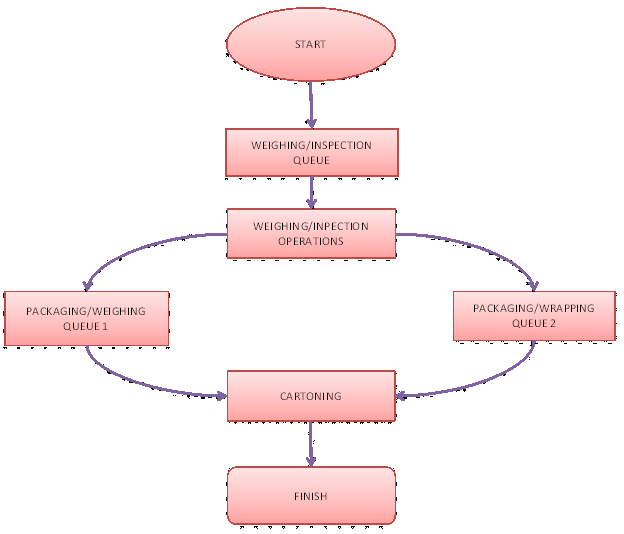
From the inspection and weighing machines the applications (bush press automobile parts) are directed into another queue of the packaging or wrapping machines where they are wrapped before being put into cartons and then taken to the warehouse for storage awaiting dispatch to the market. There are two packaging or wrapping machines arranged in a conveyor format each with a capacity of 1000 applications (bush press automobile parts) meaning the total buffering capacity of the wrapping machines is 2000.
Subsequently, the wrapped applications (bush press automobile parts) are directed to the cartoning machines which package them into cartons. There are four cartoning machines {m = 1, 2, 3, 4} which operate effectively throughout unless during planned maintenance shutdown and during this period the production is temporarily stopped or a contingency plan is implemented in case there is a high demand. This operation takes duration of between 2 and 15 minutes for each application (bush press automobile parts) meaning the process a uniform cycle time of between 2 and 15 minutes. The packaging area operations are illustrated in the conceptual model shown below:
Figure 1: Conceptual Model
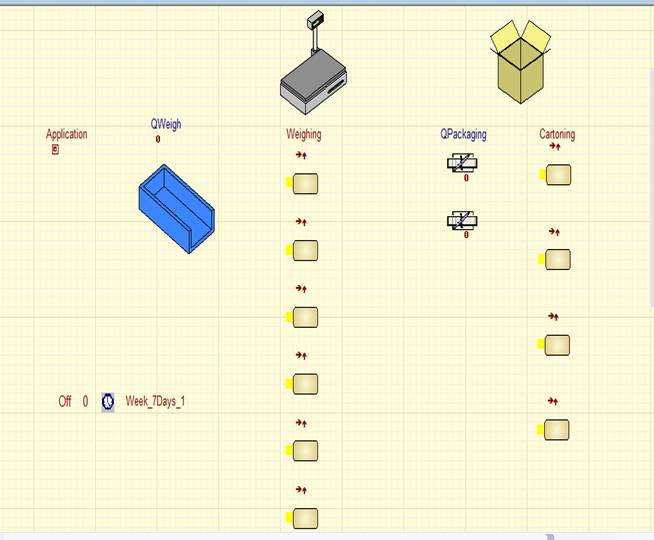
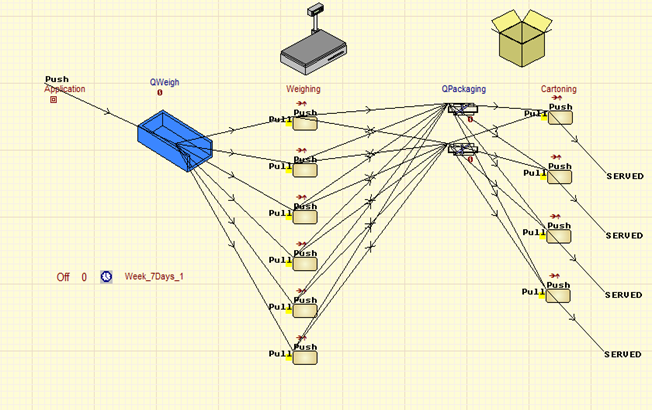
A combination of the conceptual model simulation modelling information with the shifts, sub-shifts as well as shifts and sub-shifts breaks the outcome of running the simulation model based on the specifies rules both the model outcome without element flow illustrations and the one with element flow illustrations are shown in Figure 2 and Figure 3 shown below respectively:
Figure 2: Final Model without Elements Flow
Figure 3: Final Model with Elements Flow
The Data Collection and Input Modelling Process
Data collection
According to Ballakur & Steudel (2007) data collection constitutes the most imperative part of the entire despite of it being a very daunting, frustrating as well as time consuming task mainly because it sets the stage for the simulation project as a whole. As a result, the time needed to develop the simulation model may significantly vary based on the extent of quality and quantifiable data that should be collected prior to beginning the actual simulation.
Banks and Carson (2004) argued that even when the validity of a simulation model structure has been confirmed, if collected data is inputted incorrectly collected, followed by inappropriate analysis, the resulting simulation output will not be a representation of the actual environment, and will provide misleading and possibly damaging information. In this group project, the data was not fully available and the collected data was supplemented by some tentative estimation to ensure significant variation was not witnessed between the actual production scenario and the simulation scenario.
In particular, the data was collected about Nissan’s packaging section processes specifically on the arrival profile, shifts and sub-shifts, activity cycle times, capacity of queues, as well as stoppages of the inspection and weighing machines for the bush press body parts from the assembling line.
Arrival Profile
Time
Length
Volume
1
8:00
30
50
2
8:30
30
50
3
9:00
30
50
4
9:30
30
50
5
10:00
30
50
6
10:30
30
50
7
11:00
30
50
8
11:30
30
50
9
12:00
30
50
10
12:30
30
50
11
1:00
30
50
12
1:30
30
50
13
2:00
30
50
14
2:30
30
50
15
3:00
30
50
16
3:30
30
50
17
4:00
30
50
18
4:30
30
50
19
5:00
30
50
20
5:30
30
50
Day shifts
Period Type
Working Period
Rest Time
Overtime
Subshift Name
Total
1
Subshift
480
960
0
Day subshift
1440
2
Subshift
480
960
0
Day subshift
1440
3
Subshift
480
960
0
Day subshift
1440
4
Subshift
480
960
0
Day subshift
1440
5
Subshift
480
960
0
Day subshift
1440
6
Subshift
240
1200
0
Day subshift
1440
7
Subshift
240
1200
0
Day subshift
1440
Total
2880
7200
0
10080
Breaks during Shifts
Period Type
Working Time
Rest Time
Overtime
Subshift Name
Total
1
Period
180
15
0
195
2
Period
105
60
0
165
3
Period
120
15
0
135
4
Period
75
870
0
945
Total
480
960
0
1440
Stoppages of the Final Inspection and Weighing Machines
Final Inspection and Weighing Machine Operation Stoppages
Busy Time
Negative exponential distribution of 240 minutes
Repair Time
A uniform distribution of 15 minutes minimum and 20 minutes maximum
Simulation rules were also considered whereby all input rules were set to be push and the output rules were set as pull i.e. the default rules in the simulation model settings. As a result, the simulation rules were used to connect the flow of elements through the simulation model from start to finish.
Want help to write your Essay or Assignments? Click here
Want help to write your Essay or Assignments? Click here
1.0 Introduction
The paper will evaluate the strategic position of Transocean, a major player in global offshore drilling services in the oil and gas industry. Strategic management is a process that entails formulating and implementing main objectives as well as initiatives a company takes based on the available resources. It also takes into consideration the evaluation of external and internal environment in which the firm operates.
Founded in 1953, the company is headquartered in Houston Texas. Transocean administrative division has since shifted to Vernier, Switzerland for tax and client servicing reasons. Various models such as STEEPLE, Ansoff and Porter’s Five Forces will be used to paint the company’s strategic position when it comes to, macro-environmental review, competition, diversification strategy, market development, product development and market penetration. To wrap up, the paper will make recommendations regarding the direction the company has to take to remain sustainable.
1.1 Strategic Analysis of Transocean Limited
Transocean is a prominent global provider when it comes to offshore drilling services for energy establishments. The company owns and operates the world’s most multipurpose flotillas that concentrate on deep-sea and extremely harsh environment drilling (Deepwater.com, 2016). With a fleet of sixty-one portable offshore drilling components, the company offers powerful rigs for deepsea drilling. Transocean helps clients to establish and develop oil as well as natural gas stockpiles.
The company offers an exceptional drilling performance that is anchored in a solid experience that spans more than a half a century. Transocean shares are listed on the New York Stock Exchange under the acronym RIG and Swiss Stock Market under the acronym RIGN.Transocean operates more than 140 offshore rigs in almost all mainmarine markets. Apart from offering drilling services offshore, the company offersdrill management services globally. Transocean operates not just the largest extreme-deepsea flotilla of drill ships global, but it is also the largest offshore fleet worldwide.
The company hires more than 20,000 employees with the technical expertise that is the envy of their business rivals(Deepwater.com, 2016). Moreover, Transocean provides management and accomplishment services for assessment and production firms regarding offshore drilling schedules. The company’s mission is to become a leading offshore drilling organisation that provides rig-based services with a global reach, by incorporating a highly dedicated workforce,state of the art machinery and ultra-modern technology, while concentrating on technically demanding environments (Transocean, 2007b)..
The company is dedicated to values that represent its focus, innovativeness, safety, trust and reliability. The company promises to surpass not just the anticipations of theclient, but employees and shareholders as well (Deepwater.com, 2016). Transocean’s strategic goals include getting aligned with its customers when it comes to supporting and ensuring delivery of clients’ business objectives.
The company conducts its operations with distinction which is characterized by safety and efficientoffshore solutions (Deepwater.com, 2016). In addition,Transocean keeps on enhancing its corporate culture and processes to optimize returns. Lastly, the company not only attracts but also nurtures and retains the industry’s best employees.
Want help to write your Essay or Assignments? Click here
2.0 Strategic Industry Trends
Drilling oil and gas was previously dependent on backlogs. Contract bores alter their rates based on their rig charges relative to retailing oil and gas prices. Usually, contract bores tend to wait on the day down, and speedily adjust their prices upwards depending on how the markets are performing (Redall, 2012). There has been a widespread pattern of extreme deepsea rig business with strong daily charges.
However, there has been a downward trend in mid-water rig markets. The most lucrative market lies of the Gulf of Mexico and West African coastal line, down to the south of Africa. The demand for deep-sea rigs is anticipated to remain jerky in the short-term(Helman, 2015).As of now, approximately 206 floaters are operating under contract across the industry (Deepwater.com, 2016).A large percentage of the total number is idle for completing major contracts.
3.0 Strategic Analysis the different types of strategic options
3.1 Ansoff Matrix:
Existing Markets
Market Penetration
Product Development
New Markets
Market Development
Diversification
Existing Products
New Products
Transocean is a dominant player in a market that is not highly saturated. However, to remain at an edge over its closest business rivals, the company has adopted different approaches. Based on the Ansoff matrix, Transocean has been using a low pricing model to penetrate the market. When it comes to market development, Transocean has been offering ultra-deepsea drilling and management services in various parts of the world. What makes the company the envy of its business rivals is the fact that Transocean’s product development strategy works magic. Apart from ultra-deepsea boring services, the company offers rig and deepsea drilling consultancy services which is certainly some form of diversification hence competitive edge.
In short, Transocean operates in the same market by adopting a horizontal strategy in terms of expanding the product line. Lastly, Transocean has a predominantly diversified portfolio. To diversify risks, the company has necessitated mergers and acquisitions when it comes to financial management and technical expertise. The company operates in various regions such as the United States, the Gulf of Mexico, the North Sea, West Africa, and Southeast Asia, Middle East and the Arctic.
3.2 Porter’s Five Forces of Strategic analysis
3.2.1 Competition
Transocean threat of competition is moderate to high. For example, following a merge in mid-2007 between Rig and Transocean’s chief rival Global Sante Fe, this attempt reduced competition particularly, in ultra deep-water segments. While Transocean has almost a monopoly in ultra deep-water drilling, It is likely to enjoy less competition in ultra deep-water, especially in harsh climates that require technical personnel.
In fact, this contributed to the need for anti-trust lawsuit following the merger between RIG and GSF. Nonetheless, the firm has exposure to different offshore markets such as jackupsegment that is associated with intense competition in various regions globally as well as pricing (Porter, 2008). By and large, the organisation has less competition in ultra deep-water segments, with a somewhat intense competition in mid-water floater and also jackup segments.
Want help to write your Essay or Assignments? Click here
3.2.2 New entrants
Transocean enjoys a low threat of new entrants. With respect to offshore contract drilling sector, it requires huge investment in fleet and rigs before getting inflows from gas and oil organisations (Porter, 2008). This makes nearly impossible for new firms to enter this sector.
3.2.3 Substitute
The main threat of substitute is the changing the energy source from hydrocarbon to renewable sources across the world, which is not likely in the short-run (Turner, 2007). Therefore, the threat of substitute is low.
3.2.4 Strategic Purchasing power
Transocean’s purchasing power is moderate. Much as exploration and production firms have power when it comes to negotiating, especially in mid-water floaters and jackupsegments, they have sufficient ability and provision of idle rigs. In essence, the buyers are in aposition to negotiate low daily rates in the contracts while ultra deep water segments maintain stringent rates (Schlumberger, 2008).
3.2.5 Suppliers’ power
The supplier power is moderate. Transocean providers have some degree of power. For instance, suppliers like National Oilwell Varco take part in the decision making in constructing Transocean’srigs andother essential parts. Luckily, this is crucial for Transocean since National Oilwell Varco has a few plans of increasing the fleet of drillships. In general, benefits from pricing since they are the main clients to themajority of their specialised providers (Porter, 2008).
Want help to write your Essay or Assignments? Click here
3.3 STEEPLE
3.3.1 Social
The organisation takes part in various social activities, including charitable contributions to developing environmental initiatives to increase its reputation.
3.3.2 Technological
Technology is necessaryfor drilling sector as such Transocean gets its strength in technological development. While oil drilling and the ecology are related, so is technology and demand. Drilling in deepwater is more and more vital from drilling organisations since they are considered to be more profitable. The firm is positioning itself to capitalize in this segment. For instance, in 2007, Transocean acquired a drillship worth USD 470m to take advantage of deep-water drilling, which allows the firm to drill up to ten thousand feet.
Due to advanced underwater drilling, there has been a decrease in jackup rigs demand (Associated Press, 2007). This presentsTransoceanwith the opportunity to beat their rivals like Noble Corporation in the struggle for innovation. Currently, the firm is leading in deep-water exploration (Katsaros & Christy, 2005).
3.3.3 Economic
Cost is a major challenge for drilling organisations. As oil price rises, the cash flow increases too, which makes organisationsinvest considerably in drilling activities? Furthermore, the new techniques of recovering oil though they are essential in the growth of petroleum production, are leading to an increase in the gasoline price. Implicitly, thehigh price of oilis required to make drilling firms profitable. High global investment drives drilling.
With great interest to drill in foreign regions, global investors are significantly investing, hence leading to expansionof oil and gas sector (Maksoud, 2007).Even though raising oil cost will adversely influence Transocean, in reality, will be beneficial in the long run. Oil cost is inelastic. In other words, afluctuation will insignificantly affect demand. Therefore, increasing oil prices willboost cash flow for Transocean, which means additional business like funding new drilling projects.
3.4.4 Environmental
On environmental protection, Transocean is committed to enhancing its stringent police on Environmentalmanagement system (EMS). Transocean’s EMS visitation is conducting its operations in a standardised manner that fulfills the high levels of stipulated laws to drive continuous enhancements while instilling ownership across its facilities (Transocean, 2007a). The organisation is environmentally sustainable by way of using green products and assessment is utilized as part of routine operations.
The firm also focuses on recycling. Additionally, Transocean has set up a recycling plan, where recyclables are sorted and compressed in rigs. After compression, they are transported to Tech Oil Products and donated to a recycling hub in the ARC of Iberia.
Transocean has collaborated with different oil and gas firms such as Subsea 7, and BP in the SERPENT project. Thisentails necessitating access to the installations, in partnership with their customers to present scientific knowledge to experts in the SERPENT project (Dictionary.Cambridge 2012). In turn, the analysts conduct various projects including assessing biodiversity and effects of drilling on the environment.
The analysts also work on the company’s rigs to study marine species (Transocean, 2007a). By and large, Transocean protects the environment in which it operates to demonstrate that the company recognises the consequences of natural demand shifters.
3.4.5 Political/Legal
Oil presents this organisation with a strong political force. Because oil is the primary source of energy internationally, thus, the supply of oil is related to power regardingpolitics; oil firms leverage authority over regimes (Dictionary.Cambridge 2012). With no oil organisations, United States is likely to lose its dominance in developing nations remarkably. Though oil drilling firms are fundamental in giving regimes the authority, they are still regulated and work as per government laws, such as prohibiting drilling in particular regions like the Gulf of Mexico to protect the environment.
In 2007, the Congress was promoting the closure of a quarter-century ban on the production of offshore energy. This decree banned 85 percent of all drilling in United States’ continental shelf, greatly affecting oil drilling firms including Transocean (Kamalick, 2007). Furthermore, the Congress were supporting the opening of additional shorelines, which was associated with renewable sources of energy, as such they sought for support from environmentalists. While regimes exercise their authority on oil and gas providers, these providers, in turn, have authority over the very regimes.
Want help to write your Essay or Assignments? Click here
3.4.6Ethical Standards
Transocean aspires to ensure financial discipline in their disclosure, honesty and candor in all their engagements with clients, ahigh esteem for employees, customers and suppliers, the safety of employees, property and the ecosystem and technical leadership. Loyalty to these core values demands the company to execute its operations in tandem with thelaw and the utmost standards of business ethics.
In advancing that objective, the company embraces the Code of Business Conduct and Morality, the firm’s environment is also a corrupt free zone and an Anti-Corruption and Business Conduct Policy takes care of that. Again, directors and employees are not allowed to enhance the culture of inside trading. Nonetheless, all employees should adhere to the privacy policy.
4.0 Recommendations
Since oil is directly associated with international authority, oil drilling organisations have authority over regimes, nevertheless, with another alternative, Transocean should continuously go this direction to maintain the lead if the primary source changes
Much as the company has advanced drillship tools, it should take a notch higher by researching new products in comparison to its rivals.When it comes to maintaining competitiveness in oil and gas industry, Transocean should use differentiation strategy that will be vital in developing clients’feedback and service delivery. The differentiation strategy should focus on quality rigs, particularlydeep-water drilling and ability to survive environmental disasters such as hurricanes.
While this threat of substitute islow, in future it may reduce the demand for oil. For that reason, Transocean should create awareness among clients about the benefits of oil in comparison to other energy sources. This can be carried out through advertisements. For instance, the organisation should use ads that demonstrate even with the use of alternative sources such as ethanol, which is considered environmentally sustainable compared to oil. Ethanol requires aconsiderable quantity of biomass. In the even that US, ethanol from corn is employed on a large scale, then it will contribute to increased costs of corn.
The prices of beef will also skyrocket remarkably as cows feed on corn products. On the other hand, if Brazilian corn is used thatis produced from sugar; rainforests in the region will be cut to provide land to grow sugar. Creating awareness through ads will help Transocean increase the demand for oil while increasing the demand for petroleum products from the company.
The company should embrace Ansoff model to diversify its portfolio. Instead of concentrating on drilling and consultancy, the company can take a leap of faith and venture in other business like marine transport, finance, healthcare, real-estate, heavy metal processing among others. Diversification is critical because it will help the company spread risks, when oil business is at its low.
Want help to write your Essay or Assignments? Click here
5.0 Conclusion
The study set out to evaluate Transocean position in the offshore drilling services. The company’s background, values and strategic goals were highlighted at the outset. To understand the company’s product and market development; market penetration and diversification, the Ansoff Matrix was used. The Porter’s Five Forces were employed to establish the intensity of the competition. However, STEEPLE model was used to evaluating the company macro-environment. In the end, the paper touched on the best practices as assured by ethics codes. Recommendations were made regarding the corporation’s future.
6.0 Bibliography
Associated Press 2007. JP Morgan Securities analyst upgrades GlobalSantaFe, Transocean to “neutral.” Retrieved 17th March. 2016 from Factiva.
Berman, A. 2007. Drilling advances. World Oil, 19. Retrieved March 17, 2016 from Business Source Premier Database
Deep Sea Drilling Project 2015.” The Columbia Encyclopedia, 6th ed.. 2015. Encyclopedia.com. 17 Mar. 2016 <http://www.encyclopedia.com>.
Want help to write your Essay or Assignments? Click here
Balance sheet Financial Reporting
The balance sheet captures the current financial position of the NGO. Net assets should balance with the liabilities and equity since the each of the asset is funded by the resources contributed by members and other sponsors. The statement should provide a snapshot of the assets, liabilities, and net assets as the specified date. Gabel’s statement of financial position gives detailed information about the financial position of the company as indicated by the figures. It has the assets section, the liabilities section, and the equity section.
Each fixed asset should have its book value minus the depreciation to get the current net value. By giving the value of the asset in a different line with its total depreciation value makes the balance sheet untidy and crowded making it hard to analyze (Elizabeth, 2010). The net of the fixed asset is the one used to analyze the current financial position of the organization. It is therefore important to indicate the net of the fixed assets to avoid confusion. Deductions and accruals should just indicate the total amounts instead of individual amounts since the receipts will be attached to the statement to avoid congesting the statement.
Since the company is a non-profit, the balance sheet should only indicate the assets and the liabilities. The assets and liabilities are the values used to indicate the financial position of the organization and not the equity hence the net income and equity are not inclusive.
Also, it is important for the accountants to indicate the previous year’s balance sheet values for comparison purposes. The current values should be shown against the previous year’s or, at least, the past three years to make the analysis of the statement viable. When the values of two periods are shown, it makes it easy for analysts to make comparisons and understand the changes that may have taken place to get the current balance sheet values.
Want help to write your Essay or Assignments? Click here
Income Statement
The statement is used to give information regarding the operating activities of the organization from one date to another. It gives information pertaining the revenues and expenses during a particular time, and it’s useful to forecast future activities. For NGOs, activities are measured as received and used contributions. The statement is divided between temporary, restricted, unrestricted, and permanently restricted activities.
Recorded revenues should be classified into one of the four activities based on the donor’s intent. Expenses should be divided into the program, administrative, and fundraising expenses. Revenues are either in the form of activities, membership dues, program revenues, special event and investment income. By categorizing revenues and expenses in the different classification, it provides for better analysis as well as being in line with the global accounting standards.
Gabel’s statement does not give columns for the different activities under income and expenses. By generalizing the revenues and expenses and indicating their categories randomly makes it hard for analysis and is not in line with the required reporting standards. It is also important that the statement also records prior year values for comparison purposes. Categorizing each activity and expense into the section they fall helps stakeholders identify gaps in the company for improvement.
Want help to write your Essay or Assignments? Click here
Statement of cash flows
Statement of cash flow is used to record the cash inflows and cash outflows over a specified period. The statement is divided into three sections: cash flows from operating activities, cash flows from investing activities, and cash flows from financing activities (Ron, 2013). The total amount from the three sections gives an explanation of how the cash flow from the beginning of the period was converted to the balance at the end of the operating period.
Gabel’s statement should show the net cash for each of the sections and sum up the amounts resulting from same activity instead of detailing each activity. The statement is supposed to provide an overview of the cash flows to make it easy for reporting.
Accrual accounting
NGOs have a stringent requirement of using the accrual method of accounting as per the Generally Accepted Accounting Standards (Elizabeth, 2010). The accrual method records revenues when earned and expenses when they have been incurred. By using the accrual method, an organization can indicate its current financial position in a pronounced manner than the cash accounting method.
As an NGO, it is possible to get donors that offer to donate at a later period and when the amount is recorded, it gives the organization a stronger financial position. If Gabel uses the accrual methods, it can recognize pledges of donations and income when they have been made and record cash when it has been received making the income higher than if it used the cash accounting. Cash accounting only considers income when cash has been paid and expense when the amount has been disbursed making it hard to present the current financial position of the organization.
As long as a transaction is to take place and all the necessary conditions have been met then it should be recorded in the financial statements. With addition of statement of activities to the three financial statements, the company should apply accrual accounting to all its recordings not only to meet the required regulations but also to enable stakeholders have a correct view of the current financial position of the firm.
Want help to write your Essay or Assignments? Click here
Recommendations
1. Gabel’s Company should increase its campaigns to reach to more people hence increase its chances of donations. Though the company has net profit, it has a lot of activities it requires to attend to and perform using its wide assets base. Through fundraising campaigns, more donors will be attracted to pay and if they are followed up, they may end up increasing the contributions amount hence increasing the net realized income.
2. Another method the company can use is to increase member’s contributions and subscription fees as well as holding part of dividends to investment in rentals. The amount contributed by members can be added up at a small percentage with respect to individual member’s contribution and set of activity. If each member’s contributions is increased by a small margin, the total amount will subsequently increase helping to cover up for the administrative and other expenses to have a high income at the end of the period.
3. The company should also dispose of some of its unused assets before they lose their value. The amount generated can then be used to invest in some of its productive investment activities. There is a lot of available assets that may be disposed of to increase the net income. Some of the depreciating assets should be sold and a portion of the land rented out or even sold to raise extra income for the company to facilitate its daily operations.
Want help to write your Essay or Assignments? Click here
Strategic Risk Management
Strategic risk management has been effective in promoting stability and mitigating risk within an organization. Specifically, international corporations are exposed to a different forms of risk from internal to external factors. In this relation, the need to adopt a suitable strategic risk management process is mandatory. This will be useful in ensuring continuous business operation as well as offer a tool for risk analysis and opportunity discovery for an organization operating in international markets.
The two method of risk management that can be used by the overseas organization to counter their risk effective are external risk management and human resource risk management (Frigo & Anderson, 2011, p. 22). Each of the two categories is specific to the nature and type of risk that they mitigate for the organization. They also offer various alternatives and opportunities in solving risk faced by the organization.
Want help to write your Essay or Assignments? Click here
External risk management
External risk management focuses on the competitive risk and market changes risk that an organization experiences while conducting business overseas. International markets are very competitive, and companies adopt a more elusive method of tackling external risk. Foreign companies operating in overseas market face external challenges such as economic factors, differences in market performance and preference, competition from local corporations and political constraints.
External risk factors can be minimized through increasing capital efficiency and support decision making. These strategies will help a company maintain its competitiveness in the new market and identify new forms of business operation. Companies have prospered through building investors’ confidence and establishing good working relationship to protect them from external risks such as competition and market changes.
Want help to write your Essay or Assignments? Click here
A case example of external risk management factors can be observed on a Thai non-profit organization, Wikimedia Foundation, Inc, operating in ICT which conducted a risk management on their company through analysis the external factors (Dana, 2011, p. 505). They are faced with poor technological competitiveness and market influence from other ICT companies operating in the international market.
Therefore, through validating and finalizing their risk the company developed a build alternative method of tackling the competitive risk. They also developed investor cooperative relationship with the local organization to tackle the external challenge.
Human resource risk management
This form of strategic risk management focuses on the relationship between the foreign company and the level of staffing coordination and employee theft being experienced. This kind of risk encountered by an organization can be managed through having a well-structured human resource management system (Frigo & Læ, 2012, p. 27). A strategy that is capable of taking care of the company staffing procedure and avoids employee theft in international markets is considered highly useful.
International companies face challenges in maintaining their staffing process and having a reliable team of workers. This, in turn, affects the development and strategic performance of the company. Accordingly, the adoption of human resource risk management can be imperative in controlling risk allocated by employee relationship and staffing
Want help to write your Essay or Assignments? Click here
International companies are advised to identify and evaluate their location and acclimatize with the local to ensure the stable relationship with the locals (McConnell, 2012, p. 115). Favorable employee relationship is effective in increasing business performance in various sector of the organization. The benefit of conducting a human resource management scheme is to guide the company in the pattern or performance among their staffing and have a reliable team to work within the business environment.
A case study of Black CAP, a volunteering international non-profiting organization that faced challenges in their workplace through the balance of fund and their staffing process is a good example (Cooper & Winsor, 2015, p. 34). Through adopting the human resource risk management strategy, they improved their annual operation through identity with the local employee to balance the cost of operation.
Dana L.K. Hoag 2011, “A strategic risk management program for agriculture”, China Agricultural Economic Review, vol. 3, no. 4, pp. 505-517. Retrieved from search.proquest.com/business/docview/912292275/42051F6C6D2A41E7PQ/2?accountid=45049
Want help to write your Essay or Assignments? Click here
External risk management
External risk management focuses on the competitive risk and market changes risk that an organization experiences while conducting business overseas. International markets are very competitive, and companies adopt a more elusive method of tackling external risk. Foreign companies operating in overseas market face external challenges such as economic factors, differences in market performance and preference, competition from local corporations and political constraints.
External risk factors can be minimized through increasing capital efficiency and support decision making. These strategies will help a company maintain its competitiveness in the new market and identify new forms of business operation. Companies have prospered through building investors’ confidence and establishing good working relationship to protect them from external risks such as competition and market changes.
A case example of external risk management factors can be observed on a Thai non-profit organization, Wikimedia Foundation, Inc, operating in ICT which conducted a risk management on their company through analysis the external factors (Dana, 2011, p. 505). They are faced with poor technological competitiveness and market influence from other ICT companies operating in the international market.
Therefore, through validating and finalizing their risk the company developed a build alternative method of tackling the competitive risk. They also developed investor cooperative relationship with the local organization to tackle the external challenge.
Want help to write your Essay or Assignments? Click here
Strategic Risk Management
The two method of risk management that can be used by the overseas organization to counter their risk effective are external risk management and human resource risk management (Frigo & Anderson, 2011, p. 22). Each of the two categories is specific to the nature and type of risk that they mitigate for the organization. They also offer various alternatives and opportunities in solving risk faced by the organization.
Strategic risk management has been effective in promoting stability and mitigating risk within an organization. Specifically, international corporations are exposed to a different forms of risk from internal to external factors. In this relation, the need to adopt a suitable strategic risk management process is mandatory. This will be useful in ensuring continuous business operation as well as offer a tool for risk analysis and opportunity discovery for an organization operating in international markets.
Want help to write your Essay or Assignments? Click here
Human resource risk management
This form of strategic risk management focuses on the relationship between the foreign company and the level of staffing coordination and employee theft being experienced. This kind of risk encountered by an organization can be managed through having a well-structured human resource management system (Frigo & Læ, 2012, p. 27). A strategy that is capable of taking care of the company staffing procedure and avoids employee theft in international markets is considered highly useful.
International companies face challenges in maintaining their staffing process and having a reliable team of workers. This, in turn, affects the development and strategic performance of the company. Accordingly, the adoption of human resource risk management can be imperative in controlling risk allocated by employee relationship and staffing
Want help to write your Essay or Assignments? Click here
International companies are advised to identify and evaluate their location and acclimatize with the local to ensure the stable relationship with the locals (McConnell, 2012, p. 115). Favorable employee relationship is effective in increasing business performance in various sector of the organization. The benefit of conducting a human resource management scheme is to guide the company in the pattern or performance among their staffing and have a reliable team to work within the business environment.
A case study of Black CAP, a volunteering international non-profiting organization that faced challenges in their workplace through the balance of fund and their staffing process is a good example (Cooper & Winsor, 2015, p. 34). Through adopting the human resource risk management strategy, they improved their annual operation through identity with the local employee to balance the cost of operation.
Dana L.K. Hoag 2011, “A strategic risk management program for agriculture”, China Agricultural Economic Review, vol. 3, no. 4, pp. 505-517. Retrieved from search.proquest.com/business/docview/912292275/42051F6C6D2A41E7PQ/2?accountid=45049
Want help to write your Essay or Assignments? Click here
China superpower of manufacturing economy
Over a period of many years, China has held its position as the world superpower of the manufacturing in the general merchandise sector. This is due to the rapid and dynamic growth in its economy, building focus in the world demand for manufacturing products and services. The country’s population, political stability and consumer interest and pattern can be explain its position as the world superpower of manufacturing in general merchandize. The country is however experiencing stiff competition from India, one of the world’s rapidly growing country economies.
India has in the past twenty years rapidly increased its share in the manufacturing industry. The country has recorded positive improvement in its gross domestic product (GDP). India just like China records one of the highest populations in the world (Ghemawat & Hout, 2016, p. 86). This offers a vast market for consumers and traders in the region. The country has taken advantage of its growing population to invest in merchandise market development. This has posed a significant threat to China’s position as the world superpower in the manufacturing industry.
Want help to write your Essay or Assignments? Click here
Subsequently, it can be argued that India is rapidly rising into the next superpower after China through their shift in development of technology (Gupta & Wang, 2009, p.25). The country is facing a drastic change in the industrial revolution through adopting a modern forms of technology applied in the manufacturing industry. This has increased their overall business performance.
India has tightened its grip in both the private and public sector, embraced trade liberalization and increased their involvement in foreign direct investment (Xingxing 2015, p. 685). This has primarily improved the manufacturing industry of India, making it a viable candidate as the next superpower after China.
Furthermore, the rapid expansion of information technology in India has accounted for the growth of commerce, business services, and banking. Moreover, India has gained an international reputation as an IT enabled center of the world. This has increased its global position in the e-commerce sector, improving its strength in the manufacturing industry globally.
In addition, India is experiencing growing investment rate, with an average of thirty-two percent compared to that of China at thirty-five percent (Mahtaney, 2007, p. 2455). This rate is set to project in the next year and India could surpass China’s the rate, making it the world superpower in the manufacturing industry.
Want help to write your Essay or Assignments? Click here
China is facing a significant challenge in their population, as a large percentage of the population is set to experience old age in the future years. This is bound to affect its general labor output, unlike that of India which is strengthening. India has a demographic surplus of younger generation increasing their task force in the manufacturing sector (Takeuchi, Chen & Lam, 2009, 86). The growing generation is also experiencing the best form of education, expanding their expertise in the sector. Based on these projections, it is predicted that India may overtake China as the current superpower in the manufacturing industry.
Reference List
Ghemawat, P, & Hout, T 2016, ‘Can China’s Companies Conquer the World?‘, Foreign Affairs, 95, 2, pp. 86-98, Academic Search Premier, EBSCOhost, viewed 30 March 2016./
Gupta, A, & Wang, H 2009, Getting China And India Right: Strategies For Leveraging The World’s Fastest-Growing Economies For Global Advantage, San Francisco: Jossey-Bass, eBook Collection (EBSCOhost), EBSCOhost
Mahtaney, P 2007, India, China, And Globalization: The Emerging Superpowers And The Future Of Economic Development, Basingstoke [England]: Palgrave Macmillan, eBook Collection (EBSCOhost), EBSCOhost
Takeuchi, N, Chen, Z, & Lam, W 2009, ‘Coping with an emerging market competition through strategy-human resource alignment: a case study evidence from five leading Japanese manufacturers in the People’s Republic of China’, International Journal of Human Resource Management, vol. 20, no. 12, pp. 2454-2470. Available from: 10.1080/09585190903363763.